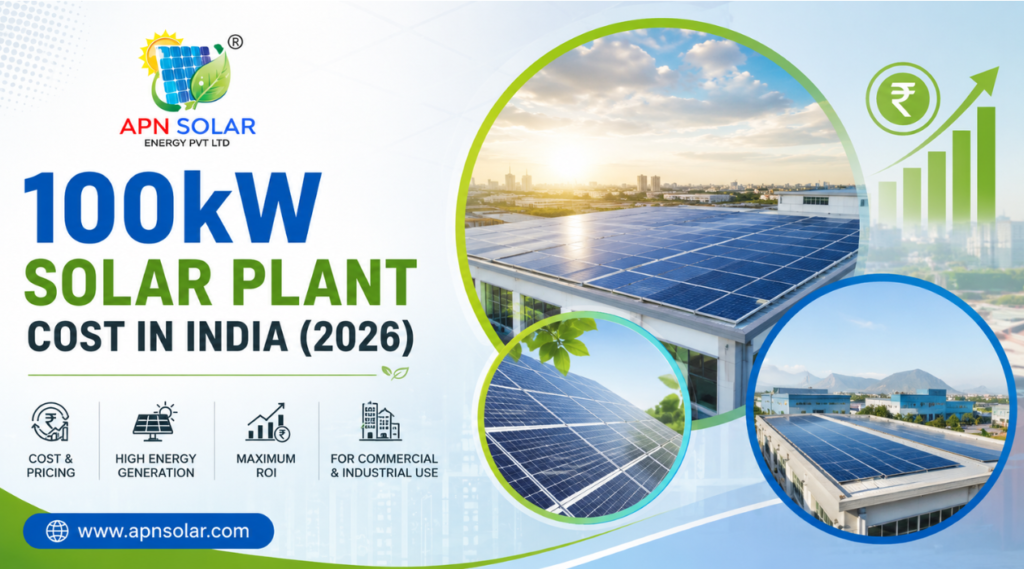
With commercial electricity tariffs continuing to rise across India, businesses are increasingly looking for long-term solutions to reduce operational expenses and improve energy efficiency. As a result, solar energy adoption has accelerated among factories, warehouses, hotels, educational institutions, hospitals, and commercial buildings seeking greater control over their electricity costs, especially with growing demand for a reliable commercial solar system for businesses in India.
A 100kw solar system is one of the most popular choices for medium to large commercial establishments because it can generate substantial amounts of clean electricity while offering attractive long-term savings. However, before making an investment, it is important to understand the 100kw solar panel price in india, installation requirements, expected energy generation, return on investment (ROI), and available policy benefits. A well-planned solar project can significantly reduce dependence on grid electricity and protect businesses from future tariff increases.
The overall solar power plant cost depends on several factors, including solar panel technology, inverter selection, mounting structure, project location, and installation complexity. Pricing can also vary by city, brand, and site conditions. With solar panels typically designed to operate efficiently for 25 years or more, many businesses now view solar as a strategic infrastructure investment rather than just an energy-saving upgrade.
As India’s commercial and industrial sectors continue their transition toward renewable energy, understanding the true cost and performance of a 100kW solar plant is essential for making an informed investment decision.
What Is a 100kW Solar Plant?
A 100kw solar system is a commercial-scale solar power installation designed to generate up to 100 kilowatts (kW) of electricity under standard operating conditions, which relates closely to understanding key system sizing concepts like difference between kW, kVA, and kWh in solar systems. It is commonly installed on the rooftops of industrial and commercial buildings to reduce electricity expenses and improve energy independence. A 100 kilowatt solar system is significantly larger than residential solar setups and is intended for organizations with high daily power consumption.
Depending on the solar panel wattage selected, a 100kW plant typically requires approximately 150 to 180 high-efficiency solar panels. For rooftop installations, businesses generally need around 6,000 to 8,000 square feet of shadow-free roof space to accommodate the system, maintenance pathways, and safety clearances.
Under favorable weather conditions in India, a 100kW solar plant can generate approximately 400 to 500 units (kWh) of electricity per day. This translates to roughly 12,000 to 15,000 units per month and 1.4 to 1.8 lakh units annually, depending on location, solar irradiation levels, panel technology, and system maintenance.
Who Should Install a 100kW Solar System?
A 100kw solar system is ideal for organizations with substantial electricity consumption, including factories and manufacturing units, and is a key part of modern commercial rooftop solar for commercial buildings adoption in India.”
- Factories and manufacturing units operating machinery and production equipment.
- Hotels and hospitality businesses with round-the-clock energy requirements.
- Schools, colleges, and educational institutions looking to reduce utility expenses.
- Commercial complexes and office buildings with large daytime power demand.
- Hospitals and healthcare facilities requiring reliable electricity for critical operations.
For such organizations, a 100kW solar plant can provide long-term savings while supporting sustainability and renewable energy goals.
100kW Solar Plant Cost in India in 2026
The average 100kW solar plant cost in India ranges between ₹35 lakh and ₹55 lakh depending on panel technology, inverter brand, mounting structure, project location, and installation requirements.
For most commercial and industrial projects, the 100kw solar panel price in india varies based on equipment quality, engineering requirements, and site conditions. Businesses planning to install a solar system should evaluate the complete project cost rather than focusing only on solar panel prices, and should also understand how to evaluate providers through how to choose best solar company in India guidelines. A well-designed solar plant can deliver reliable electricity generation for over 25 years, making it a long-term infrastructure investment.
The overall solar power plant cost typically includes solar modules, inverters, mounting structures, electrical accessories, installation services, and monitoring systems. Premium components may increase the upfront investment but often provide higher energy generation, better efficiency, and lower maintenance costs over the system’s lifetime.
Estimated 100kW Solar Plant Cost Breakdown
| Component | Estimated Cost (₹) |
| Solar Panels | ₹18 Lakh – ₹28 Lakh |
| Solar Inverters | ₹3 Lakh – ₹6 Lakh |
| Mounting Structure | ₹2 Lakh – ₹5 Lakh |
| Wiring & Electrical Components | ₹1 Lakh – ₹3 Lakh |
| Installation & Commissioning | ₹2 Lakh – ₹5 Lakh |
| Monitoring System | ₹50,000 – ₹1.5 Lakh |
| Total Estimated Cost | ₹35 Lakh – ₹55 Lakh |
Factors That Affect 100kW Solar Plant Pricing
1. Solar Panel Technology
Solar panels account for the largest share of the total solar plant cost. Higher-efficiency panels generally cost more but can generate greater energy output from the same roof area.
2. Mono PERC vs TOPCon Panels
Mono PERC panels remain a popular option due to their balance of cost and performance. However, TOPCon technology is gaining popularity because of its higher efficiency, improved temperature performance, and is explained in detail in TOPCon solar panels guide for better understanding of modern solar advancements. and better long-term energy yield. Projects using TOPCon modules may have a higher solar plant price but can deliver increased generation over the system’s lifespan.
3. Inverter Selection
The choice between string inverters and central inverters significantly impacts system pricing. Reputable inverter brands often provide better monitoring capabilities, efficiency, warranty coverage, and long-term reliability.
4. Rooftop vs Ground-Mounted Installation
Ground-mounted systems generally require additional land preparation, civil work, and support structures, which can increase the total solar power plant cost compared to rooftop installations.
5. Project Location
Installation costs can vary by city and state due to differences in labor charges, transportation expenses, roof conditions, local regulations, and weather patterns. Businesses should always obtain a site-specific assessment before finalizing their solar investment.
Cost Breakdown of a 100kW Solar Power Plant
Understanding the individual cost components of a solar project helps businesses accurately evaluate the overall solar panel plant cost and identify where their investment is being allocated. While the total project price varies based on technology and site conditions, each component plays a critical role in system performance, safety, and long-term energy generation.
Solar Panels
Solar panels typically account for 50% to 60% of the total project investment, making them the largest contributor to the overall cost. The solar panel cost per watt in india generally varies depending on panel efficiency, manufacturer, warranty coverage, and technology such as Mono PERC or TOPCon. Higher-efficiency panels may have a higher upfront cost but can generate more electricity over the system’s 25+ year lifespan.
Solar Inverters
Solar inverters convert the direct current (DC) generated by solar panels into usable alternating current (AC). Inverter quality directly impacts system efficiency, monitoring capabilities, and long-term reliability. Commercial projects commonly use multiple string inverters or central inverters depending on system design requirements.
Mounting Structures
Mounting structures provide the foundation that supports solar panels throughout their operational life. These structures are typically made from galvanized steel or aluminum and must withstand wind loads, weather conditions, and corrosion. The type of roof and installation method significantly affect structure costs.
Electrical Components
Electrical equipment includes DC cables, AC cables, junction boxes, combiner boxes, earthing systems, surge protection devices, and safety accessories. Although these components represent a smaller percentage of the budget, they are essential for ensuring safe and efficient system operation.
Installation and Engineering Charges
Installation costs cover site surveys, structural assessments, system design, engineering, labor, testing, and commissioning. For commercial projects, the solar panel cost per kw often includes these services, ensuring the plant operates efficiently and complies with industry standards and local regulations.
Solar Panel Installation Cost in India for a 100kW Project
The solar panel installation cost in India for a 100kW commercial project typically forms an important part of the overall investment, and is closely linked with professional execution as explained in industrial solar panel installation guide India. While equipment such as solar panels and inverters account for most of the project budget, professional installation ensures the system operates safely, efficiently, and reliably for more than 25 years. The final solar power plant installation cost varies depending on roof conditions, project complexity, location, and engineering requirements.
Site Survey
Every successful solar project begins with a detailed site survey. Solar experts assess roof dimensions, shadow-free areas, electricity consumption patterns, and available space to determine the most suitable system design and panel layout.
Structural Analysis
Before installation, engineers evaluate the roof’s load-bearing capacity to ensure it can safely support the solar mounting structure and panels. This step is particularly important for factories, warehouses, and commercial buildings with large rooftop installations.
Installation Process
The installation phase includes mounting structure fabrication, solar panel placement, inverter installation, cable routing, and safety system integration. Proper panel orientation and tilt angle are carefully planned to maximize annual energy generation.
Electrical Integration
The solar system is then connected to the building’s electrical infrastructure. This includes AC/DC wiring, protection systems, earthing, and integration with net metering equipment where applicable.
Testing and Commissioning
Before the plant becomes operational, technicians perform performance testing, safety inspections, and system commissioning to verify that all components function correctly.
High-quality installation directly impacts long-term energy output, system safety, and maintenance costs. Even premium solar equipment can underperform if installation standards are compromised, making experienced engineering and execution essential for maximizing return on investment.
Commercial Solar Power Plant Subsidy for 100kW Systems
Commercial and industrial 100kW solar plants generally do not qualify for central rooftop solar subsidies in India, unlike residential users under the PM Surya Ghar solar subsidy scheme guide. Residential consumers can access financial assistance under the PM Surya Ghar: Muft Bijli Yojana, but most commercial installations must be funded without central capital subsidies.
Many business owners researching a commercial solar power plant subsidy often assume that the same incentives available for residential rooftops also apply to factories, warehouses, hotels, and commercial buildings. However, current central government subsidy programs primarily focus on residential rooftop solar adoption.
Under the PM Surya Ghar scheme, eligible homeowners can receive financial support that reduces the effective solar panel price with subsidy for residential systems. These benefits are not typically available for commercial and industrial projects such as a 100kW solar plant.
That said, businesses should not overlook state-specific renewable energy policies. Some states may offer incentives related to net metering, electricity duty exemptions, banking facilities, or other benefits that can improve overall project economics. Since these policies vary by state and are subject to regulatory updates, businesses should verify the latest guidelines before making investment decisions.
When evaluating a commercial solar project, it is important to focus on long-term electricity savings rather than relying on subsidy assumptions. Although the subsidy solar panel price and government solar panel price often attract significant search interest, the primary financial advantage of a 100kW solar plant comes from reducing grid electricity consumption and stabilizing energy costs over the system’s 25+ year operational lifespan.
For the most accurate information, businesses should consult qualified solar EPC providers and review the latest state and central renewable energy regulations before proceeding with installation.
Electricity Generation from a 100kW Solar Plant
A 100kW solar plant in India can typically generate 400 to 500 units (kWh) of electricity per day, depending on system sizing and module selection, which can be better understood through solar panel requirement calculation methods. depending on location, solar radiation levels, weather conditions, and system design. This level of generation can significantly reduce a business’s dependence on grid electricity, helping lower the long-term solar power cost associated with commercial operations.
Average Electricity Generation from a 100kW Solar Plant
| Time Period | Estimated Electricity Generation |
| Daily Generation | 400–500 Units |
| Monthly Generation | 12,000–15,000 Units |
| Annual Generation | 1.4–1.8 Lakh Units |
These figures are based on typical Indian solar irradiation conditions and assume proper system maintenance and a shadow-free installation area.
Factors That Affect Electricity Generation
Location
Solar plants installed in states with higher solar irradiation, such as Rajasthan, Gujarat, Maharashtra, and Telangana, generally produce more electricity than systems installed in regions with lower sunlight availability.
Shadow-Free Area
Even partial shading from nearby buildings, water tanks, trees, or other structures can reduce energy production. Proper site assessment is essential to maximize system performance.
Weather Conditions
Cloud cover, rainfall, dust accumulation, and seasonal variations influence daily energy output. While solar systems continue generating electricity on cloudy days, production levels may be lower than peak sunny conditions.
Panel Technology
Modern TOPCon and high-efficiency Mono PERC panels can generate more electricity from the same roof area compared to older technologies, improving overall system performance.
For example, a factory consuming approximately 13,000 units of electricity per month could offset a substantial portion of its energy demand with a well-designed 100kW solar plant, helping stabilize future solar power price fluctuations and reduce long-term operating expenses.
Return on Investment (ROI) of a 100kW Solar Plant
Most 100kW solar systems achieve payback within 3 to 5 years depending on electricity tariffs, system utilization, and local net metering policies. After the payback period, the system continues generating nearly free electricity for its remaining lifespan, significantly reducing long-term solar power cost for businesses.
The ROI of a 100kW solar installation depends mainly on the initial solar system price, electricity savings, and how efficiently the system is utilized throughout the year. Commercial consumers with high daytime electricity usage typically achieve faster returns compared to low-consumption users.
Electricity Savings Potential
A 100kW solar plant generating around 1.5 lakh units annually can help businesses save significantly on monthly electricity bills. If the average commercial tariff is ₹8 per unit, annual savings can be approximately:
- 1,50,000 units × ₹8 = ₹12,00,000 per year (approx.)
Net Metering Benefits
Net metering allows businesses to export excess electricity to the grid, earning credits that further reduce electricity bills, as explained in the net metering guide for solar users. that further reduce electricity bills. This improves overall system efficiency and enhances ROI, especially in months with lower internal consumption.
25-Year Savings Potential
Over a 25-year lifespan, even with gradual efficiency degradation, a 100kW system can generate substantial long-term savings. The total lifetime benefit can be several times the initial solar system price, making it a financially strong infrastructure investment.
ROI Example
If the total installation cost is around ₹45 lakh and annual savings are ₹12 lakh:
- Payback period = ₹45,00,000 ÷ ₹12,00,000 ≈ 75 years
After payback, the system continues producing electricity at minimal operating cost, improving profitability year after year.
By reducing dependence on fluctuating grid tariffs, businesses also protect themselves from rising solar system rate and long-term energy inflation risks.
Roof Area Required for a 100kW Solar System
A 100kw solar system typically requires around 6,000 to 8,000 square feet of shadow-free roof space, depending on the type of modules used such as mono or poly crystalline panels explained in types of solar panels in India. The exact area may vary depending on panel efficiency, layout design, and mounting structure type used in the project.
For ground-mounted systems, the space requirement may be slightly higher due to additional spacing between panel rows to avoid shading and ensure proper airflow. This makes land planning an important factor when evaluating large-scale installations, especially for industrial setups where space utilization is critical.
Proper layout design is essential to maximize output and reduce losses. Engineers carefully plan panel orientation, tilt angle, and row spacing to ensure maximum sunlight exposure throughout the year. Even small design inefficiencies can impact overall system performance and increase long-term industrial solar panel price considerations due to reduced energy yield.
Maintenance pathways are also a key part of the design. Adequate walking space between panel rows allows safe cleaning, inspection, and repair activities, which helps maintain long-term system efficiency and prevents performance degradation.
Overall, accurate space planning ensures that the 100kW solar plant operates at peak efficiency while maintaining safety, accessibility, and long-term reliability.
How to Choose the Right EPC Company for a 100kW Solar Plant
Selecting the right EPC (Engineering, Procurement, and Construction) company is critical for ensuring the long-term performance, safety, and return on investment of a 100kW solar plant. A well-qualified EPC partner directly impacts the overall solar power plant installation cost and determines how efficiently the system performs over its 25+ year lifecycle.
Experience
Always choose an EPC company with proven experience in executing commercial and industrial solar projects. Companies with a strong portfolio are better equipped to handle complex site conditions, load requirements, and system design challenges.
Certifications
Ensure the EPC provider follows industry standards and uses certified components that comply with MNRE guidelines and international quality benchmarks. Proper certifications ensure system safety, efficiency, and regulatory compliance.
Product Quality
The quality of solar panels, inverters, mounting structures, and electrical components significantly affects the total solar plant cost and long-term performance. High-quality components reduce maintenance needs and improve energy output.
Warranty
Check both product and performance warranties. Standard solar panels typically come with 25-year performance warranties, while inverters and other components have shorter coverage periods. Strong warranty terms indicate supplier confidence and reliability.
After-Sales Support
Reliable maintenance and technical support are essential for ensuring consistent energy generation and system uptime.
Best Solar Company in India such as APN Solar provide end-to-end solar solutions including site assessment, system design, installation, net metering assistance, and maintenance support for commercial and industrial solar projects. Choosing an experienced EPC partner like this helps businesses achieve better system reliability and long-term value without compromising quality or transparency.
Why Businesses Are Investing in 100kW Solar Plants
Businesses are increasingly adopting 100kW solar systems as a strategic solution to reduce operational expenses and achieve long-term energy stability. One of the primary reasons is the continuous rise in solar power cost and grid electricity tariffs across India, which directly impacts manufacturing, service industries, and commercial operations.
By installing a solar plant, companies can significantly reduce their dependency on grid power and stabilize their solar power price exposure over the long term. This is especially important for energy-intensive sectors such as factories, warehouses, hotels, and institutions where electricity forms a major portion of monthly expenses.
Another key driver is sustainability. Many businesses are aligning with environmental goals by reducing carbon emissions and adopting cleaner energy sources. A 100kW solar plant can offset a substantial amount of CO₂ annually, supporting corporate ESG (Environmental, Social, and Governance) commitments.
In addition, solar investments offer strong long-term financial benefits. With a typical lifespan of 25+ years, businesses can enjoy decades of reduced electricity bills and improved cash flow stability. Energy independence is another major advantage, allowing companies to protect themselves from future tariff fluctuations and power shortages.
Overall, the shift toward solar is not just a cost-saving decision but a long-term infrastructure investment for sustainable business growth.
Conclusion
A 100kw solar system is a strong long-term investment for commercial and industrial users looking to reduce electricity expenses and improve energy efficiency. The 100kw solar panel price in india typically ranges based on technology, components, and installation quality, while the overall solar power plant cost depends on system design, equipment selection, and site conditions.
From a financial perspective, most 100kW systems achieve a payback period of around 3 to 5 years, after which businesses benefit from nearly free electricity for decades. This makes solar one of the most effective ways to control rising energy costs and stabilize long-term operating expenses.
However, proper installation and quality engineering are critical to achieving expected performance and returns. Poor installation can reduce system efficiency and impact long-term savings.
For accurate pricing, system design, and end-to-end execution, it is recommended to consult experienced EPC providers such as APN Solar, who can guide businesses through assessment, installation, and maintenance for optimal results.
Frequently Asked Questions (FAQs)
1. What is the cost of a 100kW solar plant in India?
The 100kw solar panel price in india typically ranges between ₹35 lakh and ₹55 lakh depending on panel type, inverter quality, and installation design. The overall solar plant cost also varies based on location, structure type, and project complexity for commercial and industrial applications.
2. How much electricity does a 100kW solar system generate per day?
A 100kw solar system generally generates around 400–500 units of electricity per day in India. The exact output depends on sunlight availability, panel efficiency, weather conditions, and proper system maintenance throughout the year.
3. How much roof space is required for a 100kW solar plant?
A 100 kilowatt solar system typically requires about 6,000 to 8,000 square feet of shadow-free rooftop area. The actual space may vary depending on panel efficiency, layout design, and spacing required for maintenance access.
4. Is subsidy available for a 100kW commercial solar plant?
The commercial solar power plant subsidy is generally not available for industrial and commercial rooftop projects in India. Subsidies mainly apply to residential systems under government schemes, while commercial users benefit more from net metering and tax savings.
5. What is the payback period of a 100kW solar power plant?
The payback period of a solar plant depends on the solar power plant cost, electricity tariff, and usage pattern. On average, a 100kW system pays for itself in 3 to 5 years, after which it generates significant long-term savings.
6. How many solar panels are needed for a 100kW solar system?
A 100kw solar system typically requires around 150 to 180 solar panels, depending on wattage per panel. Higher-efficiency panels reduce the total number required while optimizing rooftop space utilization.
7. Is a 100kW solar plant suitable for factories and commercial buildings?
Yes, a 100kW system is ideal for factories and commercial buildings. The industrial solar panel price and system efficiency make it a cost-effective solution for reducing electricity bills and ensuring stable energy supply for high-consumption operations.