Electricity costs in India have continued to rise over the past few years, prompting many homeowners to explore solar energy as a long-term solution for reducing their dependence on grid power. With increasing awareness of renewable energy, government support through initiatives such as the PM Surya Ghar Muft Yojana, and advancements in solar technology, residential solar installations are growing rapidly across the country.
One of the most common questions homeowners ask before investing in solar is, “how many solar panels do I need?” The answer depends on several factors, including your monthly electricity consumption, available rooftop space, local sunlight conditions, and the solar panel capacity you choose. A home that consumes 300 units of electricity per month will require a different system size than a home consuming 800 units per month.
At APN Solar, one of the most common questions homeowners ask before installation is how much solar panel required for home energy needs and how many panels are necessary to generate sufficient electricity throughout the year. Understanding these calculations helps homeowners select the right solar system size, estimate rooftop space requirements, and make an informed investment decision.
In this guide, we’ll explain how to calculate the number of solar panels needed for your home, how panel capacity affects system design, and how much electricity different solar systems can generate under Indian conditions.
How to Calculate How Many Solar Panels You Need
If you’re wondering how many solar panels do I need for my home, the answer depends on your electricity consumption and the solar panel capacity you choose. You can also use a detailed method explained in our guide on solar panel requirement calculation for homes in India to get a more accurate estimate. By calculating your energy usage and matching it with the right solar system size, you can estimate the number of panels required accurately.
Step 1 – Calculate Monthly Electricity Consumption
Start by reviewing your electricity bills from the last 6–12 months. Identify your average monthly electricity usage in units (kWh).
Example:
- Average monthly consumption = 450 units
This number serves as the foundation for determining the appropriate solar system size for your home.
Step 2 – Estimate Daily Energy Requirement
Convert your monthly consumption into daily consumption.
Formula:
Daily Units × 30 = Monthly Consumption
Therefore:
Daily Consumption = Monthly Consumption ÷ 30
Example:
450 ÷ 30 = 15 units per day
Your solar system should ideally generate around 15 units of electricity daily to offset your energy usage.
Step 3 – Determine Solar System Size
Next, calculate the required solar system capacity using average peak sunlight hours. Most regions in India receive approximately 4.5–5.5 peak sun hours per day.
Formula:
Required System Size = Daily Consumption ÷ Average Sun Hours
Example:
15 ÷ 5 = 3 kW
A household consuming 450 units per month would generally require a 3kW solar system.
Step 4 – Calculate Number of Panels
The final step is determining the number of solar panels based on panel wattage.
Formula:
Number of Panels = System Size (W) ÷ Solar Panel Capacity (W)
Example using 540W panels:
3,000W ÷ 540W = 5.55
Rounded up, you would need approximately 6 solar panels.
| Monthly Consumption | Daily Consumption | Recommended System Size | Approx. Number of 540W Panels |
| 300 Units | 10 Units | 2kW | 4 Panels |
| 450 Units | 15 Units | 3kW | 6 Panels |
| 750 Units | 25 Units | 5kW | 9–10 Panels |
This step-by-step method provides a reliable estimate, although actual requirements may vary depending on roof orientation, shading, panel efficiency, and local weather conditions. A professional site assessment can further refine these calculations.
How Many Solar Panels Are Required Based on System Size?
The number of solar panels required depends on the size of the solar system and the wattage of the panels being used. Modern residential installations in India commonly use high-efficiency 540W or 550W solar panels, which require fewer panels compared to older 330W or 400W modules.
If you are searching for how many solar panels required for 1kw, how many solar panels required for 3kw, or how many solar panels required for 5kw, the table below provides a quick estimate based on 540W solar panels. You can also explore a detailed breakdown of system sizing in our guide on 3kW, 5kW, and 10kW solar system configurations in India.
| System Size | Approx. Panels (540W Module) |
| 1kW | 2 Panels |
| 2kW | 4 Panels |
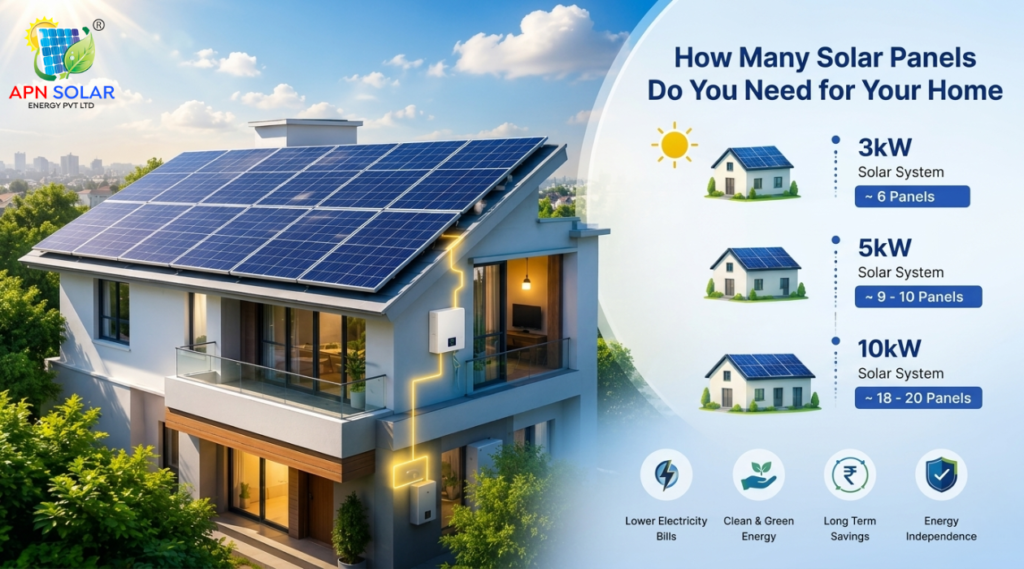
| 3kW | 6 Panels |
| 5kW | 9–10 Panels |
| 10kW | 18–19 Panels |
How Many Solar Panels Are Required for a 1kW Solar System?
A 1kW solar system typically requires 2 solar panels of 540W each. This system is generally suitable for homes with low electricity consumption, such as small apartments or households using around 120–150 units per month.
How Many Solar Panels Are Required for a 3kW Solar System?
For homeowners asking how many solar panels required for 3kw, a standard 3kW solar system usually needs 6 solar panels of approximately 540W each. In other words, how many panels in a 3kw solar system depends on panel wattage, but with modern modules, six panels are generally sufficient. A 3kW system can typically support monthly consumption of around 350–450 units.
How Many Solar Panels Are Required for a 5kW Solar System?
If you are wondering how many solar panels required for 5kw, most installations require 9–10 solar panels using 540W modules. Similarly, how many panels in a 5kw solar system can vary slightly depending on the exact panel capacity selected. A 5kW system is commonly recommended for medium to large homes consuming approximately 600–750 units per month.
Why Panel Count Can Vary
The actual number of panels required is influenced by the panel wattage selected:
- 400W panels require more modules.
- 540W–550W panels reduce panel count.
- 600W+ panels may further reduce rooftop space requirements.
Therefore, while system size remains the same, the number of solar panels can differ depending on the solar panel capacity, available roof area, and the technology used by the manufacturer.
Roof Area Required for Different Solar System Sizes
Before installing a solar system, it is important to determine whether your rooftop has sufficient space. Homeowners can also understand overall system cost implications through our guide on home solar panel installation cost and government subsidies in India. Homeowners can also understand overall system cost implications through our guide on home solar panel installation cost and government subsidies in India. The roof area required depends on the system size, solar panel dimensions, mounting structure design, and spacing between panels. For optimal performance, solar panels should be installed on a shadow-free roof with proper orientation and tilt.
The table below provides a general estimate of rooftop space requirements for residential solar systems in India.
| System Size | Roof Area Required |
| 1kW | 80–100 sq ft |
| 3kW | 250–300 sq ft |
| 5kW | 400–500 sq ft |
| 10kW | 800–1000 sq ft |
1kW Solar System Roof Space Requirement
The 1kw solar panel area required is typically between 80 and 100 square feet. This makes a 1kW system suitable for small homes, apartments, or households with relatively low electricity consumption.
3kW Solar System Roof Space Requirement
The area required for 3kw solar panel installations is generally around 250–300 square feet. If you’re wondering how much area required for 3kw solar system, the exact requirement depends on the panel wattage and roof layout. A shadow-free terrace with adequate spacing is usually sufficient for a standard 3kW residential setup.
5kW Solar System Roof Space Requirement
The area required for 5kw solar panel systems is approximately 400–500 square feet. This system size is commonly installed on independent houses and larger residential properties with higher electricity consumption.
10kW Solar System Roof Space Requirement
The area required for 10kw solar panel installations typically ranges from 800–1000 square feet. Such systems are often used by large homes, villas, apartment societies, and small commercial establishments.
Factors That Affect Roof Space Requirements
Even if your roof meets the minimum area requirement, several factors can impact the final installation design:
- Shadow-Free Space: Trees, water tanks, nearby buildings, and other obstructions can reduce solar generation and may require additional panel spacing.
- Roof Orientation: In India, south-facing roofs generally receive the highest solar exposure and deliver better annual energy production.
- Tilt Angle: Solar panels are installed at a specific angle to maximize sunlight capture. The ideal tilt varies by location and roof structure.
A professional site survey helps determine the actual usable rooftop area and ensures the solar system is designed for maximum efficiency and long-term performance.
Solar Panel Size and Capacity Explained
Understanding solar panel capacity is essential when calculating the number of panels required for your home. Solar panel capacity refers to the maximum amount of power a panel can generate under standard test conditions and is measured in watts (W). The higher the panel wattage, the more electricity each panel can produce.
Today, residential solar installations in India commonly use the following module ratings: 400W, 540W, 550W, and 600W panels. To better understand which option suits your home, explore our detailed guide on types of solar panels in India and their efficiency differences.
- 400W solar panels
- 540W solar panels
- 550W solar panels
- 600W solar panels
Difference Between Solar Panel Size and System Size
Many homeowners confuse panel size with system size, but they are not the same.
- Solar panel size refers to the capacity of an individual panel (e.g., 540W or 550W).
- Solar system size refers to the total capacity of all panels combined (e.g., 3kW, 5kW, or 10kW).
For example, when discussing the solar panel size for 3kw systems or the 3kw solar panel size, the actual system capacity remains 3kW, but the number of panels changes depending on the wattage of each module.
| Panel Capacity | Panels Required for 3kW System |
| 400W | 8 Panels |
| 540W | 6 Panels |
| 550W | 6 Panels |
| 600W | 5 Panels |
The same principle applies to a 5kw solar system size. Higher-capacity panels reduce the total number of modules required, helping homeowners save rooftop space while simplifying installation.
For instance, a 5kW solar system may require around 13 panels using 400W modules, whereas the same system can be installed using only 9–10 panels with modern 540W or 550W modules. This is why high-efficiency panels are increasingly preferred for residential rooftops where available space is limited.
Choosing the right combination of system size and panel capacity helps maximize energy generation while making the most efficient use of your roof area.
How Much Electricity Can Different Solar Systems Generate?
The amount of electricity generated by a solar system depends on its capacity, local sunlight availability, weather conditions, and panel efficiency. You can also learn how solar systems help reduce long-term electricity expenses in our detailed guide on how solar panels reduce electricity bills in India. In India, most well-designed rooftop solar systems generate an average of 4–5 units of electricity per day for every 1kW of installed capacity.
The table below provides estimated daily generation for common residential solar system sizes.
| System Size | Daily Units Generated |
| 1kW | 4–5 Units |
| 2kW | 8–10 Units |
| 3kW | 12–15 Units |
| 5kW | 20–25 Units |
| 10kW | 40–50 Units |
How Many Units Does a 2kW Solar System Generate Per Day?
For homeowners searching 2kw solar panel how many units per day, a properly installed 2kW solar system typically generates between 8 and 10 units of electricity daily under normal Indian weather conditions. This output is generally suitable for small households with moderate energy consumption.
How Many Units Does a 3kW Solar System Generate Per Day?
One of the most common residential solar questions is 3kw solar panel how many units per day. On average, a 3kW system generates around 12–15 units per day.
If you’re wondering how many units generated by 3kw solar panel or how much electricity does a 3kw solar panel produce, the monthly generation can be estimated as:
12–15 units × 30 days = 360–450 units per month
Therefore, when homeowners ask 3kw solar panel generates how many units per day or 3 kw solar panel produces how many units, the answer is typically between 12 and 15 units daily, depending on location and system performance.
How Many Units Does a 5kW Solar System Generate Per Day?
For users searching 5kw solar panel how many units per day, a standard 5kW rooftop solar system can generate approximately 20–25 units of electricity per day.
Similarly, if you’re asking how much unit 5kw solar system produce, the monthly output is generally:
20–25 units × 30 days = 600–750 units per month
This makes a 5kW system a popular choice for medium to large homes with higher electricity consumption.
Factors That Affect Solar Power Generation
Actual electricity production may vary due to several factors:
- Seasonal Variations: Solar generation is usually higher during summer and lower during monsoon months due to reduced sunlight.
- Geographic Differences: States such as Rajasthan, Gujarat, Maharashtra, and Telangana typically receive more solar radiation than regions with frequent cloud cover.
- Panel Efficiency: High-efficiency modules convert more sunlight into electricity, improving overall system performance.
While these generation figures are useful estimates, actual output depends on system design, shading conditions, roof orientation, maintenance practices, and local weather patterns throughout the year.
Factors That Affect the Number of Solar Panels Needed
The number of solar panels required for a home is not determined by electricity consumption alone. Several technical and practical factors influence system sizing. Understanding these factors helps homeowners choose a solar system that meets their current and future energy needs while maximizing rooftop efficiency.
Electricity Consumption
Your monthly electricity usage is the most important factor in determining how many solar panels you need. Homes consuming 300 units per month will require a smaller system than households consuming 700–800 units monthly. Reviewing electricity bills from the previous 12 months provides the most accurate basis for system sizing.
Solar Panel Efficiency
Not all solar panels produce the same amount of electricity. Higher-efficiency modules can generate more power from the same rooftop area. For example, a 550W panel can produce more electricity than a 400W panel, reducing the total number of panels required. This is why solar panel capacity plays a significant role in system design.
Roof Space Availability
Available rooftop area can directly impact the size of the solar system that can be installed. Even if a homeowner requires a larger system, limited roof space may restrict the number of panels that can be accommodated. Factors such as water tanks, skylights, and shading obstacles must also be considered during site assessment.
Location and Sunlight
Solar generation varies across different regions of India. Areas with higher solar irradiance generally require fewer panels to achieve the same energy output. Roof orientation, tilt angle, and the number of peak sunlight hours received throughout the year also influence system performance.
Future Electricity Usage
Homeowners should consider future energy requirements before finalizing a solar system. Planned additions such as air conditioners, electric vehicle charging, water heaters, or new household appliances can increase electricity consumption over time. Designing a system with future expansion in mind can help avoid costly upgrades later and improve the long-term value of the investment.
Choosing the Right Solar System for Your Home
Selecting the right solar system size depends on your household’s electricity consumption, available rooftop space, and overall energy goals. For a deeper understanding of system configuration and connection types, refer to our guide on on-grid solar system working and benefits in India. If you are trying to understand how much solar panel required for home, the system size is typically categorized based on the type of residence and usage pattern.
1–2 BHK Homes (2–3kW System)
For small apartments or 1–2 BHK homes, a 2kW to 3kW solar system is usually sufficient. This system can comfortably support basic electricity needs such as lighting, fans, refrigerator, and small appliances. It is ideal for households consuming up to 300–450 units per month.
3–4 BHK Homes (3–5kW System)
For medium-sized homes, a 3kW to 5kW system is recommended. This range is suitable for families using multiple appliances such as air conditioners, washing machines, and water pumps. In most cases, the solar panel capacity in this range ensures efficient coverage of 450–750 units per month, depending on usage patterns.
Villas and Large Homes (5–10kW System)
Large villas or high-consumption households typically require a 5kW to 10kW solar system. These systems are designed to handle heavy electricity usage, including multiple air conditioners, electric vehicles, and high-load appliances. Proper system sizing ensures long-term savings and reduces dependency on the grid.
Expert Recommendation
At APN Solar, a detailed site assessment is conducted before finalizing system size. As per standard industry practice, “APN Solar conducts a detailed site assessment to determine the ideal solar system size based on roof area, electricity consumption, and future energy requirements.” This ensures that homeowners receive an optimized system tailored to their specific energy needs and rooftop conditions.
Choosing the right system not only improves efficiency but also ensures maximum return on investment over the 25+ year lifespan of the solar installation.
Conclusion
Understanding how many solar panels do i need for your home ultimately comes down to a few key factors. Your monthly electricity consumption is the primary driver of system size, while available roof area and sunlight conditions directly impact installation feasibility. Additionally, the solar panel capacity you choose determines how many panels are required to meet your energy needs.
In most cases, higher wattage panels reduce the total number of modules needed, making better use of limited rooftop space. However, accurate sizing cannot be based on estimates alone.
To ensure the right decision, a professional site assessment is always recommended. Homeowners can also explore government incentives like the PM Surya Ghar Muft Bijli Yojana solar subsidy scheme to reduce installation costs significantly. It helps determine how much solar panel required for home based on real consumption patterns and site conditions. For accurate guidance and system design, homeowners can consult experts at APN Solar for a tailored solar solution.
Frequently Asked Questions
1. How many solar panels do I need for a typical home in India?
The number of solar panels required depends on your electricity consumption, roof space, and solar panel capacity. On average, a typical Indian home consuming 300–600 units per month may need a 2kW to 5kW system, which usually translates to 4–10 solar panels depending on wattage.
2. How many solar panels are required for a 3kW solar system?
A 3kW system generally requires around 6 solar panels of 540W each. If you are searching for how many solar panels required for 3kw or how many panels in a 3kw solar system, the exact number may vary slightly based on panel efficiency and manufacturer specifications.
3. How many solar panels are required for a 5kW solar system?
A 5kW solar system typically requires around 9–10 panels of 540W capacity. For users asking how many solar panels required for 5kw or how many panels in a 5kw solar system, the final count depends on panel wattage and available rooftop space.
4. How much area is required for a 3kW solar system?
A 3kW solar system usually requires about 250–300 square feet of shadow-free roof space. If you are wondering area required for 3kw solar panel or how much area required for 3kw solar system, the exact requirement may vary depending on panel size and installation layout.
5. How many units does a 3kW solar system generate per day?
A 3kW solar system typically generates around 12–15 units per day under normal sunlight conditions in India. For queries like 3kw solar panel how many units per day or how many units generated by 3kw solar panel, actual output may vary based on weather, location, and system efficiency.
6. How many units does a 5kW solar system generate per day?
A 5kW solar system generates approximately 20–25 units per day. If you are searching for 5kw solar panel how many units per day or how much unit 5kw solar system produce, this output can vary depending on seasonal sunlight and installation quality.
7. What factors determine how many solar panels are needed for a home?
The number of solar panels needed depends on electricity consumption, solar panel capacity, roof space availability, and local sunlight conditions. Homes with higher energy usage or lower-efficiency panels require more modules, while professional system design ensures accurate sizing for optimal performance.