India is increasingly adopting solar energy as households, businesses, and industries look for ways to manage electricity costs and use cleaner energy. Government initiatives, rising awareness of renewable energy, and improvements in solar technology have made solar power an important option for long-term energy planning.
However, choosing a solar system involves more than selecting panels. Buyers also need to consider product quality, system design, installation standards, warranties, and after-sales service. Working with a reliable solar partner helps ensure that the system is suitable for the property’s energy requirements and performs as expected over time.
APN Solar Energy Pvt. Ltd. provides solar manufacturing and EPC services, connecting solar module supply with engineering, procurement, installation, and project execution. APN Solar supports residential, commercial, and industrial solar requirements, helping customers identify solutions based on their electricity consumption, available space, and project objectives.
Whether you are planning a rooftop solar system for your home or a larger installation for a business, understanding how to choose the right solar partner is an important first step.
What Makes a Solar Panel Manufacturer the Best?
The Best Solar Panel Manufacturer in India is not necessarily the company offering the lowest price or the highest advertised efficiency. A reliable manufacturer should provide suitable products, clear technical specifications, dependable quality, appropriate warranties, and support throughout the solar project’s lifecycle.
When evaluating solar panel manufacturers in India, consider the following factors.
1. Product Quality and Manufacturing Standards
Solar panels operate outdoors and must withstand changing weather conditions, heat, rain, dust, and other environmental factors. Product quality and manufacturing consistency are therefore essential.
APN Solar has a solar module manufacturing facility in Bhiwandi, Maharashtra, according to its company information. When evaluating APN Solar or another manufacturer, customers should review the relevant module specifications, applicable certifications, and documentation for the products proposed for their project.
2. Efficiency and Energy Requirements
Solar panel efficiency indicates how effectively a panel converts sunlight into electricity. Higher-efficiency modules can be particularly useful when roof space is limited, but the right choice also depends on the budget, installation conditions, and expected energy generation.
APN Solar’s manufacturing and EPC approach helps connect product selection with the practical requirements of a project. Customers should request suitable module specifications based on their available space and electricity consumption rather than choosing panels by efficiency figures alone.
3. Reliability and Industry Experience
A solar partner should understand product selection, system design, installation requirements, and long-term operation. Experience across different project types can help customers assess whether a provider is suitable for their requirements.
APN Solar works across residential, commercial, and industrial solar applications. Its manufacturing and EPC capabilities bring product supply and project execution together, helping customers coordinate important stages of a solar installation.
4. Engineering and Project Support
Solar performance depends on more than the panels themselves. Roof orientation, shading, inverter selection, electrical design, mounting structures, and installation quality can all affect the final system.
APN Solar EPC services cover engineering, procurement, and construction for solar projects. This allows project planning and execution to be considered together instead of treating panel selection as an isolated decision.
Types of Solar Panels Available in India
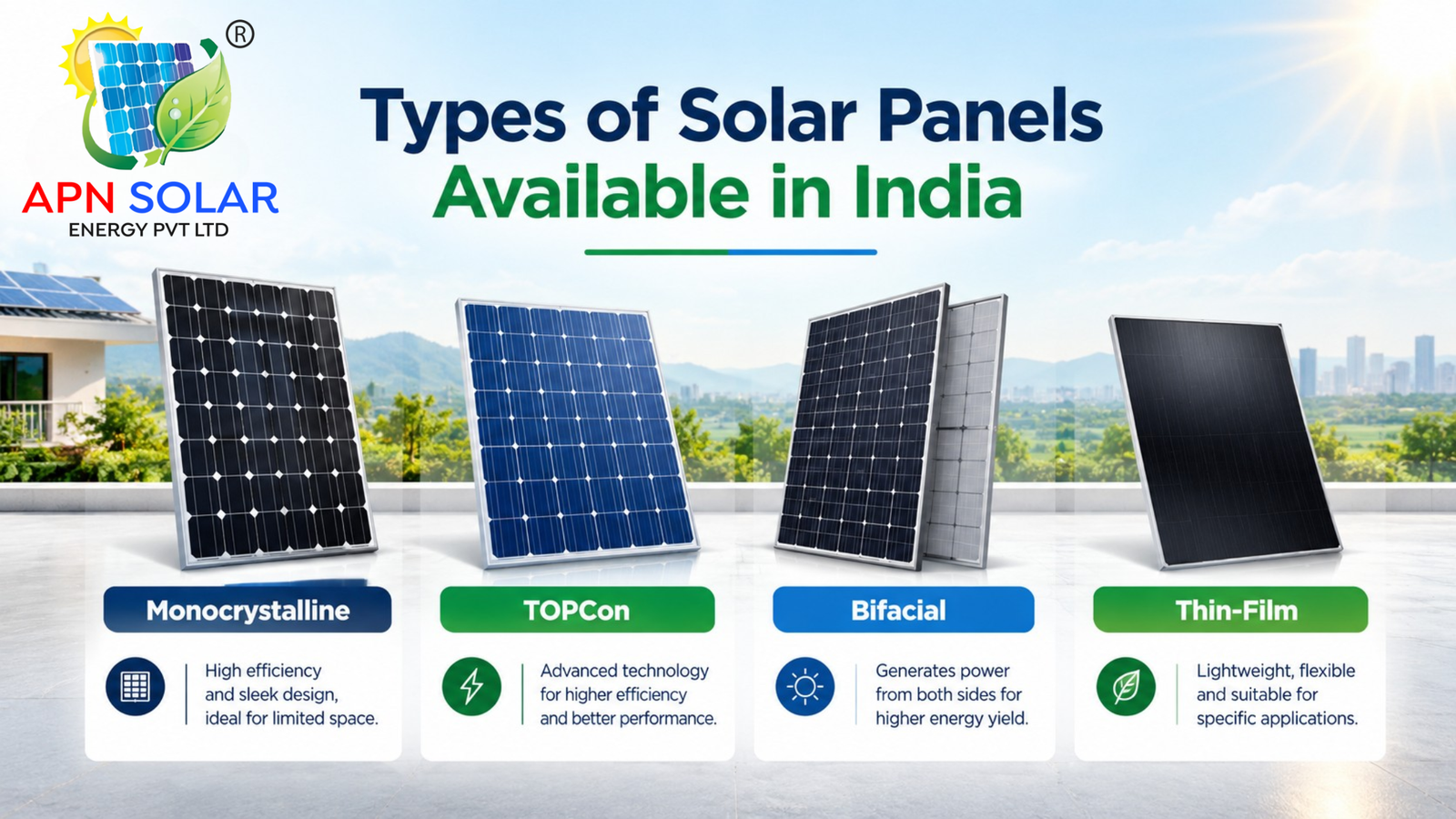
Different solar technologies suit different budgets, roof conditions, and energy requirements. Understanding the main options can help buyers discuss the right solution with APN Solar or another qualified solar partner.
| Solar panel type | Key characteristics | Potential applications | What to consider |
| Monocrystalline | Made using monocrystalline silicon cells; commonly available in modern rooftop systems | Residential rooftops, commercial buildings, and industrial projects | Efficiency, dimensions, warranty, and overall system cost |
| TOPCon | A modern crystalline-silicon cell technology designed for high efficiency | Projects requiring efficient use of available roof or installation space | Exact module specifications, price, and verified product performance |
| Bifacial | Can generate electricity from light reaching both the front and rear sides under suitable conditions | Ground-mounted systems and installations with suitable reflective surroundings | Rear-side light availability, mounting height, surface conditions, and installation design |
| Thin-film | Uses thin semiconductor layers and is available in different product configurations | Selected projects where its characteristics suit the application | Efficiency, space requirements, durability, and product availability |
Which Solar Panel Technology Should You Choose?
Choosing the right solar panel technology is an important step towards achieving better energy efficiency and long-term savings. Since every solar project has different requirements, the ideal technology depends on factors such as budget, available space, electricity consumption, and expected system performance. For residential rooftops, high-efficiency panels can be a suitable option when roof space is limited. Commercial and industrial installations, on the other hand, require careful consideration of energy demands, roof area, structural suitability, and overall project costs.
APN Solar helps customers identify suitable solar solutions based on their specific project requirements through its manufacturing and EPC (Engineering, Procurement, and Construction) services. By evaluating available solar panel technologies, product specifications, and performance data, APN Solar supports informed decision-making for residential, commercial, and industrial solar projects.
Whether you are planning a rooftop solar installation or a large-scale commercial project, selecting the right technology with guidance from APN Solar can help you achieve a practical, reliable, and cost-effective solar energy solution.
Choosing the Best Solar Manufacturer
Choosing a solar manufacturer requires more than comparing product prices. Buyers should examine product documentation, warranties, certifications, installation support, and the availability of technical assistance.
1. Product Quality and Technical Specifications
Before choosing a manufacturer, ask for a datasheet showing the module’s rated power, efficiency, dimensions, electrical characteristics, and operating conditions. Compare equivalent products rather than relying on general marketing claims.
APN Solar’s manufacturing and EPC capabilities make it important to assess both the proposed module and its suitability for the complete solar system.
2. Certifications and Compliance
Check which certifications and regulatory requirements apply to the specific module, project type, and installation. Depending on the application, relevant documentation may include applicable BIS standards, IEC test certifications, and ALMM listing requirements where mandated.
Do not assume every product has the same approvals. Customers should verify the specific module model, manufacturer details, and current documentation before placing an order.
3. Warranty and After-Sales Service
Solar panels generally have two distinct warranty considerations:
- Product warranty: Covers specified manufacturing or material defects under the warranty terms.
- Performance warranty: Sets out the manufacturer’s commitments regarding power output over a defined period.
The actual coverage and duration vary by product and manufacturer. Buyers should read the warranty document carefully and understand the claim process, exclusions, and responsible service provider.
APN Solar also provides operations and maintenance support for applicable installations, including monitoring, maintenance, and technical assistance. Confirm the precise service coverage and warranty arrangements for your proposed system before signing an agreement.
4. Solar Installation and Subsidy Assistance
For eligible residential customers, APN Solar assists with the solar installation and applicable subsidy process. Under the PM Surya Ghar: Muft Bijli Yojana, qualifying households may be able to access government financial assistance subject to the scheme’s current rules and eligibility conditions.
Subsidy eligibility, approved equipment requirements, documentation, and application procedures must be checked against current official guidelines. Assistance with an application does not guarantee approval or payment.
APN Solar can help eligible customers understand the relevant installation and subsidy steps. Customers should confirm what assistance is included in their quotation and remain aware of the applicable scheme requirements.
Solar Panel Manufacturer vs. Solar Installer
Solar panel manufacturers and solar installers have different responsibilities, although some companies provide both types of services.
| Comparison point | Solar panel manufacturer | Solar installer | APN Solar |
| Main responsibility | Produces solar modules | Installs and connects solar equipment | Offers solar manufacturing and EPC services |
| Product role | Manufactures panels and provides product documentation | Sources suitable panels and other system components | Connects module manufacturing with project execution |
| Engineering and design | May provide product specifications and technical guidance | Plans installation according to project requirements | Provides engineering as part of its EPC services |
| Installation | Not necessarily included in manufacturing alone | Carries out on-site installation | Provides solar installation and project execution through EPC services |
| Maintenance | Handles applicable product warranty responsibilities | May offer installation-related support | Provides O&M and technical support for applicable installations |
A solar EPC company goes beyond supplying panels or installing equipment. EPC generally covers engineering, procurement, and construction, bringing system design, equipment sourcing, and project execution together.
APN Solar combines solar manufacturing and EPC capabilities, giving customers a partner to discuss both module requirements and project implementation. Before proceeding, confirm which services are included in the specific APN Solar proposal.
Why Choose a Reliable Solar Partner?
Selecting a reliable solar partner can help customers make better decisions about equipment, installation quality, project costs, and long-term system operation. A suitable partner should explain the proposed system clearly and provide documentation that supports its recommendations.
Key Reasons to Choose a Reliable Solar Partner
1. Quality Equipment
Solar panels and other system components should be selected according to the property’s requirements, product specifications, and applicable standards. Choosing equipment only because it is inexpensive may overlook important differences in quality, warranties, and suitability.
APN Solar’s manufacturing and EPC services help connect solar module requirements with the wider project. Customers should review the specific product datasheets and equipment list included in their proposal.
2. Safety and Compliance
A solar installation should follow applicable electrical safety requirements, installation standards, and relevant regulatory conditions. Proper system design, suitable mounting structures, safe wiring, and appropriate protection devices are important for residential and larger installations.
APN Solar’s EPC services include engineering and project execution. Customers should confirm the safety provisions, technical scope, and required approvals for their installation before work begins.
3. Subsidy and Net-Metering Assistance
Eligible residential customers may need support understanding the PM Surya Ghar scheme, required documentation, and the applicable application process. Net metering may also be relevant where permitted by the local electricity distribution company and applicable regulations.
APN Solar assists eligible customers with the solar installation and subsidy process. Customers should verify current scheme rules, local net-metering requirements, and any applicable charges. Subsidies and approvals are subject to the relevant authorities and are not guaranteed by the installer.
4. Transparent Pricing
A clear quotation should explain the proposed system capacity, panel and inverter specifications, mounting structures, electrical components, installation charges, taxes, and any additional services.
APN Solar customers should request an itemised quotation so they can understand what is included in the proposed project and compare it fairly with other offers.
5. Long-Term Service and Technical Support
Solar systems require ongoing attention to maintain safe and reliable operation. Depending on the installation, this may include performance monitoring, inspections, cleaning guidance, maintenance, and technical troubleshooting.
APN Solar provides operations and maintenance services for applicable installations. Confirm the service agreement, response arrangements, and scope of support before finalising the project.
APN Solar for Residential, Commercial, and Industrial Projects
APN Solar serves different customer segments through its manufacturing and EPC capabilities.
- Residential solar: Rooftop planning, installation, and assistance with applicable subsidy processes.
- Commercial solar: Solutions assessed according to electricity consumption, available space, and business requirements.
- Industrial solar: Project planning and execution based on energy demand, site conditions, and technical requirements.
- Solar business partnerships: Franchise opportunities with agreed technical, engineering, and operational support.
This range allows customers to discuss their project requirements with a solar partner that works across more than one application type. The final scope, equipment, and service commitments should be documented in the project proposal.
How to Compare Solar Panel Manufacturers in India
Before finalising a solar manufacturer or installer, compare at least two or three quotations with similar system capacities and equipment specifications.
| Comparison Factor | What to Check | Why It Matters |
| Manufacturing | Own facility or third-party sourcing | Helps establish the company’s manufacturing role |
| Panel technology | Monocrystalline, TOPCon, or bifacial models | Helps match the technology to your needs |
| Efficiency | Rated efficiency and power output | Helps evaluate space utilisation and generation potential |
| Certifications | Applicable BIS, IEC, ALMM, and DCR requirements | Helps verify quality and project compliance |
| Warranty | Product and performance warranty terms | Clarifies long-term coverage |
| Installation | Engineering, installation, and commissioning scope | Helps ensure proper system execution |
| Pricing | Itemised quotation and included components | Makes cost comparisons more accurate |
| After-sales support | Service arrangements and warranty assistance | Helps resolve issues after installation |
For residential rooftop systems, also consider roof orientation, shading, electricity consumption, and available installation space. Commercial and industrial customers should additionally evaluate daytime energy demand, structural suitability, and project-specific engineering requirements.
This approach helps you choose a solar installation company in India based on value, quality, and suitability rather than price alone.
Compare Quotations on an Equal Basis
Before choosing a solar partner, obtain written quotations that specify the proposed system capacity, equipment models, installation scope, warranty coverage, payment schedule, and exclusions.
For residential systems, check whether the proposal addresses applicable subsidy and net-metering requirements. For commercial and industrial projects, pay particular attention to energy consumption, available installation space, engineering requirements, and the expected project scope.
APN Solar customers should compare the complete proposal rather than selecting a provider solely on the basis of the lowest initial price. A transparent quotation makes it easier to understand what the project includes and which services may require separate payment.
Why Consider APN Solar Energy Private Limited?
APN Solar brings several parts of the solar value chain together under one company.
Key company capabilities include:
- Established in 2011: Experience in the solar industry.
- Own manufacturing facility: Solar module manufacturing in Bhiwandi, Maharashtra.
- Manufacturing and EPC: Integrated capabilities across manufacturing and project execution.
- Residential solar: Rooftop solutions and assistance with applicable subsidy processes.
- Commercial and industrial solar: Solar EPC solutions based on site and energy requirements.
- Pan-India reach: Services and project support across India.
- Solar business opportunities: Franchise and business partnership options for entrepreneurs.
- Operations and maintenance: Technical and maintenance support for applicable installations.
Whether you are comparing solar panel manufacturers in Maharashtra, looking for a solar EPC company in India, or exploring solar solutions for your home or business, APN Solar can help you understand the options relevant to your requirements.
Conclusion :
Choosing the best solar panel manufacturing partner in India requires careful evaluation of product quality, efficiency, applicable certifications, warranty conditions, installation capabilities, and long-term support. The right choice depends on the specific requirements of your home, business, or industrial facility.
APN Solar Energy Pvt. Ltd. brings solar manufacturing and EPC services together, supporting residential, commercial, and industrial solar projects. Its service areas include solar module manufacturing, engineering, procurement, construction, installation, and operations and maintenance for applicable projects. APN Solar also assists eligible residential customers through relevant installation and subsidy processes and offers solar franchise partnerships with agreed support.
If you are planning a solar installation, start by assessing your energy needs, available space, budget, and applicable regulatory requirements. Request product specifications and a detailed quotation from APN Solar to understand which solution may be appropriate for your project.
Choosing a solar partner with clear documentation, defined responsibilities, and suitable technical support can help you make a more informed long-term investment in solar energy.
Frequently Asked Questions (FAQs)
1. How do I choose the best solar panel manufacturer in India?
Compare product specifications, efficiency, applicable certifications, warranties, manufacturing details, and after-sales support. Also assess whether the company can meet your project’s technical requirements. APN Solar offers manufacturing and EPC services for residential, commercial, and industrial solar projects.
2. What solar services does APN Solar provide?
APN Solar provides solar module manufacturing and EPC services, including engineering, procurement, construction, and installation. It also offers residential rooftop solar, commercial and industrial solutions, O&M for applicable installations, and solar franchise partnerships.
3. Which types of solar panels are best for rooftop installations?
Monocrystalline and modern high-efficiency crystalline-silicon modules may suit many rooftop projects, depending on roof space, budget, and product availability. Ask APN Solar for current module options and technical specifications before selecting a system.
4. Does APN Solar help with the PM Surya Ghar subsidy?
APN Solar assists eligible residential customers through the solar installation and applicable subsidy process. Eligibility and approval depend on the current government scheme guidelines and the relevant authorities.
5. What is the difference between a solar panel manufacturer and an EPC company?
A manufacturer produces solar modules, while an EPC company handles engineering, procurement, and construction. APN Solar offers both manufacturing and EPC capabilities, subject to the services included in the particular project agreement.
6. What warranties should I check before buying solar panels?
Review the product warranty and performance warranty, including their coverage, duration, exclusions, and claim procedure. You should also check the warranty terms for the inverter and other system components.
7. Does APN Solar provide maintenance and technical support?
APN Solar provides operations and maintenance services, including monitoring, maintenance, and technical assistance for applicable installations.
8. How can I request a solar quotation from APN Solar?
Share your project type, location, electricity consumption, available installation space, and other relevant requirements with APN Solar. Request a detailed quotation that identifies the proposed equipment, system capacity, installation scope, warranty terms, and applicable additional charges.