India’s solar energy industry has grown rapidly, with companies now operating across solar panel manufacturing, engineering, procurement and construction (EPC), installation, project development and maintenance.
Because of this, searching for the best solar company in India does not always lead to companies offering the same type of service. Some companies are primarily solar panel manufacturers, some specialise in EPC and installation, while others operate across multiple parts of the solar energy value chain.
For homeowners, businesses and industries, the right company depends on factors such as manufacturing capability, solar panel technology, certifications, project experience, EPC capabilities, warranty, after-sales support and geographical reach.
This guide looks at 5 notable solar companies in India in 2026 based on these practical factors.
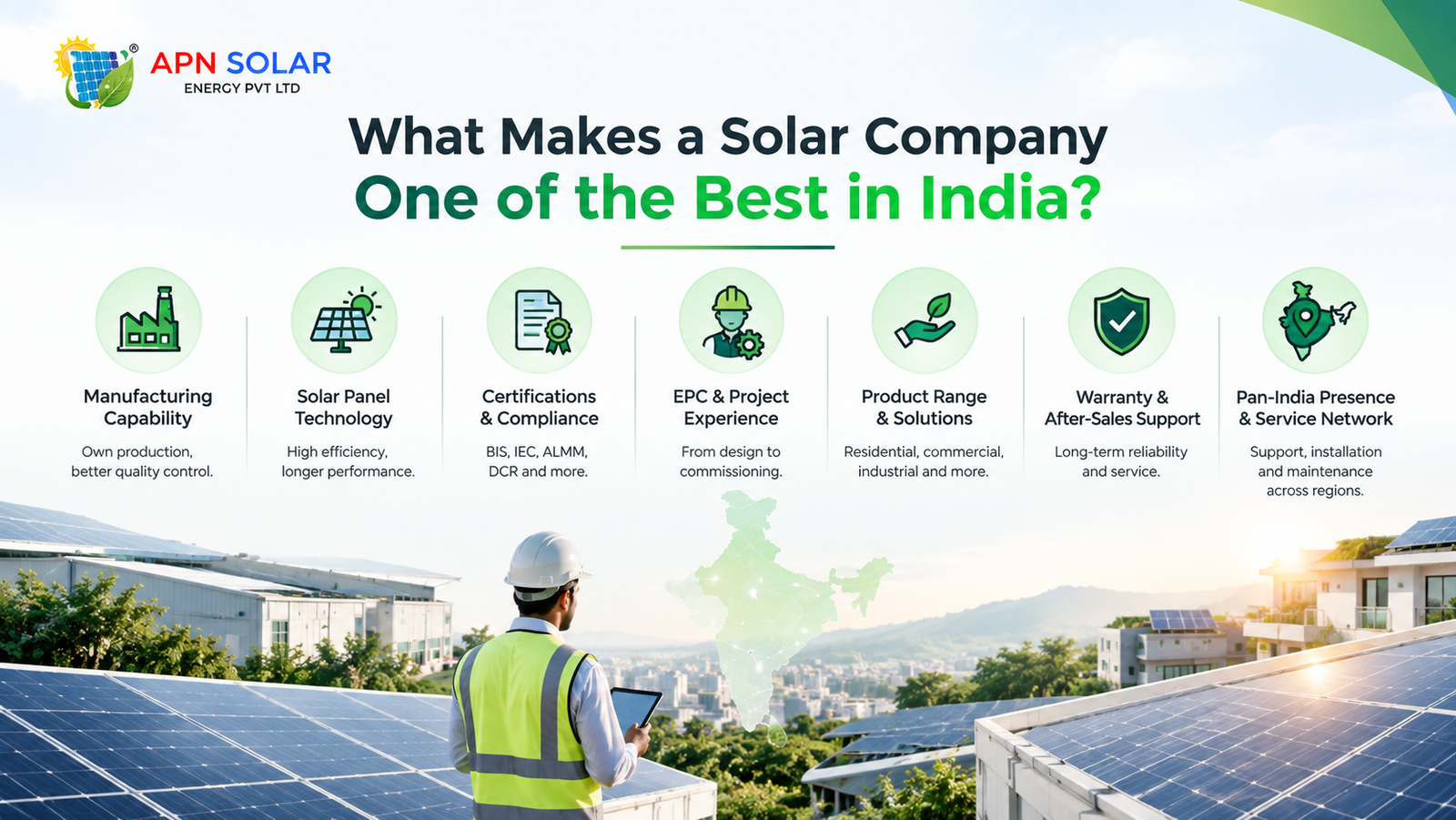
What Makes a Solar Company One of the Best in India?
There is no single specification that determines whether a solar company is suitable for every project. A residential rooftop system, a commercial installation and an industrial solar plant can have very different requirements.
When comparing solar companies in India, consider the following factors:
-
Manufacturing Capability
A company that manufactures solar modules can offer greater visibility into its product specifications, manufacturing processes and quality-control systems.
However, manufacturing capacity alone should not determine the choice. Buyers should also examine the technology, certifications, applicable standards and actual product specifications.
-
Solar Panel Technology
Solar technology continues to evolve. Modern Indian manufacturers offer technologies such as:
- N-Type TOPCon
- Bifacial modules
- Mono PERC
- High-wattage modules
- Glass-to-glass modules
- Other high-efficiency PV technologies
The right technology depends on the project’s available space, energy requirements, environmental conditions and system design.
-
Certifications and Compliance
Certifications can help establish whether solar products and manufacturing processes meet applicable standards.
Depending on the project, buyers may need to check:
- BIS certification
- IEC standards
- ALMM listing
- DCR compliance
- Quality-management certifications
- Product-specific test reports
ALMM is particularly relevant in India because MNRE’s current framework specifies which listed solar PV module models and manufacturers are eligible for certain government and government-assisted projects, as well as specified open-access and net-metering projects. Buyers should always check the latest applicable ALMM list rather than relying on an old list or a general company claim.
-
Project and EPC Experience
Solar panels are only one part of a complete solar power system.
Engineering, system design, mounting structures, electrical work, installation, commissioning, grid connection and monitoring can all affect long-term system performance.
A company with manufacturing as well as EPC capabilities can operate across more stages of the project lifecycle.
-
Product and Service Range
A solar company may work with residential customers, commercial buildings, factories, institutions or large-scale solar projects.
A broader product and service portfolio can be useful when the company has the engineering capability to adapt solutions to different applications.
-
Warranty and After-Sales Support
Solar systems are long-term infrastructure investments. Customers should examine product warranties, performance warranties, installation warranties and the company’s after-sales support structure before selecting a provider.
-
Geographic Reach
A company may have strong products but limited service coverage. For projects outside major cities, installation capability, logistics, technical support and maintenance availability can become important factors.
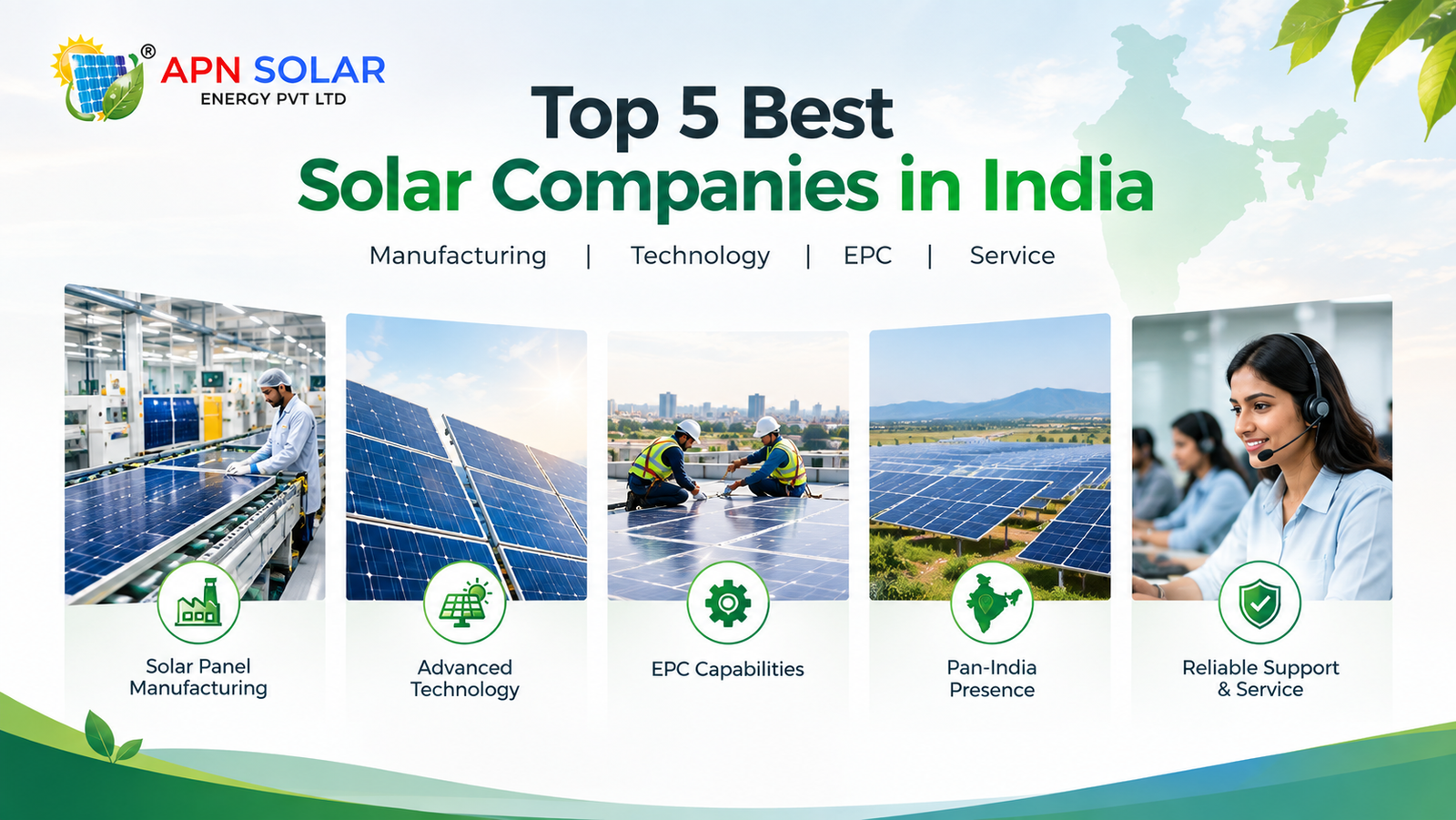
Top 5 Best Solar Companies in India
-
APN Solar Energy
APN Solar Energy is an Indian solar manufacturing and EPC company established in 2011. The company operates across solar manufacturing, engineering, project execution, installation and operations and maintenance.
One of APN Solar’s key differentiators is its own solar module manufacturing facility in Bhiwandi, Maharashtra. The company combines manufacturing with EPC capabilities, allowing it to work across residential, commercial and industrial solar requirements.
APN Solar’s current company information lists more than 12,000 cumulative solar installations and more than 40 MW of cumulative installed capacity.
The company’s solar manufacturing and EPC model covers different stages of a solar project, from module manufacturing and system design to installation and project execution.
Key areas to consider
- Own solar module manufacturing facility in Bhiwandi
- Solar manufacturing + EPC under one company
- Residential solar solutions
- Commercial and industrial EPC
- Ground-mounted solar projects
- Installation and O&M support
- Pan-India customer and project reach
- BIS, ALMM, IEC, DCR and TÜV-related compliance credentials
- ISO 9001:2015, ISO 14001:2015 and ISO 45001:2018 certifications
APN Solar is also registered as an official vendor on the PM Surya Ghar National Portal for eligible rooftop solar subsidy-related installations.
For customers comparing a solar company in India, APN’s combination of manufacturing and EPC is an important factor to examine alongside product specifications, certifications, project experience and service capabilities.
-
Adani Solar
Adani Solar is the solar PV manufacturing arm of the Adani Group and operates one of India’s major vertically integrated solar manufacturing ecosystems.
Its manufacturing operations at Mundra cover multiple stages of the solar PV value chain. According to the company’s current information, Adani Solar has 4 GW of cell and module manufacturing capacity and 2 GW of ingot-wafer manufacturing capacity.
The company manufactures both monofacial and bifacial PV modules using TOPCon and Mono PERC technologies.
Adani Solar also highlights its presence in domestic and international markets and its focus on vertically integrated manufacturing.
Key areas to consider
- Vertically integrated solar manufacturing
- 4 GW cell and module capacity
- 2 GW ingot-wafer capacity
- TOPCon and Mono PERC technology
- Monofacial and bifacial modules
- Utility and large-scale solar applications
- Domestic and international market presence
For buyers comparing solar panel companies in India, Adani Solar is particularly relevant when manufacturing integration and large-scale production are important considerations.
-
Tata Power Solar
Tata Power Solar operates across solar manufacturing, rooftop solutions, EPC and other renewable-energy applications.
One of its major manufacturing assets is the 4.3 GW solar cell and module manufacturing facility in Tirunelveli, Tamil Nadu.
The facility uses advanced TOPCon and Mono PERC technologies. Tata Power has also reported production of ALMM-certified modules and DCR modules using Made-in-India cells at the facility.
Beyond manufacturing, Tata Power has a significant presence in solar EPC and rooftop solar projects, making it relevant to both residential and larger project applications.
Key areas to consider
- 3 GW integrated cell and module facility
- TOPCon and Mono PERC technology
- DCR module production
- ALMM-certified modules
- Solar manufacturing and EPC capabilities
- Residential rooftop solar
- Commercial and utility-scale applications
- Established nationwide energy business
For customers looking for an integrated solar company in India, Tata Power Solar demonstrates how manufacturing and project execution can operate together within one solar business.
-
Vikram Solar
Vikram Solar is an Indian solar module manufacturer headquartered in Kolkata and has expanded its manufacturing footprint significantly in recent years.
In 2025, the company announced the commissioning of a 5 GW manufacturing facility at Vallam, Tamil Nadu, taking its total module manufacturing capacity to 9.5 GW.
The Vallam facility uses advanced automation, robotics, material-handling systems and built-in quality checks as part of its manufacturing process.
Vikram Solar also reports an international presence and a growing distributor and system-integrator network across India.
Key areas to consider
- 5 GW module manufacturing capacity
- 5 GW Vallam facility in Tamil Nadu
- Automated manufacturing
- High-efficiency solar PV modules
- International presence
- Pan-India distributor and system-integrator network
- Solar EPC and O&M capabilities
For buyers comparing best solar panel companies in India, manufacturing scale, technology and distribution reach are useful factors to examine alongside product specifications and warranty terms.
-
Waaree Energies
Waaree Energies is one of India’s largest solar manufacturing companies and has expanded its operations across solar modules, cells, EPC and other clean-energy technologies.
The company’s current disclosures state that it has 25.8 GW of installed solar PV module manufacturing capacity and 5.4 GW of solar cell manufacturing capacity.
Waaree has also been expanding further into the solar value chain, including upstream manufacturing, energy storage and other renewable-energy infrastructure.
The company operates across both Indian and international markets.
Key areas to consider
- 8 GW solar PV module manufacturing capacity
- 4 GW solar cell manufacturing capacity
- Solar module and cell manufacturing
- TOPCon and other advanced module technologies
- EPC capabilities
- Residential, commercial and utility-scale applications
- International market presence
- Expansion into broader clean-energy technologies
For customers evaluating a solar panel company in India, Waaree demonstrates the importance of manufacturing scale, product technology and supply-chain integration.
Comparison of the Top Solar Companies in India
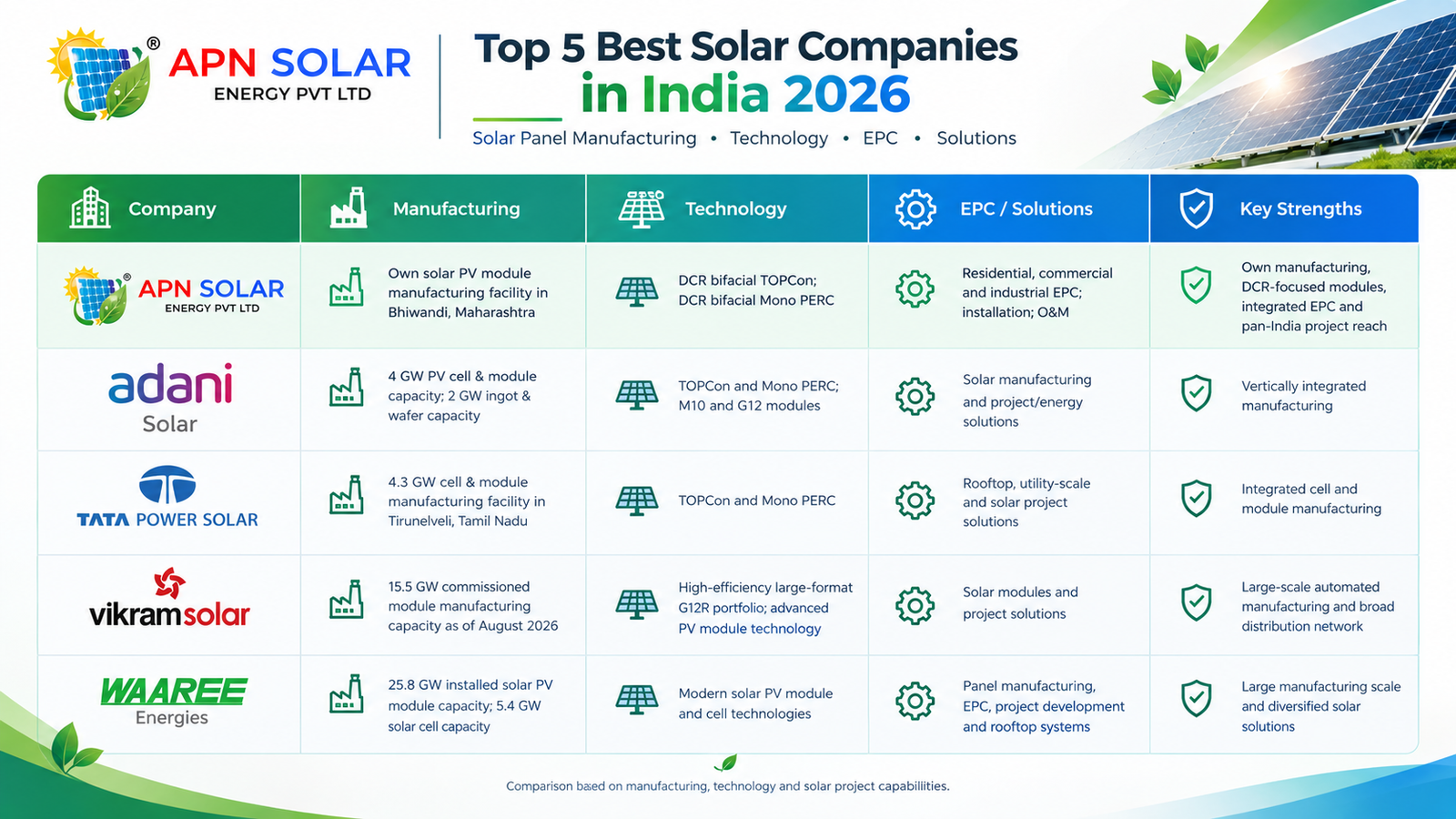
| Company | Manufacturing | Key Technology / Focus | EPC / Project Capability | Geographic Reach |
| APN Solar | Own manufacturing facility in Bhiwandi | TOPCon, bifacial, Mono PERC | Residential, commercial & industrial EPC | Pan-India |
| Adani Solar | Integrated cell, module & upstream manufacturing | TOPCon, Mono PERC, bifacial | Large-scale solar ecosystem | India & international |
| Tata Power Solar | 4.3 GW cell & module facility | TOPCon, Mono PERC, DCR | Rooftop, commercial & utility | Pan-India |
| Vikram Solar | 9.5 GW module capacity | High-efficiency PV modules | EPC & O&M capabilities | India & international |
| Waaree Energies | 25.8 GW module + 5.4 GW cell capacity | Advanced PV technologies | EPC & renewable-energy solutions | India & international |
The figures above should be treated as company-reported capacity figures and may change as new manufacturing facilities and production lines are commissioned.
How to Choose the Best Solar Company in India for Your Project
The largest manufacturer is not automatically the right company for every solar installation.
Instead, start by identifying the type of project you have.
For residential solar
Look at:
- Government-scheme eligibility
- Module technology
- Installer experience
- System design
- Warranty
- Installation quality
- After-sales service
- Local technical support
For eligible residential customers, government programmes such as PM Surya Ghar can also affect the choice of products and vendors.
For commercial solar
Businesses should examine:
- Electricity consumption
- Roof or land availability
- Engineering capability
- Module and inverter selection
- Structural requirements
- EPC experience
- Expected generation
- Monitoring
- O&M support
For industrial solar
Industrial projects can involve considerably more complex engineering.
Important factors can include:
- Electrical load requirements
- Structural assessment
- High-capacity modules
- Grid integration
- Safety systems
- Project execution experience
- Commissioning
- Monitoring
- Long-term maintenance
The best solar company for an industrial project may therefore be different from the most suitable company for a small residential rooftop.
Manufacturer vs Solar Installer vs EPC Company
Before selecting a solar company, it is also important to understand what type of business you are dealing with.
A solar manufacturer produces solar modules or other components.
A solar installer primarily installs solar systems at customer locations.
A solar EPC company handles engineering, procurement and construction of a solar project.
An integrated solar company may combine manufacturing, engineering, EPC, installation and maintenance.
This distinction matters because a company appearing in a list of “top solar companies in India” may not actually manufacture solar panels.
For buyers specifically searching for the best solar panel company in India, checking whether the company has its own manufacturing capabilities, applicable certifications and verifiable product information is an important first step.
Frequently Asked Questions
Which is the best solar company in India?
There is no single solar company that is automatically the best for every project. The right choice depends on factors such as manufacturing capability, technology, certifications, EPC experience, project size, warranty, service support and location.
Which are the best solar panel companies in India?
Some of the major Indian solar panel companies to compare include APN Solar Energy, Adani Solar, Tata Power Solar, Vikram Solar and Waaree Energies. Buyers should compare the companies based on manufacturing, technology, certifications, project experience and service requirements.
What should I check before choosing a solar company in India?
Check the company’s manufacturing or sourcing model, product specifications, BIS and applicable certifications, ALMM status where relevant, DCR applicability, project experience, warranty terms, installation capabilities and after-sales support.
Are all solar companies manufacturers?
No. Solar companies can operate as manufacturers, installers, EPC companies, project developers or integrated businesses. Some companies operate across multiple categories.
Is manufacturing capacity important when choosing a solar company?
Manufacturing capacity can indicate production scale, but it should not be considered on its own. Technology, product quality, certifications, project experience, warranty and after-sales support are also important.
What is the difference between TOPCon and Mono PERC solar panels?
TOPCon and Mono PERC are different photovoltaic cell technologies. TOPCon is a newer high-efficiency cell architecture that is increasingly being adopted by Indian manufacturers. The appropriate technology depends on project requirements, available space, product specifications and system economics.
Final Thoughts
The Indian solar market includes manufacturers, EPC companies, installers, project developers and integrated renewable-energy businesses. This makes it important to look beyond a company’s brand name when comparing the best solar company in India.
Manufacturing capability, panel technology, certifications, ALMM and DCR compliance where applicable, EPC experience, project track record, warranty, after-sales support and geographic reach provide a more useful framework for comparison.
For residential, commercial and industrial buyers, the right solar company should ultimately be evaluated according to the requirements of the specific project rather than a generic list position.
As India’s solar manufacturing ecosystem continues to expand, comparing companies on verifiable capabilities and current product information can help customers make a more informed decision.