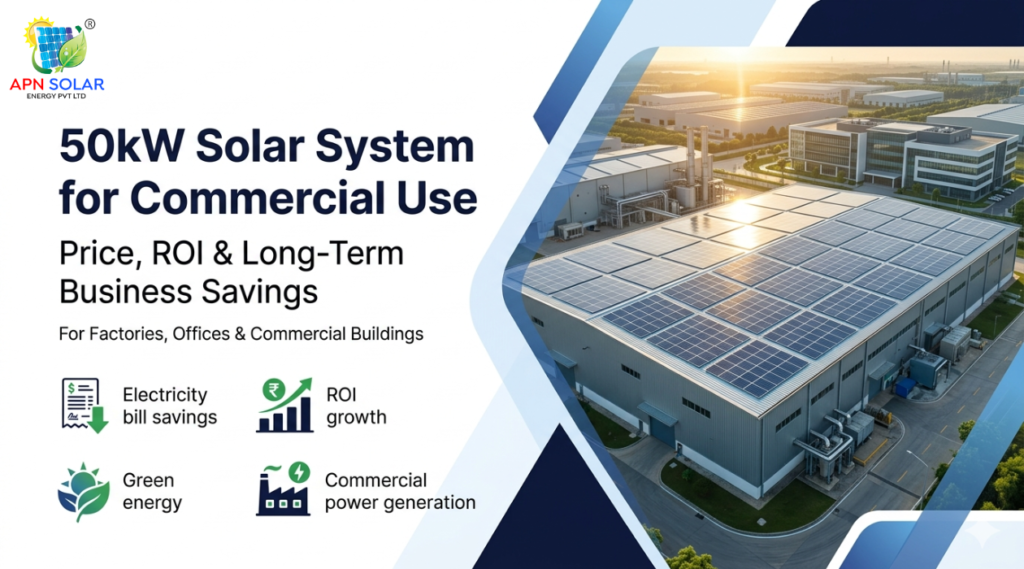
Rising electricity prices and increasing operational costs are encouraging businesses across India to shift toward solar energy as a long-term cost-saving solution. Today, commercial establishments such as factories, offices, schools, hospitals, hotels, warehouses, and retail buildings are actively investing in rooftop solar for business operations. Many businesses prefer a scalable solution like a
commercial solar system for businesses to reduce electricity costs and improve long-term energy efficiency.
A 50kw solar system is one of the most popular choices for medium to large commercial properties because it can generate substantial daily electricity while delivering long-term financial savings. Businesses searching for the latest solar power plant cost are increasingly choosing commercial rooftop solar systems to achieve faster return on investment, lower monthly electricity bills, and greater energy independence.
In addition to reducing operational expenses, a commercial solar system also supports sustainability goals by helping businesses adopt cleaner and greener energy solutions. With proper installation, a 50 kilowatt solar system can operate efficiently for more than 25 years with minimal maintenance requirements.
What Is a 50kW Solar System?
A 50 kilowatt solar system is a large-scale commercial solar system designed to generate electricity for businesses and high-energy-consuming properties. In simple terms, a 50 kw solar plant can produce approximately 180–250 units of electricity per day, depending on sunlight conditions, rooftop direction, and geographic location. On average, the system can generate around 5,500–7,500 units of electricity per month, making it suitable for reducing heavy commercial electricity bills.
This type of industrial solar system is commonly installed on factories, offices, schools, hospitals, warehouses, hotels, and other commercial buildings that operate multiple electrical appliances, machinery, air conditioning systems, or production equipment daily. where large-scale deployment follows guidelines similar to a industrial solar installation guide to ensure maximum efficiency and safety standards.
A standard 50kW solar installation usually requires around 4,000–5,000 square feet of shadow-free rooftop space for efficient performance. Most systems in India are grid-connected and work through net metering, allowing businesses to export excess electricity back to the grid and receive credits on their electricity bills.
A commercial solar system of this capacitcy typically includes high-efficiency solar panels, industrial-grade inverters, mounting structures, safety components, and monitoring systems for real-time performance tracking. With proper maintenance and professional installation, a 50 kilowatt solar system can deliver reliable performance for 25 years or more, making it a long-term investment for commercial energy savings and sustainability goals.
50kW Solar System Price in India
The average 50kw solar system price in India typically ranges between ₹18 lakh and ₹32 lakh for commercial installations, depending on the system type, component quality, and project requirements. The final solar plant cost may vary based on rooftop structure, electricity consumption pattern, location, and installation complexity.
Approximate 50kW Solar System Pricing
| System Type | Estimated Price Range |
| On-Grid 50kW Solar System | ₹18 lakh – ₹24 lakh |
| Off-Grid 50kW Solar System | ₹28 lakh – ₹32 lakh |
| Hybrid 50kW Solar System | ₹24 lakh – ₹30 lakh |
An on-grid commercial solar installation is the most popular option for businesses because it works with the utility grid and supports net metering. This allows commercial users to export excess electricity and reduce monthly power bills significantly. Off-grid systems include battery storage, which increases the overall solar power plant cost but provides backup during power outages. Hybrid systems combine both grid connectivity and battery backup for better energy reliability.
Several factors affect the total solar plant price of a commercial project:
- Solar panel type and efficiency
- Inverter brand and capacity
- Mounting structure quality
- Roof height and installation complexity
- Local electricity regulations
- Net metering approval charges
- City-wise labor and transportation costs
A professionally installed 50kW commercial solar system can help businesses save lakhs of rupees in electricity expenses over its operational lifespan of 25 years or more. Many commercial properties achieve ROI within approximately 3–5 years, depending on electricity tariffs and daily power consumption.
However, the exact solar plant cost should always be determined after a detailed site survey, rooftop inspection, and load analysis because pricing can differ significantly based on business requirements and component selection.
Power Generation Capacity of a 50kW Solar Plant
A 50kw solar system can generate approximately 180–250 units of electricity per day under standard sunlight conditions in India. The actual output of a solar power plant depends on factors such as geographic location, rooftop shadow conditions, solar panel efficiency, weather patterns, and system maintenance.
On average, a commercial rooftop solar system of 50kW capacity can produce around 5,500–7,500 units per month and nearly 66,000–90,000 units annually. This level of generation is suitable for factories, offices, hospitals, hotels, schools, and other commercial establishments with high daytime electricity consumption. For comparison, smaller systems such as a 20kW solar system price guide
help illustrate how generation scales with system size.
Average Power Generation of 50kW Solar System
| Time Period | Estimated Electricity Generation |
| Daily Generation | 180–250 units |
| Monthly Generation | 5,500–7,500 units |
| Annual Generation | 66,000–90,000 units |
Several factors influence the performance of a commercial rooftop solar installation:
- Availability of peak sunlight hours
- City and climatic conditions
- Shadow-free rooftop space
- Proper panel tilt and orientation
- Quality of solar components
- Regular cleaning and maintenance
For maximum efficiency, solar panels should be installed on a properly designed rooftop structure with minimal shading and correct south-facing orientation wherever feasible. Regular maintenance and performance monitoring also help maintain consistent long-term energy generation.
Rooftop Space Required for 50kW Solar System
A commercial solar system with 50kW capacity generally requires approximately 4,000–5,000 square feet of shadow-free rooftop space for proper installation and efficient power generation. The exact area requirement may vary depending on the solar panel wattage, mounting structure design, and panel layout used in the project.
For maximum performance, rooftop solar for business installations should be placed on a shadow-free surface because nearby buildings, water tanks, trees, or equipment can reduce energy generation significantly. Even partial shading on solar panels can affect the overall output of the system.
A 50kW industrial solar system can be installed on multiple rooftop types, including:
- RCC concrete rooftops
- Metal sheet rooftops
- Industrial shed rooftops
- Commercial building terraces
Modern mounting structures provide flexible installation options based on rooftop condition, wind load requirements, and building design. Professional site surveys are important to evaluate roof strength, usable space, shadow analysis, and panel orientation before installation.
Quick Answer:
A 50kW solar system typically requires around 4,000–5,000 sq. ft. of shadow-free rooftop area.
Types of 50kW Solar Systems
A 50kW commercial solar system is available in three major types: on-grid, off-grid, and hybrid systems. The right option depends on electricity usage patterns, power backup requirements, and overall solar power plant cost. Businesses should choose the system type based on operational needs, local grid reliability, and long-term energy goals.
On-Grid 50kW Solar System
An on-grid commercial solar system is directly connected to the electricity grid and is the most commonly used option for commercial buildings, factories, schools, and offices. This system works without batteries and supports net metering, allowing businesses to export excess electricity to the grid and reduce monthly power bills. It offers lower installation and maintenance costs compared to battery-based systems. You can understand its working in detail through the on-grid solar system guide
which explains grid interaction and billing benefits.
Off-Grid 50kW Solar System
An off-grid system operates independently from the utility grid and includes large battery banks for electricity storage. This setup is suitable for remote industrial locations or areas with frequent power cuts. However, the off grid solar system cost is significantly higher because of battery storage and backup infrastructure requirements.
Hybrid 50kW Solar System
A hybrid commercial solar system combines grid connectivity with battery backup. It can use solar energy during the day, store excess electricity in batteries, and draw power from the grid when required. Hybrid solar system are ideal for businesses needing uninterrupted power supply and better energy security.
Comparison of 50kW Solar System Types
| Feature | On-Grid | Off-Grid | Hybrid |
| Approximate Cost | Lower | Highest | Medium-High |
| Battery Required | No | Yes | Yes |
| Net Metering Support | Yes | No | Yes |
| Maintenance Level | Low | High | Medium |
| Best Use Case | Urban businesses | Remote locations | Backup power needs |
Benefits of Installing a 50kW Solar System for Commercial Use
A 50kW commercial solar system offers long-term financial and operational advantages for businesses looking to reduce dependency on rising electricity costs. With increasing solar plant cost efficiency and improved technology, rooftop solar for business has become one of the most effective energy solutions for factories, offices, schools, hospitals, and other commercial establishments.
One of the biggest benefits is significantly lower electricity bills. Businesses can reduce monthly power expenses by generating their own electricity through a solar power plant, which directly offsets grid consumption. This leads to a fast return on investment, often within 3–5 years depending on usage patterns and tariff rates.
Commercial solar installations also provide strong financial advantages such as tax benefits and accelerated depreciation, which help reduce overall taxable income for businesses. Over a system lifespan of 25+ years, companies can achieve substantial long-term savings and better financial stability.
benefits include:
- Reduced electricity bills
- Fast ROI and long-term savings
- Tax benefits and accelerated depreciation
- Energy independence from grid fluctuations
- Eco-friendly and sustainable operations
- Improved brand image and business credibility
- Low maintenance requirements
- Stable power generation for decades
A commercial solar system also helps businesses protect themselves from future electricity price hikes, ensuring predictable energy costs for long-term planning. Additionally, adopting solar energy improves sustainability scores and supports environmental responsibility goals.
Companies like APN Solar provide customized solar power plant solutions designed to match business energy requirements, ensuring maximum efficiency and long-term performance. With proper design and installation, businesses can significantly reduce operational expenses over the lifetime of the system while contributing to a cleaner energy future.
Government Subsidy & Commercial Solar Policies
In India, government support for a 50kW commercial solar system is different from residential schemes. Direct subsidies on solar power plant cost are generally limited or not available for most commercial and industrial users. However, businesses still benefit from several indirect financial advantages that significantly reduce overall investment impact.
One of the most important policies is net metering, which allows commercial users to export excess electricity generated by their solar system back to the grid. This reduces monthly electricity bills and improves overall savings from commercial solar installation.
Another key financial benefit is accelerated depreciation, which allows businesses to claim a significant portion of the solar system cost as a tax deduction in the early years. This helps reduce taxable income and improves cash flow for companies investing in solar energy.
Solar policies also vary from state to state, especially in terms of net metering rules, approval timelines, and export limits. Some states offer faster approvals and more favorable net metering caps, while others may have stricter guidelines.
Overall, while direct subsidies may be limited for commercial users, the combination of net metering and tax benefits makes solar investment highly profitable for businesses adopting large-scale rooftop solar systems.
ROI and Payback Period of 50kW Solar System
The return on investment (ROI) for a 50kW commercial solar system is one of the key reasons businesses adopt solar energy. On average, the payback period for a solar power plant of this size in India ranges between 3 to 5 years, depending on electricity tariffs, solar plant cost, and daily energy consumption patterns.
A well-designed commercial solar system can significantly reduce monthly electricity bills by offsetting grid consumption. For most businesses, this results in 60%–90% savings on electricity expenses, especially for daytime operations such as factories, offices, schools, and warehouses.
Estimated Savings Breakdown
- Average annual savings: ₹4 lakh – ₹7 lakh (approx., varies by tariff and usage)
- 25-year total savings: ₹1 crore – ₹1.5 crore (approx.)
These savings make rooftop solar for business a highly profitable long-term investment. Once the initial system cost is recovered within a few years, the remaining operational life of 20+ years generates nearly free electricity, making it a financially stable energy solution.
The ROI is also influenced by factors such as net metering benefits, system efficiency, maintenance costs, and local sunlight conditions. Businesses in high-tariff states generally achieve faster payback periods due to higher electricity savings.
Overall, investing in a 50kW system ensures long-term cost control, predictable energy expenses, and protection against rising electricity prices, making it one of the most reliable energy investments for commercial users. This becomes even more attractive when compared with larger-scale installations like a 20kW solar system price in India which helps businesses understand scaling economics across system sizes.
Maintenance Requirements of a 50kW Solar Plant
A 50kW solar power plant requires very low maintenance compared to other commercial energy systems, making it a practical choice for long-term use in businesses. A well-installed commercial solar system can operate efficiently for 25 years or more with minimal upkeep.
The main maintenance activity is regular panel cleaning to remove dust, pollution, and bird droppings that can reduce energy generation. Depending on the location, cleaning is typically required once or twice a month.
In addition, periodic inverter inspection is important to ensure stable system performance and avoid unexpected downtime. Modern systems also include performance monitoring tools that allow businesses to track real-time energy generation and detect any drop in efficiency.
Annual maintenance checks are recommended to inspect wiring, mounting structures, and electrical safety components.
Overall, the low maintenance nature of a solar power plant significantly reduces operational costs, making it a reliable and hassle-free energy solution for commercial users.
Why Businesses Are Switching to Commercial Solar
Businesses are rapidly adopting commercial rooftop solar due to rising electricity prices and the need for long-term cost stability. An industrial solar system helps companies reduce dependency on grid power and control operational expenses more effectively.
Solar power plant installations also support ESG (Environmental, Social, and Governance) goals, allowing businesses to demonstrate environmental responsibility and improve their sustainability ratings. This is becoming increasingly important for companies working with global clients and investors.
Energy security is another major factor. With unpredictable power tariffs and supply fluctuations, solar ensures a more stable and predictable energy source for commercial operations. It also reduces exposure to future electricity price hikes.
In addition, solar adoption improves long-term profitability by significantly lowering energy expenses over a system lifespan of 25+ years. As a result, commercial solar is no longer just an option—it is becoming a strategic business investment for growth and efficiency.
Conclusion
A 50kw solar system is one of the most effective solutions for businesses looking to reduce long-term electricity expenses and achieve energy independence. A well-designed commercial solar system helps industries, offices, schools, and other commercial establishments significantly lower operational costs while ensuring stable and reliable power supply.
With increasing electricity rates, investing in solar energy provides strong long-term financial benefits, including reduced dependency on the grid and protection against future tariff hikes. Although the initial solar plant price may vary based on system design and site conditions, the long-term savings over 25 years make it a highly profitable investment.
Best Solar Companies in India like APN Solar provide customized solar solutions, ensuring proper system design, high efficiency, and long-lasting performance tailored to business needs.
To get started, businesses can opt for a free consultation, site survey, and receive a customized quotation based on their energy requirements. This ensures the most accurate system design and maximum return on investment for any commercial solar installation.
Frequently Asked Questions
1. What is the average 50kW solar system price in India?
The average 50kW solar system price in India ranges from ₹18 lakh to ₹32 lakh depending on system type, panel quality, and installation requirements. The final solar plant cost varies based on on-grid, off-grid, or hybrid configuration and site conditions.
2. How much electricity does a 50kW solar system generate daily?
A 50kW solar system typically generates around 180–250 units per day under standard Indian sunlight conditions. Actual output depends on location, weather, panel efficiency, and rooftop installation quality.
3. How much rooftop area is needed for a 50kW solar plant?
A 50kW solar plant requires approximately 4,000–5,000 square feet of shadow-free rooftop space. Proper spacing, tilt angle, and layout design are important for maximizing generation efficiency in commercial installations.
4. Is a 50kW solar system suitable for factories and offices?
Yes, a 50kW system is ideal for factories, offices, schools, hospitals, and warehouses. It is designed for medium to large commercial electricity consumption and helps reduce operational costs significantly through rooftop solar generation.
5. What is the payback period for a commercial 50kW solar system?
The payback period for a 50kW commercial solar system is generally between 3 to 5 years. It depends on electricity tariffs, usage patterns, and solar plant cost. After recovery, businesses enjoy nearly free electricity for over 20 years.
6. Does a 50kW commercial solar system require batteries?
Not necessarily. Most commercial systems are on-grid and do not require batteries. Batteries are only needed in off-grid or hybrid systems where backup power is required during outages or for energy storage purposes.
7. What maintenance is required for a 50kW solar power plant?
A 50kW solar power plant requires minimal maintenance, mainly panel cleaning, inverter checks, and performance monitoring. Routine inspections ensure efficiency, while annual servicing helps maintain long-term performance and system reliability.