
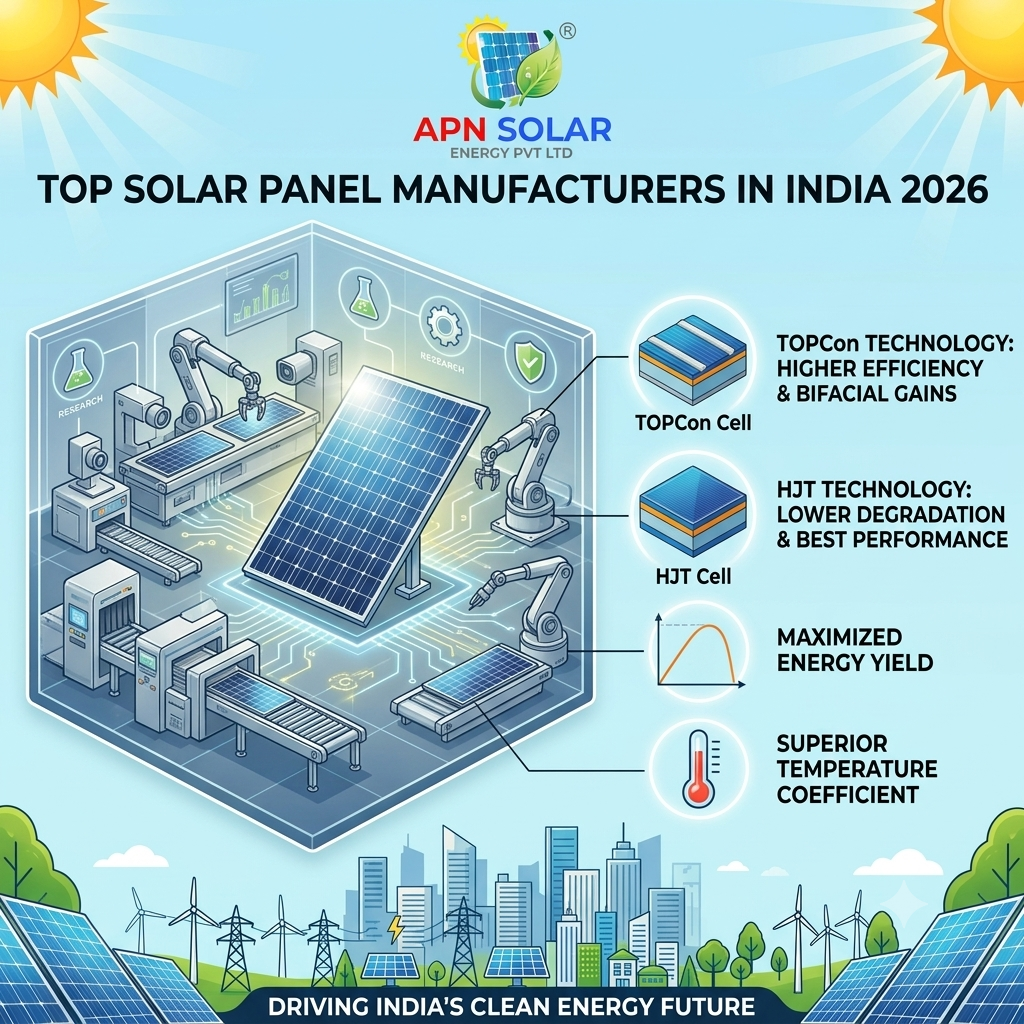
India’s solar energy sector is growing as households, businesses, industries, and institutions look for ways to reduce electricity expenses and adopt cleaner energy solutions. Solar power is becoming an important part of India’s energy transition, creating opportunities for solar panel manufacturers, distributors, installation companies, and end customers.
Choosing the best solar panel manufacturer in India in 2026 is an important decision for anyone planning a residential rooftop installation, a commercial solar project, or an industrial solar power system. The right solar panels can help deliver reliable electricity generation, make efficient use of available roof space, and support long-term project performance.
However, selecting a solar panel manufacturer involves more than comparing brand names or choosing the highest-wattage module. Buyers should also consider panel efficiency, manufacturing quality, product technology, warranty conditions, manufacturing capacity, product availability, and after-sales support.
Top Solar Panel Manufacturers in India in 2026
India’s solar manufacturing industry includes companies with different levels of manufacturing integration, product portfolios, production capacities, and market experience.
The following companies are worth evaluating when comparing solar panels for residential, commercial, and industrial applications. This is a selection of established manufacturers, not a definitive ranking of product quality. Buyers should verify the exact module model, current specifications, availability, and applicable approvals before purchasing.
1. Waaree Energies
Waaree Energies is one of India’s prominent solar photovoltaic module manufacturers. The company serves different segments of the solar market, including rooftop installations, commercial projects, industrial applications, and larger solar power developments.
Its product portfolio includes monocrystalline photovoltaic modules and newer module technologies designed to meet different project requirements.
Why consider Waaree Energies?
- A broad solar module portfolio for different applications.
- Experience serving domestic and international solar markets.
- Product options for rooftop and large-scale installations.
- A manufacturing presence and distribution network that buyers can investigate when evaluating supply availability.
Before selecting a Waaree module, compare the specific model’s efficiency, dimensions, temperature characteristics, warranty documentation, and current regulatory eligibility.
APN Solar
APN Solar Energy Pvt. Ltd. is an Indian best solar energy company working across solar manufacturing, OEM solutions and Engineering, Procurement and Construction (EPC) services. The company supports solar requirements for residential, commercial and industrial applications.
APN Solar’s business profile includes solar panel supply, manufacturing partnerships, project engineering, installation and other solar-related services. This combination can be useful for customers looking for both solar products and project execution support.
Key areas to consider:
- Solar manufacturing and OEM solutions
- Residential rooftop solar installations
- Commercial and industrial solar projects
- Solar EPC, engineering and installation support
- Operations, maintenance and partner opportunities
Who should consider APN Solar?
Homeowners, businesses, industrial customers and solar business partners can explore APN Solar for suitable products and project solutions. Buyers should request the exact module model, technical datasheet, applicable certifications, warranty terms and confirmation of current availability before finalising an order.
To learn more, visit the official APN Solar website.
Adani Solar
Adani Solar is an Indian solar manufacturing business offering photovoltaic modules in different configurations and technologies. Its product portfolio includes monofacial and bifacial module options, with specifications depending on the product series.
Monofacial panels primarily capture sunlight on the front side, while bifacial modules can also capture reflected light from the rear. The additional energy yield from bifacial modules depends on factors such as mounting height, ground reflectivity, row spacing and installation design.
Key considerations:
- Monofacial and bifacial module options
- Different module power classes and technologies
- Efficiency and space utilisation
- Compatibility with project design
- Warranty, certification and product availability
Who should consider Adani Solar?
Commercial and industrial customers, solar developers and other buyers can assess Adani Solar modules when planning projects that require a suitable combination of power output, technology and project economics.
The best choice should be based on the actual module datasheet and site conditions rather than a general brand comparison.
Vikram Solar
Vikram Solar is an Indian solar module manufacturer serving different segments of the solar market. Buyers can evaluate its product offerings based on technical performance, project compatibility and long-term reliability requirements.
For a fair comparison, it is important to examine the characteristics of the specific module under consideration. These may include rated power, conversion efficiency, temperature coefficient, degradation characteristics, mechanical load ratings and warranty conditions.
Key considerations:
- Solar PV module options
- Product specifications for different applications
- Module efficiency and power output
- Technical and warranty documentation
- Supplier availability and delivery timelines
Who should consider Vikram Solar?
Customers planning rooftop systems, commercial installations or larger solar projects can include Vikram Solar in their shortlist and compare its available modules with alternatives.
Ask the supplier to confirm the exact product model and whether it meets the technical and regulatory requirements of your project.
Premier Energies
Premier Energies is an Indian solar manufacturing company with activities across solar cells and solar modules. Its position in the solar manufacturing value chain makes it another company to consider when researching module suppliers and solar industry options.
As with other manufacturers, the suitability of a product depends on its actual specifications, availability and compatibility with the planned installation.
Key considerations:
- Solar cell and module manufacturing
- Available module technologies and specifications
- Product documentation and warranty terms
- Supply capability for the required order
- Compliance with applicable project requirements
Who should consider Premier Energies?
Solar installers, project developers, commercial customers and other buyers can evaluate Premier Energies’ available products according to their technical and commercial requirements.
Before placing an order, confirm which module models are currently available and whether they meet the relevant approval and certification requirements.
Types of Solar Panels Available in India: Which One Should You Choose?
With India rapidly advancing toward its renewable energy goals, rooftop solar installations are booming across residential, commercial, and industrial sectors. If you are planning to invest in a solar system, choosing the right solar panel is the single most important decision you will make. It dictates your system’s efficiency, lifespan, performance in low light, and overall return on investment (ROI).
1. Monocrystalline Solar Panels (PERC & Modern Variants)
Monocrystalline panels are made from a single, pure silicon crystal, giving them a uniform dark black appearance and high aesthetic appeal.
- Efficiency: Very high (typically ranges between 20% to 22%+).
- Space Requirement: Low. Because of their high efficiency, they generate more power per square foot, making them ideal for rooftops with limited space.
- Low-Light Performance: Excellent. They perform exceptionally well on cloudy days and during early morning/late afternoon hours.
- Lifespan & Durability: Long-lasting (often comes with a 25-to-30-year performance warranty).
- Cost: Premium pricing compared to older technologies, but offers a faster ROI due to higher generation.
2. Polycrystalline Solar Panels
Polycrystalline panels are made by melting multiple silicon fragments together. They have a distinct bluish hue and a textured, mosaic-like look.
- Efficiency: Moderate (typically ranges between 15% to 17%).
- Space Requirement: Higher. Because efficiency is lower, you need a larger roof area to generate the same amount of power compared to monocrystalline panels.
- Low-Light Performance: Decent, but degrades faster in high-temperature environments.
- Cost: Budget-friendly. These have historically been the most affordable panels on the market, though their market share is shrinking as advanced technologies become more cost-effective.
3. TOPCon Solar Panels (Tunnel Oxide Passivated Contact)
TOPCon technology is currently revolutionizing the Indian solar market as the next-generation upgrade to traditional PERC monocrystalline panels.
- Efficiency: Extremely high (often exceeding 23% to 24%).
- Degradation Rate: Very low. TOPCon panels suffer from minimal power loss over time, ensuring high output even after 25 years.
- Temperature Coefficient: Performs brilliantly even during scorching Indian summers when panel temperatures peak.
- Bifacial Capability: Many TOPCon panels are bifacial, meaning they can absorb sunlight from both the front and reflected light from the back (ideal for commercial or ground-mounted setups).
- Best Suited For: Residential rooftops with limited space and commercial/industrial projects looking for maximum power generation.
4. HJT Solar Panels (Heterojunction Technology)
HJT panels combine the best properties of amorphous silicon and crystalline silicon, representing the pinnacle of current solar cell engineering.
- Efficiency: Among the highest in the industry (24% to 25%+).
- Temperature Resilience: Offers near-zero power loss in extreme heat, making it a stellar choice for hot Indian climates.
- Lifespan: Outstanding durability with extremely low degradation rates.
- Cost: High initial capital investment, but unmatched lifetime energy yields.
5. Thin-Film Solar Panels
Thin-film panels are manufactured by depositing one or more thin layers of photovoltaic material (such as cadmium telluride or amorphous silicon) onto a substrate.
- Flexibility & Weight: Extremely lightweight and flexible. Some variants can even be curved over unique architectural structures.
- Efficiency: Lower (typically 10% to 13%), meaning they require massive surface areas.
- Best Suited For: Large-scale commercial utility projects, building-integrated photovoltaics (BIPV), or specialized portable applications. They are rarely used for standard residential rooftops.
Comparison Summary: Which One Should You Choose?
| Feature | Polycrystalline | Monocrystalline (PERC) | TOPCon | HJT |
| Efficiency | Low (15-17%) | High (20-22%) | Very High (23-24%+) | Maximum (24-25%+) |
| Space Needed | High | Moderate | Low | Very Low |
| Heat Tolerance | Moderate | Good | Excellent | Superior |
| Cost | Lowest | Moderate | Competitive/Mid-High | Premium |
| Best For | Tight budgets, large open roofs | Standard residential/commercial | High-efficiency modern homes & businesses | Maximum ROI & premium performance |
Best Solar Panel Manufacturers for Commercial and Industrial Projects
Commercial and industrial solar installations have different requirements from smaller residential rooftop systems.
Factories, warehouses, shopping complexes, hospitals, hotels, offices, and manufacturing facilities may require larger solar capacities, detailed engineering, reliable energy generation, and careful coordination with their existing electrical infrastructure.
For these projects, the best solar panel manufacturer is not necessarily the company offering the lowest price. The preferred supplier should be able to provide suitable products, consistent supply, complete technical documentation, and warranty arrangements that meet the project’s requirements.
1. Consider the Project’s Energy Requirements
Before selecting a solar module, analyse the facility’s electricity consumption, operating schedule, available roof area, and electrical infrastructure.
For example, a factory operating primarily during daylight hours may be able to use a substantial portion of the electricity generated by its rooftop solar installation directly.
A facility with limited roof space may benefit from evaluating higher-efficiency modules, provided the overall project economics and technical suitability justify the choice.
A qualified solar EPC provider can assess the site and recommend an appropriate system configuration.
2. Compare Module Efficiency and Power Density
Commercial rooftops often have competing requirements involving roof access, ventilation, structural loads, and equipment placement.
Higher-efficiency modules can produce more rated capacity from a given module area. However, the overall result also depends on panel dimensions, the number of modules that can be installed, shading, roof layout, and system design.
Buyers should compare the power rating and efficiency of actual module models rather than assuming that a higher wattage automatically means better performance.
3. Evaluate Long-Term Performance
Industrial solar systems may operate for decades. Module degradation, temperature behaviour, environmental exposure, and installation quality can affect their long-term performance.
When comparing manufacturers, review the performance warranty, stated degradation limits, product warranty, and testing documentation.
Consider whether the installation environment involves high temperatures, dust, humidity, coastal conditions, or other factors that may influence module selection and maintenance requirements.
4. Check Manufacturing Capacity and Delivery Reliability
Large commercial and industrial projects often require hundreds or thousands of modules.
A supplier’s ability to deliver the required quantity on time can affect project schedules, labour planning, and commissioning dates.
Before confirming a purchase, obtain a written delivery schedule and verify the availability of the exact module model and specification. Manufacturing capacity alone does not guarantee immediate stock availability.
5. Review Regulatory and Project Requirements
Certain government-supported, government-assisted, open-access, and net-metering projects are subject to applicable ALMM requirements and other technical conditions.
Project developers should confirm which module models, manufacturers, and sourcing requirements apply to their specific installation.
Do not assume that a module is eligible simply because the manufacturer is a well-known brand. Check the relevant model and current official requirements.
6. Compare Total Project Economics
For commercial and industrial installations, module cost is only one component of the total project budget.
Other expenses may include mounting structures, inverters, electrical protection, cables, engineering, transportation, installation labour, grid integration, monitoring, and maintenance.
A slightly more expensive module may be justified if it provides a measurable technical or economic benefit. Conversely, a premium product may not be necessary if a more economical option meets the project’s performance and reliability requirements.
The decision should be based on the complete project design and realistic financial calculations.
How to Choose the Right Solar Panel Manufacturer
Selecting a suitable solar panel manufacturer involves comparing product quality, technical suitability, warranty terms, regulatory compliance, and supply reliability.
The following steps can help homeowners, installers, dealers, and project developers make a more informed decision.
1. Define Your Application
First, determine whether the panels will be used for a residential rooftop, commercial building, industrial facility, agricultural installation, or another application.
Each project has different requirements for capacity, roof area, electrical design, operating conditions, and regulatory compliance.
A manufacturer that supplies suitable modules for one project may not necessarily be the best choice for another.
2. Compare Technical Specifications
Review the manufacturer’s official datasheet for the exact module model.
Important specifications include rated power, module efficiency, dimensions, operating temperature characteristics, electrical parameters, mechanical load ratings, and degradation information.
The datasheet should match the product actually being supplied. Avoid making a purchasing decision based only on a brochure or a general statement about a brand’s capabilities.
3. Verify Applicable Certifications and Approvals
Check the relevant product certifications and applicable Indian regulatory requirements.
Where ALMM eligibility is required, verify the manufacturer’s listing and the specific model against the current official information.
For relevant domestic-content requirements, confirm the applicable rules and required documentation rather than relying solely on a seller’s verbal assurance.
4. Understand the Warranty
Solar panel warranties generally cover different aspects of product quality and long-term power output.
A product warranty concerns specified defects or product failures, subject to its terms and exclusions. A performance warranty concerns the module’s warranted power output over time.
Read the complete warranty document to understand the coverage period, exclusions, claim process, responsibilities, and remedies.
Do not assume that all manufacturers offer identical warranties or that a longer warranty automatically means better service.
5. Check Supplier Reliability
A manufacturer’s reputation matters, but the supplier handling the actual transaction also matters.
Confirm that the seller is legitimate, the module model is genuine, and the product is supplied with appropriate documentation.
For large purchases, review the supplier’s delivery capacity, payment terms, return policy, and process for handling damaged or defective products.
6. Evaluate After-Sales Support
Ask how warranty claims are handled and whether technical support is available for installation and troubleshooting.
For commercial and industrial customers, a clear escalation process can be particularly important because delays in resolving equipment issues may affect project operations.
Understand which responsibilities belong to the manufacturer, distributor, EPC contractor, and installer.
7. Compare the Total Cost of Ownership
Do not choose a manufacturer solely on the basis of initial price.
Consider product cost, expected energy generation, degradation assumptions, installation expenses, maintenance requirements, warranty support, and the potential consequences of downtime.
A suitable module should meet the project’s technical requirements while supporting its financial objectives.
8. Work With a Qualified Solar Installation Provider
Even a good solar panel can underperform if the system is poorly designed or installed.
A professional installation provider should evaluate roof conditions, shading, orientation, mounting arrangements, electrical protection, earthing, inverter compatibility, and commissioning requirements.
The provider should also explain system operation, monitoring, maintenance, and warranty responsibilities.
For residential projects, confirm the relevant grid-connection procedures and whether any applicable government programme requires an authorised or registered vendor.
9. Request a Site-Specific Recommendation
Before finalising a commercial or industrial solar installation, request an assessment based on the actual site.
The recommendation should account for electricity consumption, available area, environmental conditions, structural considerations, and applicable technical requirements.
A site-specific proposal is more useful than selecting a module based only on a generic list of the best solar panel brands in India.
Conclusion
However, choosing the best solar panel manufacturer in India requires more than comparing company names or advertised prices.
Buyers should assess the exact module specifications, efficiency, manufacturing quality, applicable certifications, current regulatory eligibility, warranty terms, product availability, and supplier reliability.
For commercial and industrial projects, delivery schedules, technical documentation, system design, and total project economics are especially important. For residential customers, the overall installation quality and availability of dependable after-sales support can be just as important as the panel brand.
At APN Solar, the opportunity is to help customers understand their solar requirements and evaluate suitable solar solutions based on their application, budget, and energy goals. A well-planned solar installation begins with reliable equipment, appropriate engineering, transparent pricing, and realistic expectations about performance and savings.
If you are planning a residential rooftop installation or a commercial or industrial solar project, contact APN Solar to discuss your requirements and explore suitable solar solutions.
Frequently Asked Questions (FAQs)
1. Which is the best solar panel manufacturer in India in 2026?
There is no single best manufacturer for every application. Waaree Energies, Tata Power Solar, Adani Solar, Vikram Solar, Premier Energies, Goldi Solar, Emmvee, RenewSys, Jakson Solar, and Saatvik Green Energy are among the established companies buyers can evaluate. The right choice depends on the exact module, technical requirements, warranty, availability, and project budget.
2. Which Indian solar panel manufacturers should I compare for a commercial project?
You can evaluate established manufacturers such as Waaree Energies, Adani Solar, Vikram Solar, Premier Energies, Goldi Solar, Emmvee, and other suitable suppliers. Compare module specifications, delivery capacity, warranty terms, regulatory eligibility, and total project economics before selecting a supplier.
3. How much do solar panels cost in India in 2026?
Solar panel prices vary with wattage, technology, manufacturer, order quantity, taxes, and delivery costs. The cost of a complete rooftop solar system is higher than the cost of its panels alone because it includes other equipment, installation, and related work. Request an up-to-date quotation for the exact product and application.
4. Which solar panel technology is best in 2026?
TOPCon, PERC, HJT, and bifacial modules have different technical and commercial characteristics. The appropriate technology depends on efficiency, roof area, temperature behaviour, project conditions, price, and system design. Compare actual module datasheets rather than assuming that one technology is always best.
5. What should I check before buying solar panels?
Check the exact model, rated power, efficiency, product quality documentation, applicable certifications, regulatory eligibility, warranty terms, supplier reliability, and after-sales support. For complete installations, also assess the inverter, mounting structure, electrical protection, installation quality, and commissioning process.
6. What is the difference between a solar panel manufacturer and a solar installer?
A manufacturer produces solar modules or related equipment. A solar installer or EPC provider designs or coordinates the installation, supplies equipment, installs the system, and completes commissioning according to the agreed scope. Some companies operate in both areas, so their actual role should be verified.
7. Are Indian-made solar panels suitable for industrial use?
Indian-made modules can be suitable for industrial projects when their specifications, quality documentation, warranties, and environmental ratings meet the project’s requirements. Buyers should verify the actual product model and applicable project regulations before procurement.
8. What is the MNRE ALMM list, and why is it important?
The Approved List of Models and Manufacturers is maintained by the Ministry of New and Renewable Energy. It identifies eligible solar photovoltaic module models and manufacturers for projects covered by the applicable requirements. Buyers and project developers should consult the current official list and confirm whether their specific project must comply.
9. How long do solar panels last?
Solar panels are designed for long-term operation, and many product and performance warranties extend over approximately 25 years or longer, depending on the product. Actual service life and energy output depend on module quality, environmental exposure, installation, maintenance, and operating conditions. Always check the specific warranty document.
10. How can I choose the right solar panels for my factory or business?
Start with an assessment of electricity consumption, roof space, structural conditions, operating hours, and project budget. Then compare suitable module specifications, supplier reliability, warranty coverage, applicable regulations, and complete system costs. A qualified solar EPC provider can help prepare a site-specific proposal.