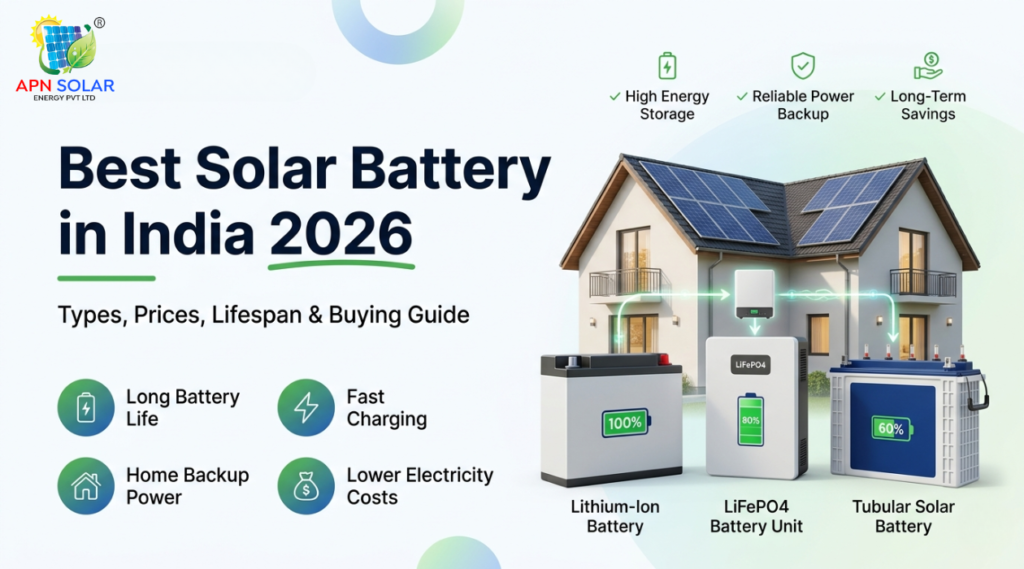
Solar battery storage allows homeowners and businesses to store excess solar energy generated during the day and use it when sunlight is unavailable. When comparing a lead acid battery vs lithium ion battery, the right choice depends on factors such as lifespan, efficiency, maintenance requirements, and long-term cost.
As solar adoption continues to grow across India, more homeowners are investing in battery storage solutions to maximize energy independence and reduce reliance on grid electricity. Whether you’re installing a new solar system or upgrading an existing one, choosing between a lithium ion solar battery and a lead acid solar battery can significantly impact your system’s performance and overall return on investment.
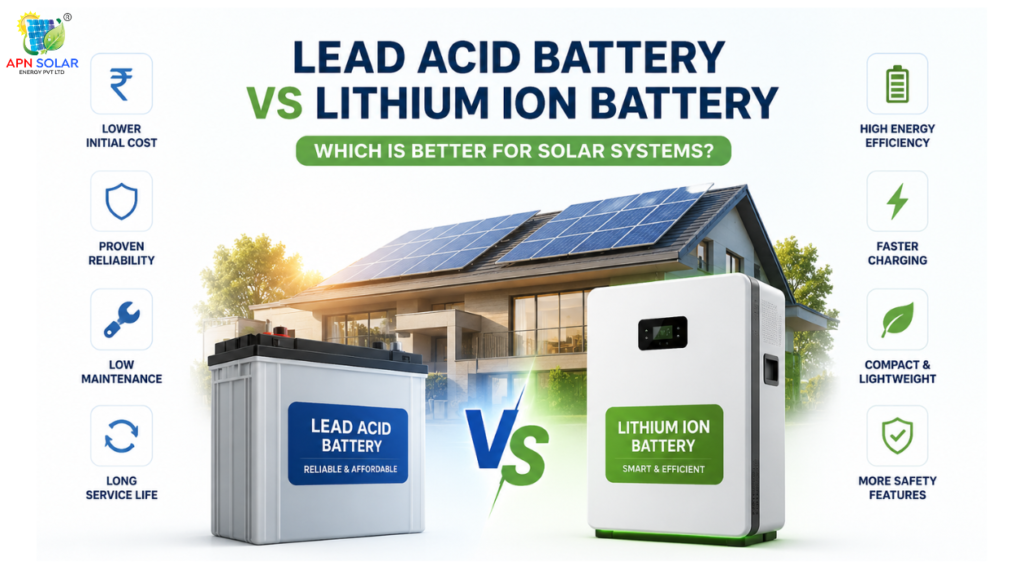
A lead-acid battery typically offers a lower upfront cost, while a lithium-ion battery provides higher efficiency, longer service life, and lower maintenance. However, the best solar battery for home use depends on your energy consumption patterns, backup requirements, available installation space, and budget.
At APN Solar, one of the most common questions from homeowners is whether lithium-ion or lead-acid batteries offer better value for long-term solar energy storage. In this guide, we’ll compare both battery technologies in detail to help you make an informed decision for your solar system.
Get Solar Battery Recommendation
Understanding Solar Batteries and Their Role in a Solar System
A solar battery is a device that stores excess electricity generated by solar panels for later use. It plays a crucial role in solar energy storage, allowing homes and businesses to use solar power even when sunlight is unavailable.
In a typical solar installation, solar panels often generate more electricity during the day than a property immediately consumes. Instead of sending all excess power back to the grid, a solar battery stores this surplus energy for use during the evening, at night, or during periods of low solar generation. This helps improve energy utilization and reduces dependence on conventional electricity sources.
One of the primary benefits of a solar power backup battery is providing uninterrupted power during grid outages. For homeowners in areas that experience frequent power cuts, battery storage can keep essential appliances such as lights, fans, refrigerators, and internet routers running when the grid is unavailable.
Solar batteries are especially important in off-grid solar systems, where they serve as the primary source of stored electricity. To understand how independent solar setups work in detail, you can explore the off-grid solar system guide. In hybrid solar systems, batteries work alongside the utility grid to provide greater energy security and flexibility.
When evaluating any battery technology, battery efficiency becomes a key factor. A more efficient battery stores and delivers a higher percentage of generated solar energy, helping maximize the overall performance and long-term value of a solar power system.
What Is a Lead Acid Solar Battery?
A lead acid solar battery is one of the most widely used energy storage solutions in solar power systems. It offers affordability and proven reliability, and manufacturers have used this technology for decades in residential, commercial, and industrial applications. When users compare a lead acid battery vs lithium ion battery, many still choose lead-acid batteries because of their lower upfront cost and easy availability in the market.
How Lead Acid Batteries Work
A lead-acid battery stores electricity through a chemical reaction between lead plates and a sulfuric acid electrolyte. During charging, electrical energy is converted into chemical energy and stored inside the battery. When power is required, the process reverses, converting the stored chemical energy back into usable electricity.
Most solar installations use a deep cycle battery design, which is specifically engineered to handle repeated charging and discharging cycles. This makes it suitable for storing solar energy generated throughout the day and supplying power when needed.
Types of Lead Acid Batteries
Common types of lead-acid batteries used in solar systems include:
- Flooded Lead Acid (FLA): Traditional batteries that require periodic maintenance and water refilling.
- Tubular Batteries: Popular in Indian solar installations due to their longer lifespan and improved durability.
- AGM (Absorbent Glass Mat) Batteries: Sealed batteries with lower maintenance requirements.
- Gel Batteries: Use a gel-based electrolyte and offer better performance in certain operating conditions.
Common Applications
Lead-acid batteries are commonly used in residential solar systems, small businesses, rural electrification projects, and budget-focused solar installations. Due to their lower initial investment, they remain a practical choice For users seeking reliable solar energy storage without the higher upfront cost associated with lithium-ion technology, many homeowners also compare options in the best solar battery in India guide to choose the right storage solution.
Get Solar Battery Recommendation
What Is a Lithium Ion Solar Battery?
A lithium ion solar battery is an advanced energy storage solution that stores excess solar electricity and delivers it when solar panels are not generating power. Due to their high battery efficiency, long lifespan, and low maintenance requirements, lithium-ion batteries have become the preferred choice for many modern solar installations.
How Lithium Ion Batteries Work
Lithium-ion batteries store energy by moving lithium ions between the positive and negative electrodes during charging and discharging cycles. When solar panels generate electricity, the battery stores this energy for later use. During periods of low solar production or power outages, the stored energy is released to power appliances and electrical loads.
Compared to traditional lead-acid batteries, a lithium battery for solar system applications can utilize a larger percentage of its stored capacity while maintaining consistent performance over thousands of charging cycles.
Battery Management System (BMS)
One of the key advantages of lithium-ion technology is the integrated Battery Management System (BMS). This intelligent electronic system continuously monitors voltage, temperature, charging, and discharging conditions to optimize performance and enhance safety. The BMS also helps prevent overcharging, deep discharge, overheating, and other issues that could affect battery life.
Why Lithium Batteries Are Becoming Popular
Lithium-ion batteries dominate modern solar installations because they offer faster charging, higher efficiency, longer operational life, and greater usable capacity than conventional battery technologies. Most quality lithium batteries can last 10–15 years or more, depending on usage patterns and operating conditions.
Their compact design requires less installation space, making them ideal for residential rooftops and commercial properties where space is limited. These advantages are often preferred in modern hybrid solar system guide setups that combine grid and battery storage. Additionally, their maintenance-free operation eliminates the need for regular water topping or routine servicing, making them a convenient long-term solution for solar energy storage.
Lead Acid Battery vs Lithium Ion Battery: Quick Comparison Table
The key difference between a lead acid battery vs lithium ion battery is that lithium-ion batteries offer higher efficiency, longer lifespan, and lower maintenance, while lead-acid batteries have a lower upfront cost. This table provides a quick comparison of the most important factors homeowners and businesses should consider before choosing a solar battery. To better understand system sizing and energy requirements, you can also refer to the on-grid vs off-grid solar system guide.
| Parameter | Lead Acid Battery | Lithium Ion Battery |
| Lifespan | 3–7 Years | 10–15+ Years |
| Battery Efficiency | 70–85% | 90–98% |
| Charging Speed | Slower Charging | Faster Charging |
| Maintenance | Regular Maintenance Required | Virtually Maintenance-Free |
| Weight | Heavier | Lighter |
| Space Requirement | Requires More Space | Compact Design |
| Depth of Discharge (DoD) | Typically 50% | Typically 80–100% |
| Initial Cost | Lower | Higher |
| Long-Term Cost | Higher Due to Replacements and Maintenance | Lower Due to Longer Lifespan |
| Warranty | Generally 2–5 Years | Generally 5–10 Years |
While lead-acid batteries remain a cost-effective option for budget-conscious solar installations, lithium-ion batteries generally provide better long-term value through higher energy utilization, longer service life, and reduced maintenance requirements. Actual performance, pricing, and warranty terms may vary depending on the battery brand, capacity, and installation conditions.
Get Solar Battery Recommendation
Difference Between Lead Acid Battery and Lithium Ion Battery
The difference between lead acid battery and lithium ion battery goes beyond just price. Factors such as lifespan, efficiency, usable capacity, maintenance requirements, and long-term operating costs significantly impact the overall performance of a solar energy storage system. Understanding these differences can help homeowners choose the right battery for their energy needs.
Lifespan Comparison
One of the biggest differences between battery technologies is lifespan. A typical lead-acid battery lasts between 3 and 7 years, depending on usage patterns, maintenance, and operating conditions. Most lead-acid batteries deliver approximately 500–1,500 charge cycles before their performance begins to decline.
In comparison, lithium-ion batteries generally last 10–15 years or more and can provide 3,000–6,000+ charge cycles, depending on battery chemistry and usage. This means a lead-acid battery may need to be replaced multiple times during the lifespan of a single lithium-ion battery. For homeowners planning a long-term solar investment, this is a major factor when evaluating the difference between lead acid battery and lithium ion battery.
Efficiency Comparison
When comparing lead acid vs lithium ion, efficiency plays a crucial role in determining how much solar energy can actually be used.
Lead-acid batteries typically offer a round-trip efficiency of 70–85%, meaning some energy is lost during charging and discharging. Lithium-ion batteries generally achieve 90–98% efficiency, allowing a larger percentage of stored solar energy to be used by the home or business.
Higher efficiency improves solar energy utilization, reduces energy losses, and helps maximize the value of electricity generated by solar panels.
Depth of Discharge (DoD)
Depth of Discharge (DoD) refers to the percentage of a battery’s capacity that can be safely used without affecting its lifespan.
Most lead-acid batteries are recommended to operate at around 50% DoD, meaning only half of their rated capacity is regularly usable. Lithium-ion batteries typically support 80–100% DoD, providing significantly more usable energy from the same battery size.
This higher usable capacity improves daily performance and reduces the amount of battery storage required for the same backup needs.
Charging Speed
Charging speed directly affects how quickly a battery can store available solar energy.
Lead-acid batteries generally require longer charging times and must be charged carefully to prevent overheating and excessive wear. Lithium-ion batteries accept higher charging currents and recharge much faster, making them more effective at capturing solar energy during limited sunlight hours.
During cloudy days or monsoon seasons, faster charging can help improve overall system performance by making better use of available solar generation.
Maintenance Requirements
Maintenance is another major area where battery technologies differ.
Lead-acid batteries, particularly flooded models, often require regular water topping, terminal cleaning, and periodic inspections to maintain performance and lifespan. Failure to perform these tasks can lead to reduced efficiency and premature battery failure.
Lithium-ion batteries are largely maintenance-free. Their sealed construction and built-in Battery Management System (BMS) automatically monitor performance, temperature, and charging conditions, eliminating the need for routine maintenance.
Weight and Space Requirements
Lithium-ion batteries have a much higher energy density than lead-acid batteries. As a result, they can store more energy while occupying less space and adding less weight.
Lead-acid battery banks often require larger installation areas, whereas lithium-ion systems provide greater flexibility for rooftop and space-constrained installations. This can be particularly beneficial in residential solar projects where installation space is limited.
Total Cost of Ownership
Although lead-acid batteries usually have a lower upfront purchase cost, total ownership costs should be evaluated over the battery’s entire lifespan.
Due to shorter lifespan, lower efficiency, and more frequent replacements, lead-acid batteries can incur higher long-term costs. Lithium-ion batteries require a larger initial investment but often deliver better lifetime value through longer service life, reduced maintenance, and higher energy utilization.
When comparing the difference between lithium ion and lead acid battery, focusing on lifetime performance rather than purchase price alone provides a more accurate assessment of overall value.
Get Solar Battery Recommendation
Advantages of Lead Acid Battery
The primary advantages of lead acid battery systems are their affordability, widespread availability, and long history of reliable performance in solar energy storage applications.
- Lower Upfront Cost: Lead-acid batteries typically cost less than lithium-ion alternatives, making them an attractive option for homeowners and businesses with limited budgets.
- Easy Availability: These batteries are widely available across India, making replacement, servicing, and procurement relatively simple in both urban and rural areas.
- Proven Technology: Lead-acid batteries have been used for decades in solar, automotive, and backup power applications, providing a well-established track record of reliability.
- Established Recycling Infrastructure: Lead-acid batteries have one of the most developed recycling networks in the energy storage industry, helping reduce waste and recover valuable materials.
- Suitable for Low-Budget Solar Setups: For users seeking basic backup power and lower initial investment, lead-acid batteries remain a practical choice for residential solar systems, small businesses, and rural solar installations.
While newer battery technologies offer several performance benefits, lead-acid batteries continue to be a viable option where affordability is the primary consideration.
Disadvantages of Lead Acid Battery
The main disadvantages of lead acid battery systems are their shorter lifespan, higher maintenance requirements, and lower overall efficiency compared to modern lithium-ion alternatives.
- Shorter Lifespan: Most lead-acid batteries last around 3–7 years, depending on usage and maintenance. This often results in more frequent replacements over the lifetime of a solar system.
- Regular Maintenance: Flooded lead-acid batteries require periodic water topping, terminal cleaning, and routine inspections to maintain optimal performance and prevent premature degradation.
- Lower Efficiency: With a typical round-trip efficiency of 70–85%, a portion of the stored solar energy is lost during charging and discharging cycles, reducing overall energy utilization.
- Larger Footprint: Due to their lower energy density, lead-acid batteries require more installation space to provide the same storage capacity as lithium-ion batteries.
- Slower Charging: Lead-acid batteries generally take longer to recharge, which can limit solar energy capture during shorter sunlight periods or cloudy weather conditions.
Over time, these limitations can affect system performance, increase maintenance efforts, and raise the overall cost of solar energy storage despite the lower initial purchase price.
Which Battery Is Better for Your Solar System?
When comparing a lead acid battery vs lithium ion battery, there is no one-size-fits-all answer. The best choice depends on your budget, energy consumption patterns, available installation space, and long-term goals. However, for most modern residential solar systems, a lithium ion solar battery typically offers better overall performance and lifetime value.
Choose a Lead Acid Battery If:
- Your budget is limited and minimizing upfront costs is a priority.
- Battery backup is used occasionally rather than every day.
- Adequate installation space is available.
- You are comfortable performing periodic battery maintenance.
- A lower initial investment is more important than long-term efficiency.
Choose a Lithium Ion Battery If:
- Daily battery charging and discharging is expected.
- Long-term savings and higher energy utilization are important.
- Installation space is limited.
- You prefer a maintenance-free energy storage solution.
- Higher efficiency and longer battery lifespan are priorities.
Based on practical solar installation experience, APN Solar generally recommends lithium-ion batteries for homeowners seeking reliable long-term performance, improved efficiency, and lower maintenance requirements. However, lead-acid batteries can still be a suitable option for budget-focused solar projects.
Final Verdict
| Best Choice For | Recommended Battery |
| Lowest Upfront Cost | Lead Acid Battery |
| Longest Lifespan | Lithium Ion Battery |
| Highest Efficiency | Lithium Ion Battery |
| Minimal Maintenance | Lithium Ion Battery |
| Limited Installation Space | Lithium Ion Battery |
| Budget-Focused Installations | Lead Acid Battery |
Overall: For most homeowners looking for the best solar battery for home use, a lithium-ion battery offers superior long-term value, while lead-acid batteries remain a practical option when upfront affordability is the primary concern.
Get Solar Battery Recommendation
Frequently Asked Questions (FAQs)
1. Which is better, a lead acid battery or a lithium ion battery for solar systems?
When comparing a lead acid battery vs lithium ion battery, lithium-ion batteries are generally the better option due to their higher efficiency, longer lifespan, faster charging, and lower maintenance requirements. However, lead-acid batteries can still be suitable for budget-conscious users seeking a lower upfront investment.
2. What is the difference between lead acid battery and lithium ion battery?
The primary difference between lead acid battery and lithium ion battery technologies is performance and longevity. Lithium-ion batteries offer higher efficiency, deeper discharge capability, faster charging, and a lifespan of 10–15 years, while lead-acid batteries are more affordable initially but typically last 3–7 years.
3. How long does a lithium ion solar battery last?
A quality lithium ion solar battery typically lasts between 10 and 15 years and can deliver 3,000–6,000 or more charge cycles. Actual lifespan depends on battery quality, depth of discharge, operating temperature, and usage patterns within the solar energy system.
4. What are the disadvantages of lead acid battery systems?
The main disadvantages of lead acid battery systems include shorter lifespan, lower efficiency, regular maintenance requirements, slower charging, and larger space requirements. These factors can increase long-term ownership costs and reduce the overall performance of a solar energy storage system.
5. Which battery is best for home solar systems in India?
For most homeowners, a lithium-ion battery is considered the best solar battery for home use because it provides higher efficiency, longer service life, faster charging, and maintenance-free operation. However, lead-acid batteries may still be a practical choice when upfront affordability is the primary concern.
6. Are lithium ion batteries worth the higher price for solar systems?
Yes, lithium-ion batteries are often worth the higher upfront cost because they offer longer lifespan, higher efficiency, faster charging, and lower maintenance. Although the initial investment is greater, many homeowners benefit from lower replacement costs and better long-term value over the battery’s lifetime.
7. Can a lead acid battery be replaced with a lithium ion battery in an existing solar system?
Yes, a lead-acid battery can be replaced with a lithium-ion battery in many solar systems, but compatibility must be checked first. The inverter and charge controller should support lithium charging settings, and the Battery Management System (BMS) must work properly with the system.