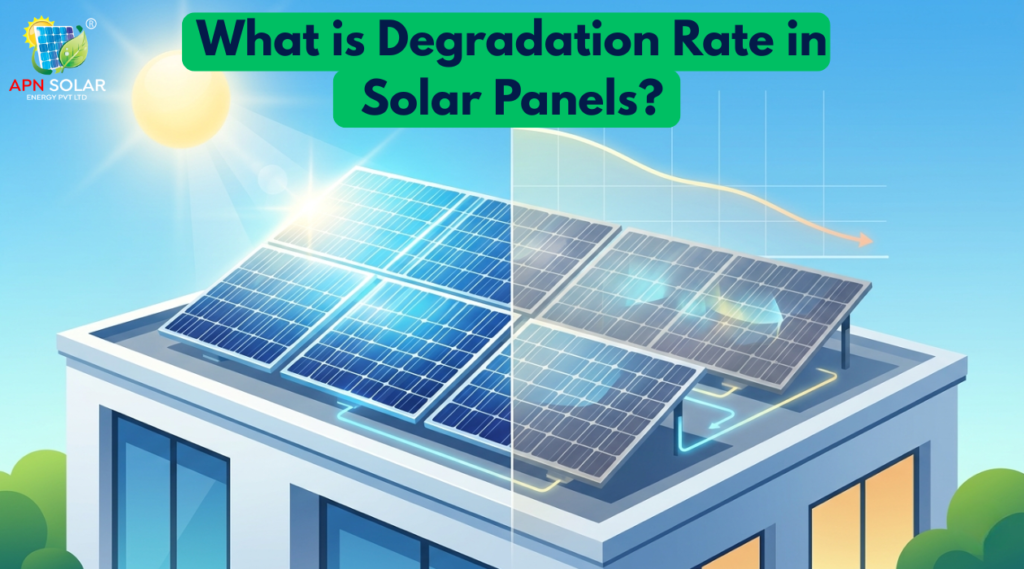
Solar panel degradation rate is the gradual reduction in a solar panel’s electricity generation capacity over time. On average, most panels experience a yearly efficiency decline of around 0.3% to 0.8%. This happens naturally because solar panels remain exposed to continuous sunlight, changing temperatures, humidity, dust, and varying weather conditions throughout their operational life. Although the efficiency drops slowly each year, this process is completely normal and expected in every solar energy system.
Despite this gradual performance decline, modern solar panels are built to deliver reliable power for nearly 25–30 years. Rather than failing suddenly, they continue producing electricity at slightly reduced efficiency levels over time. Even after decades of usage, most high-quality panels can still generate a substantial percentage of their original output, making solar energy a dependable and cost-effective long-term solution for homes and businesses.
Selecting premium-quality solar systems from reliable providers like APN Solar can help minimize degradation and maintain stronger long-term performance. Factors such as superior panel technology, proper installation practices, and the use of high-quality components contribute significantly to system durability and energy consistency. With the right setup and maintenance, users can achieve better efficiency, stable energy generation, and improved returns throughout the complete lifespan of their solar system.
What is Solar Panel Degradation Rate?
Solar panel degradation rate is the annual reduction in a solar panel’s energy output over time, typically ranging between 0.3% and 0.8% per year. It directly impacts the overall solar panel lifespan, determining how efficiently a system performs throughout its 25–30 year life cycle.
How Solar Panel Efficiency Reduces Over Time
Solar panels are exposed to continuous environmental stress, which gradually reduces their efficiency. Factors such as UV radiation, temperature fluctuations, and material aging cause a slow decline in power generation.
In practical terms:
- Year 1: Panels operate at ~100% efficiency
- Year 10: Efficiency drops to ~92–95%
- Year 25: Efficiency reduces to ~80–87%
This gradual decline is normal and already accounted for in most manufacturer warranties. A lower solar panel degradation rate means better long-term performance and higher energy output over the system’s lifetime.
Real-World Example of Performance Loss
Consider a 5 kW solar system installed on a residential property. With an average degradation rate of 0.5% per year:
- In the first year, it produces 100% of its expected output
- After 10 years, output reduces slightly but still remains above 90%
- After 25 years, the system continues to generate around 85% of its original capacity
This shows that while performance decreases gradually, a well-installed system still delivers significant energy over its entire solar panel lifespan, making solar a reliable long-term investment.
How Long Do Solar Panels Last?
Solar panels are built for long-term performance, but their output gradually declines over time due to natural degradation. Understanding how long do solar panels last helps homeowners and businesses make informed investment decisions.
Average Lifespan of Solar Panels (25–30 Years)
The typical lifetime of solar panels is around 25 to 30 years, which is considered the industry standard. During this period, panels continue to generate electricity efficiently, although their output slowly decreases due to degradation.
Most high-quality systems are designed to retain:
- Around 90–95% efficiency after 10 years
- Around 80–85% efficiency after 25 years
This means the life of solar panels is not about when they stop working, but how efficiently they perform over time.
Do Solar Panels Stop Working After 25 Years?
No, solar panels do not suddenly stop working after 25 years. Instead, they continue to produce electricity at a reduced efficiency level.
Even after their standard lifespan:
- Panels can still function for 30–40 years
- Output may drop below 80%, depending on quality and maintenance
This is why focusing on both lifetime of solar panels and degradation rate is essential when evaluating long-term performance.
Warranty vs Actual Solar Panel Lifespan
Solar panel warranties are often misunderstood. Most manufacturers provide two types of warranties:
- Product Warranty (10–15 years): Covers defects and manufacturing issues
- Performance Warranty (25 years): Guarantees a minimum efficiency level (usually ~80–85%)
In reality, the actual life of solar panels often exceeds the warranty period, especially when systems are installed correctly and maintained properly.
A well-executed solar panel installation plays a critical role in maximizing lifespan and performance. Poor installation can accelerate degradation, while professional setup ensures optimal energy output for decades.
Average Degradation Rate of Solar Panels
Understanding the average degradation rate is essential to evaluate long-term performance and returns. While often confused with the solar panel depreciation rate, degradation specifically refers to the physical decline in energy output, not financial value.
Industry Standard Degradation Rate (0.3%–0.8%)
Most modern solar panels degrade at an average rate of 0.3% to 0.8% per year, depending on quality and environmental conditions. This means the reduction in output is gradual and predictable.
- Premium panels: ~0.3%–0.5% annually
- Standard panels: ~0.5%–0.7% annually
- Lower-quality panels: 0.8% or higher
Although terms like solar depreciation rate or solar power depreciation rate are often used interchangeably, it’s important to note that degradation focuses purely on performance loss over time.
Premium vs Standard Solar Panels Performance
Not all solar panels perform the same over their lifespan. Higher-quality panels are engineered with better materials and advanced cell technology, resulting in slower degradation.
- Premium panels: Higher efficiency retention, better durability
- Standard panels: Moderate performance decline over time
The difference in technology becomes clearer when comparing monocrystalline vs polycrystalline solar panels, as monocrystalline panels generally have lower degradation rates and better long-term efficiency.
Choosing the right panel type directly impacts how much energy your system will generate over 25+ years.
25-Year Output Comparison of Solar Panels
To understand the real impact of degradation, consider how output changes over time:
- Year 1: ~100% output
- Year 10: ~92–95% output
- Year 25: ~80–87% output
For example, a system with a 0.4% annual degradation rate will produce significantly more electricity over its lifetime compared to a system degrading at 0.8%.
This long-term difference highlights why focusing on degradation not just the solar panel depreciation rate is crucial when evaluating solar investments.
Factors That Affect Solar Panel Degradation
The life of solar panels depends not just on manufacturing quality but also on real-world environmental and installation factors. While degradation is inevitable, understanding these factors and maintaining your system properly can significantly slow down performance loss.
UV Radiation and Sun Exposure
Solar panels are constantly exposed to sunlight, which is essential for energy generation but also contributes to material wear over time. Prolonged UV exposure can gradually break down the protective layers and internal components, leading to a slow decline in efficiency.
High-quality panels are designed with UV-resistant materials, which helps reduce long-term degradation.
Temperature Changes and Thermal Stress
Frequent heating during the day and cooling at night creates thermal stress on solar panels. This continuous expansion and contraction can cause micro-cracks in solar cells.
Over time:
- Micro-cracks reduce energy flow
- Efficiency drops gradually
- Overall performance declines
Regions with extreme temperature variations may experience slightly faster degradation.
Dust, Pollution, and Environmental Impact
Dust accumulation, bird droppings, and air pollution can block sunlight from reaching the panel surface, directly affecting energy output.
Regular solar panel maintenance, especially cleaning, plays a crucial role in minimizing this impact. Following proper methods like how to clean solar panels ensures panels operate at optimal efficiency and prevents long-term performance loss.
Installation Quality and System Design
One of the most overlooked factors is installation quality. Poor system design or incorrect mounting can lead to:
- Improper tilt or orientation
- Shading issues
- Water accumulation
- Loose connections
All these factors can accelerate degradation and reduce the overall life of solar panels. A professionally installed system ensures balanced load distribution and optimal sunlight exposure.
Solar Panel Material Quality
The materials used in manufacturing directly impact how well a panel resists degradation.
- Premium panels: Better encapsulation, slower degradation
- Standard panels: Moderate performance over time
- Low-quality panels: Faster efficiency loss
Investing in high-quality panels not only improves performance but also extends the effective life of solar panels, ensuring better long-term returns.
In summary, while degradation cannot be eliminated, proper solar panel maintenance, quality components, and expert installation can significantly slow it down and maximize system performance over decades.
Solar Panel Degradation vs Depreciation
Many users confuse solar panel degradation with depreciation, but they represent two completely different concepts. Understanding this distinction is important for evaluating both the technical performance and financial aspects of a solar system.
What is Solar Panel Degradation? (Performance Loss)
Solar panel degradation refers to the gradual reduction in energy output over time due to environmental exposure and material aging.
- Measured as a percentage loss per year (0.3%–0.8%)
- Directly affects electricity generation
- Impacts the overall efficiency and performance
In simple terms, degradation tells you how well your solar panels will perform over their lifespan.
What is Solar Panel Depreciation? (Financial Value Loss)
Solar panel depreciation refers to the reduction in the financial value of a solar system over time, mainly for accounting and tax purposes.
- Used in commercial and industrial projects
- Helps businesses claim tax benefits
- Based on accounting standards rather than performance
Terms like solar panel depreciation rate, solar plant depreciation rate, and depreciation rate on solar system are commonly used in this financial context.
Differences Between Degradation and Depreciation
| Factor | Degradation | Depreciation |
| Meaning | Loss of performance | Loss of financial value |
| Impact | Affects energy output | Affects accounting/tax value |
| Measurement | % efficiency loss per year | % value reduction per year |
| Relevance | Important for all users | Mainly for businesses |
This distinction is critical because a system may depreciate financially while still performing efficiently in real-world conditions.
When Depreciation Matters in Solar Projects
Depreciation becomes important primarily in commercial or large-scale solar projects, where financial planning and tax savings are key considerations.
- Businesses use depreciation to reduce taxable income
- It helps improve project ROI from an accounting perspective
- Commonly applied in solar plants and large installations
For homeowners, however, degradation is far more important than depreciation, as it directly impacts electricity generation and long-term savings.
While degradation affects how much power your system produces, depreciation affects how its value is recorded financially. Understanding both helps you make better technical and investment decisions.
Life of Solar Panels vs Life of a Solar Cell
Understanding the difference between a solar panel and a solar cell is important when evaluating durability and performance. While both degrade over time, the lifetime of solar panels is typically much longer due to system design and protective engineering.
What is a Solar Cell?
A solar cell is the basic unit that converts sunlight into electricity. Multiple solar cells are connected together to form a solar panel.
- Each panel contains dozens of cells
- Cells are made from semiconductor materials (usually silicon)
- They are responsible for actual energy generation
When people refer to performance decline, it often starts at the cell level, but the overall system behavior depends on the entire panel.
How Solar Cells Age Over Time
Like all semiconductor devices, solar cells gradually lose efficiency due to environmental exposure and internal material changes.
The life of a solar cell is generally affected by:
- Continuous sunlight (UV exposure)
- Thermal stress (heating and cooling cycles)
- Micro-cracks and material fatigue
Over time:
- Individual cells produce slightly less power
- Minor defects can develop
- Efficiency declines gradually
However, this degradation is slow and controlled, which is why solar technology remains reliable over decades.
Why Solar Panels Last Longer Than Cells
Even though individual cells degrade, the overall lifetime of solar panels remains significantly longer because of how panels are engineered.
- Panels are protected with glass and encapsulation layers
- Multiple cells work together, balancing output
- System design compensates for minor cell-level losses
This means:
- A few weaker cells don’t significantly impact total output
- Panels continue functioning efficiently even with minor degradation
In simple terms, while solar cells are the building blocks, it’s the panel-level design and protection that ensures a long lifetime of solar panels, often exceeding 25–30 years.
How to Increase Solar Panel Lifespan
The life of solar panels is not fixed it depends heavily on how well the system is installed, maintained, and managed over time. While most panels are designed to last 25–30 years, real-world performance can vary significantly. With the right approach, it is possible to slow down degradation and maintain higher efficiency for a longer duration.
Importance of Regular Solar Panel Maintenance
Consistent solar panel maintenance is one of the most critical factors in extending system lifespan. Over time, small issues such as loose connections, minor shading, or dirt accumulation can go unnoticed but gradually reduce energy output.
Regular inspections help identify these issues early before they impact long-term performance. In real-world installations, systems that are periodically checked and serviced tend to maintain better efficiency compared to those that are ignored after installation. Maintenance is not just about cleaning it also includes checking wiring, inverter performance, and structural stability.
Proper Cleaning and Dust Removal
Environmental factors like dust, pollution, bird droppings, and leaves can significantly affect how much sunlight reaches the panel surface. Even a thin layer of dust can reduce output over time, especially in areas with high pollution or dry climates.
Cleaning panels at regular intervals ensures that they receive maximum sunlight exposure. However, the method of cleaning is equally important. Using improper tools or harsh chemicals can damage the protective glass layer, which may accelerate degradation instead of preventing it. This is why following proper methods like best solar panels for Indian homes often emphasizes maintenance compatibility along with performance.
Importance of Correct Installation
Installation quality is often underestimated, but it has a long-term impact on both performance and durability. A poorly installed system can face issues such as improper tilt, shading losses, water accumulation, or mechanical stress.
A well-designed installation ensures:
- Optimal angle for sunlight exposure
- Proper airflow to reduce heat buildup
- Strong mounting to withstand environmental stress
Over time, these factors directly influence the life of solar panels. Even high-quality panels can underperform or degrade faster if the installation is not done correctly.
Performance Monitoring Systems
Modern solar systems are often equipped with monitoring tools that track real-time energy generation. These systems provide valuable insights into how your panels are performing daily, monthly, and yearly.
Monitoring helps in identifying:
- Sudden drops in performance
- Faulty components
- Shading or obstruction issues
Early detection of performance issues allows for quick corrective action, preventing long-term damage. This proactive approach plays a key role in maintaining system efficiency and reducing unnecessary degradation.
Choosing High-Quality Solar Panels
The type and quality of solar panels you choose have a direct impact on how well they perform over time. Panels built with better materials and advanced technology tend to degrade more slowly and maintain higher efficiency.
Understanding different types of solar panels is essential when selecting a system, as each type offers varying levels of performance, durability, and resistance to environmental stress. Higher-quality panels not only provide better output but also ensure more stable performance across decades.
Investing in premium panels may have a slightly higher upfront cost, but it significantly improves long-term returns by reducing performance loss and extending the overall life of solar panels.
Why Solar Panel Degradation Rate Matters for ROI
The solar panel degradation rate is not just a technical specification it has a direct impact on the financial returns of a solar system. Over time, even small efficiency losses influence total electricity production, making it an important factor when calculating long-term ROI and overall system value. Understanding this helps homeowners and businesses evaluate the true benefits of the solar panel lifespan beyond just installation cost.
Impact on Long-Term Electricity Generation
Solar panels are designed to operate for 25–30 years, but their output gradually declines each year due to degradation. This reduction in efficiency means that the total electricity generated over the system’s lifetime is lower than the initial output.
Even though the annual loss is small (typically 0.3%–0.8%), it accumulates over decades. A system that starts strong in the first few years will still perform reliably later, but with slightly reduced generation capacity. This long-term decline directly influences how much energy a system can produce over its full solar panel lifespan, making degradation a key factor in energy forecasting.
Effect on Payback Period
The payback period of a solar system depends on how quickly the investment is recovered through electricity savings. A lower degradation rate ensures higher energy output for a longer time, which directly improves cash flow from savings.
On the other hand, higher degradation slightly reduces yearly savings, which can extend the time required to recover the initial investment. While the difference may not be dramatic in the short term, over several years it becomes a significant factor in financial planning especially for large installations where solar power depreciation rate considerations are also evaluated alongside performance.
Savings Difference Over 25 Years
When evaluated over a full 25-year cycle, even small differences in degradation rates can lead to a noticeable gap in total savings. For example, a system with a lower degradation rate will consistently generate more electricity year after year compared to a system with faster performance decline.
This means:
- Higher lifetime energy output
- Greater total electricity bill savings
- Better long-term return on investment
Over decades, these incremental differences compound significantly, making degradation one of the most important hidden factors in determining the real financial benefit of solar adoption.
Expert Insights on Solar Panel Performance
Solar panel performance is not only defined by specifications on paper but also by how systems behave in real-world conditions over decades. To accurately understand the solar panel lifespan, it is important to look at industry benchmarks, testing standards, and installation quality factors that directly influence long-term output and reliability.
Industry Standards for Solar Panel Lifespan
Globally, solar panels are designed and tested based on strict industry standards such as IEC certification and long-term performance testing protocols. Most manufacturers guarantee a standard solar panel lifespan of 25 to 30 years, with performance warranties ensuring that panels still operate at around 80–85% efficiency at the end of this period.
These benchmarks are based on controlled testing conditions, which assume optimal installation and ideal environmental exposure. However, they serve as a reliable baseline for evaluating long-term system durability and expected degradation behavior across different climates.
Real-World vs Laboratory Performance
While laboratory tests provide standardized performance expectations, real-world conditions often vary. Factors such as high temperatures, dust accumulation, humidity, and inconsistent maintenance can slightly alter performance compared to controlled environments.
In real-world installations, the solar panel degradation rate may vary depending on location and usage conditions. For example, systems installed in high-heat or dusty regions may experience slightly faster efficiency decline compared to those in moderate climates. This gap between lab performance and field performance is why real-world monitoring is essential for accurate energy forecasting.
Why Installation Quality Matters
Even the highest-quality solar panels can underperform if the installation is not done correctly. Installation quality directly affects tilt angle, shading exposure, ventilation, and system safety all of which influence long-term efficiency.
Improper installation can lead to:
- Uneven energy generation due to shading losses
- Increased thermal stress due to poor airflow
- Mechanical strain on mounting structures
These issues gradually increase degradation and reduce the effective solar panel lifespan. This is why professional installation is critical for ensuring that systems perform close to their rated specifications over time.
Importance of Choosing Trusted Solar Providers
Selecting a reliable solar provider plays a major role in ensuring long-term system performance and durability. Trusted companies not only supply high-quality components but also ensure proper system design, installation standards, and after-sales support.
For example, best solar company in India like APN Solar focus on end-to-end quality from system design to execution which helps minimize early performance losses and ensures better long-term output stability.
In the long run, choosing an experienced provider significantly reduces risks related to poor installation, substandard materials, and inefficient system design, all of which directly impact the solar panel lifespan and overall return on investment.
Conclusion
The solar panel degradation rate plays a crucial role in understanding the long-term performance of a solar energy system. Although solar panels are designed with a typical solar panel lifespan of 25–30 years, their efficiency gradually decreases at an average rate of 0.3%–0.8% per year. This slow and predictable decline affects total energy generation over time but does not stop the system from producing electricity. Instead, it helps set realistic expectations for long-term performance and savings.
However, degradation can be effectively managed through proper solar panel maintenance, high-quality components, and correct installation practices. While it cannot be completely avoided, its impact can be significantly reduced, ensuring stable performance throughout the system’s lifetime. This is why understanding degradation is essential for making informed decisions and maximizing the long-term benefits of solar energy investments.
Frequently Asked Questions
1. What is solar panel degradation rate?
Solar panel degradation rate is the gradual yearly reduction in a solar panel’s energy output, typically ranging from 0.3% to 0.8% per year. It explains how much efficiency a panel loses over time while still operating throughout its solar panel lifespan of 25–30 years.
2. How long do solar panels last?
Solar panels generally last 25 to 30 years. Even after this period, they continue generating electricity but at reduced efficiency due to natural degradation over time. Proper installation and maintenance can extend their effective performance life.
3. What is average solar panel lifespan?
The average solar panel lifespan is around 25–30 years, depending on panel quality, environmental conditions, and maintenance practices. High-quality panels can often perform efficiently even beyond this range with gradual output reduction.
4. Do solar panels lose efficiency over time?
Yes, solar panels gradually lose efficiency over time due to natural wear and environmental exposure. This process is known as degradation and typically occurs at a rate of 0.3%–0.8% annually, depending on the quality of the system.
5. What affects solar panel degradation?
Solar panel degradation is influenced by several factors including UV exposure, temperature changes, dust accumulation, installation quality, and material durability. Regular solar panel maintenance can help slow down performance loss over time.
6. What is solar panel depreciation rate?
Solar panel depreciation rate refers to the financial reduction in value of a solar system over time, mainly used in accounting and taxation. It is different from degradation, which measures physical performance loss rather than monetary value.
7. Can maintenance reduce solar panel degradation?
Yes, proper solar panel maintenance such as regular cleaning, inspections, and performance monitoring can help reduce efficiency loss. While degradation cannot be fully stopped, maintenance significantly slows down performance decline and improves long-term output.