
Choosing the right metering policy is one of the most important decisions when installing a rooftop solar system in India. The way your electricity is billed whether through net metering or gross metering directly affects your monthly savings, tariff rate, ROI, and payback period. As India updates its renewable energy policies in 2026, understanding the difference between these two mechanisms has become essential for both homeowners and businesses planning to switch to solar.
This guide explains how both metering systems work, which one offers better savings, and how your solar system size and panel capacity influence your electricity billing. At APN Solar, we help customers across India choose the right metering policy based on their energy consumption pattern, rooftop size, and state regulations to ensure maximum savings and a smoother installation experience.
By the end of this 2026 guide, you’ll have a clear understanding of whether net metering or gross metering is the best choice for your solar setup, enabling you to make an informed and cost-effective decision.
What Is Net Metering in India? (Net Metering Explained)
Net metering is the most popular billing mechanism for residential rooftop solar systems in India. Under this policy, the electricity generated by your solar panels is first used to power your home. Any excess solar energy is exported to the grid, and you receive a credit on your monthly electricity bill.
In simple terms, net metering allows homeowners to offset their electricity consumption with the solar power they generate, helping them reduce monthly bills and maximize savings. The policy is available in most Indian states and is updated frequently as solar adoption increases.
How Net Metering Works for Home Solar Users
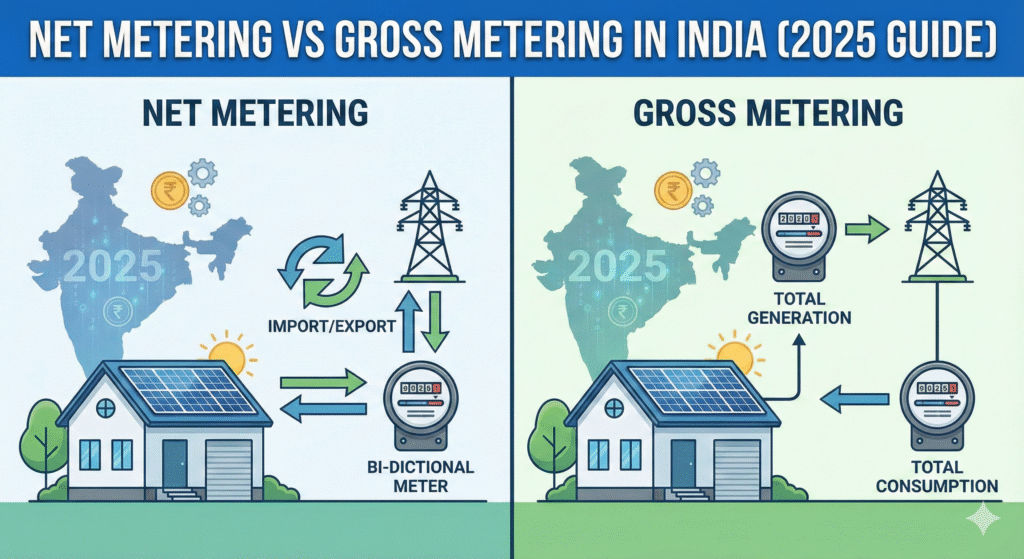
Net metering works through a bi-directional meter installed by your DISCOM. This meter tracks two things:
- Units imported from the grid
- Units exported from your rooftop solar system
Your final monthly bill is calculated as:
Net Bill = Total Grid Consumption – Solar Energy Exported
If your solar system generates more energy than your home uses during the day, the extra units become credits. These credits are automatically adjusted in the next billing cycle.
Because of this offset system, net metering is highly effective for homes with:
- regular daytime usage
- 1 kW to 10 kW rooftop solar systems
- stable grid connection
This is why many installers including APN Solar recommend net metering for most residential customers.
Benefits of Net Metering for Residential Solar Systems
Net metering offers multiple financial and operational benefits for homeowners:
- Higher Monthly Savings: You only pay for the net units consumed, which significantly reduces electricity bills.
- Faster Payback Period: Homes typically achieve solar payback in 3–5 years, depending on system size and state tariff.
- Ideal for 1 kW–10 kW Rooftop Systems: Combines well with residential load patterns and rooftop area.
- Encourages Optimal Use of Solar Generation: You don’t lose excess energy every exported unit is credited.
- Works Seamlessly With Solar Panel Calculators : When homeowners use tools like a solar panel calculator, solar rooftop calculator, or solar panel requirement calculator, net metering ensures the estimated savings reflect real billing outcomes.
Who Should Choose Net Metering in 2026
Net metering is the best choice for:
- Homeowners with moderate to high electricity consumption
- Buildings using 100–800 units per month
- Rooftop systems sized between 1 kW and 10 kW
- Homes wanting maximum savings and shorter payback
- Users planning to estimate their solar requirement using tools (solar panel calculator, solar rooftop calculator, etc.)
It is ideal if your goal is to:
- reduce monthly bills
- utilize most of your solar power
- recover your investment quickly
- offset 100% of daytime energy usage
For most Indian homes in 2026, net metering remains the most financially beneficial billing policy.
What Is Gross Metering in India? (Gross Metering Explained)
Gross metering is a billing mechanism where all the electricity generated by your rooftop solar system is exported directly to the grid, and you earn a fixed feed-in tariff per unit. Unlike net metering, you do not consume your own solar power; instead, you sell 100% of it to the DISCOM.
This model is commonly used by commercial, industrial, and institutional solar producers who install larger systems and prefer predictable monthly revenue instead of bill reductions. In 2026, gross metering continues to be promoted for non-residential installations in several Indian states.
How Gross Metering Works for Rooftop Solar Producers
Under gross metering, a dedicated solar generation meter is installed to measure the total units produced by your system. These units are sold to the grid at a pre-decided feed-in tariff (FIT), usually set by the state electricity regulatory commission (SERC).
Here’s how it works:
- Your solar system exports 100% of generated electricity to the grid.
- You receive payment for every exported unit at the fixed FIT.
- Your building continues to draw electricity from the grid at the normal consumer tariff.
- Monthly settlement is done separately for:
- Solar generation exported (earning)
- Electricity consumed from grid (billing)
This means:
Solar generation = income source
Grid consumption = regular bill
Gross metering is ideal for solar producers who want consistent cash flow rather than offsetting their electricity bill.
Benefits of Gross Metering for Commercial and Industrial Solar
Guaranteed Monthly Revenue
Since you earn a fixed rate for each exported unit, cash flow becomes predictable — ideal for businesses needing consistent returns.
- Ideal for Large Solar System Sizes (20 kW – MW scale): Commercial and industrial rooftops often have high generation potential; gross metering helps monetize every unit.
- No Need to Match Consumption With Generation: Even if the facility is closed or uses less electricity during the daytime, the solar plant continues generating revenue.
- Supports CAPEX and OPEX Solar Models: Gross metering works well with long-term investment models, especially when businesses want assured income from solar energy.
- Suitable When Grid Tariff Is Lower Than FIT: If the feed-in tariff is higher or equal to your cost of electricity, gross metering provides superior returns.
Who Should Choose Gross Metering in 2026?
Gross metering is the best choice for:
- Commercial buildings, factories, warehouses, schools, and offices
- Users installing systems above 20 kW
- Businesses wanting steady monthly income rather than bill reduction
- Institutions with low daytime consumption
- Solar producers whose FITs are higher than their consumption tariff
- Clients planning CAPEX or OPEX solar investment for long-term ROI
In 2026, gross metering continues to be the preferred policy for large rooftop solar producers, especially in states that promote industrial solar adoption.
If you’re unsure whether your system should use net metering or gross metering, APN Solar helps evaluate your load profile, rooftop size, and local tariff regulations to recommend the most financially beneficial option.
Net Metering vs Gross Metering in India
Understanding the difference between net metering and gross metering is essential before choosing the right billing policy for your rooftop solar system. Both mechanisms impact how your solar power is measured, how your electricity bill is calculated, and how much financial benefit you receive.
Here is a clear and simple comparison of the two models as implemented in India’s 2026 solar policy framework.
Difference in Metering Mechanism
Net Metering Mechanism
- Uses a bi-directional meter.
- Measures both import and export of electricity.
- You consume your own solar power first; only excess energy is exported.
- Monthly bill = Units consumed – Units exported.
Gross Metering Mechanism
- Uses a solar generation meter.
- Measures only the total solar energy generated.
- 100% of solar electricity is exported to the grid.
- You do not consume your own solar power.
- You earn money based on a feed-in tariff (FIT).
Summary:
Net metering prioritizes self-consumption, while gross metering prioritizes solar energy sales to the grid.
Difference in Tariff & Billing Method
Net Metering Tariff & Billing
- You offset your electricity bill using exported energy credits.
- You are billed based on the net units consumed from the grid.
- Savings depend on your consumer tariff (typically ₹6–₹10 per unit).
Gross Metering Tariff & Billing
- You receive payment for all solar units at a state-approved feed-in tariff (₹2.2–₹4.5 per unit in many states).
- Grid consumption is billed separately at your normal tariff.
- No offset system billing and earnings happen independently.
Summary:
Net metering reduces your grid electricity bill directly.
Gross metering gives you income, but you still pay full tariff for your consumption.
Difference in Savings, Payback & ROI
Net Metering ROI for Homes
- Highest savings for residential users.
- Typical payback: 3–5 years for 2–10 kW systems.
- Saves ₹1,000–₹7,000 per month depending on consumption.
- Works well with solar system size calculators and solar panel requirement calculators, giving accurate bill-offset predictions.
Gross Metering ROI for Businesses
- Best for commercial users with large rooftops.
- Typical payback: 4–7 years, depending on FIT rate.
- Monthly income becomes predictable because every unit is sold.
- ROI depends on the difference between FIT vs commercial tariff.
Summary:
Homes get better ROI through net metering (bill savings).
Businesses get stable revenue through gross metering (income model).
Which Policy Gives Higher Financial Benefit?
Net Metering → Best for Homes
- Residential tariffs are high.
- Offsetting your bill gives significantly higher value per unit compared to earning FIT.
- Ideal for 1 kW–10 kW systems.
Gross Metering → Best for Commercial & Industrial Users
- Commercial consumers often pay lower tariffs than FIT rates.
- Large rooftops (20 kW–MW scale) can earn predictable income.
- Ideal when daytime consumption is low.
What APN Solar Recommends
- Net Metering → for homeowners who want to reduce electricity bills and achieve faster payback.
- Gross Metering → for businesses seeking long-term solar revenue, especially in states offering attractive feed-in tariffs.
How Net Metering and Gross Metering Impact Solar System Size (solar system size & solar panel requirement)
Your choice between net metering and gross metering directly influences the ideal solar system size, the number of panels required, and how you calculate the total solar capacity for your home or business.
- Net metering encourages sizing your system based on actual household consumption, because the goal is to offset monthly electricity usage.
- Gross metering allows you to size systems larger because all generated energy is sold to the grid, making generation not consumption the priority.
To choose the right configuration, you must understand solar system size, solar panel requirement, area per kW solar panels, and total panel capacity.
How to Calculate Solar System Size for Your Home
To calculate the right solar system size for your home, start by understanding your monthly electricity consumption and how much of it you want to offset using solar.
Step 1: Identify Monthly Consumption
Check your electricity bill to find the average monthly units (kWh).
Example:
If your home uses 300 units/month, you generally need a 2–3 kW solar system.
Step 2: How Much kW Is Required for Home?
General estimation:
- 1 kW solar system = 4 units/day = 120 units/month
Formula:
Solar system size (kW) = Monthly units ÷ 120
Step 3: How Many Solar Panels Required for 1 kW?
A standard Indian rooftop uses 550W–600W solar panels.
Approximate calculation:
- 1 kW = 2 solar panels (550–600W each)
- 2 kW = 4 panels
- 3 kW = 6 panels
- 5 kW = 9–10 panels
Net vs Gross Metering Impact on System Size
- Net Metering: Size based on your home’s electricity needs, usually 1–10 kW.
- Gross Metering: You can install a larger system (10 kW–100 kW or more), as the target is selling maximum units to earn revenue.
APN Solar helps customers compute the ideal system size based on tariff, load profile, and metering policy.
Tools You Can Use: Solar Panel Calculator & Rooftop Calculator
Several online tools simplify the process of estimating your solar requirements:
1. Solar Panel Calculator
Allows you to input:
- your monthly consumption,
- number of appliances,
- average sunlight,
to instantly calculate your ideal solar panel requirement and system size.
2. Home Solar Calculator
Gives detailed recommendations for:
- how much kW required for home,
- total rooftop area needed,
- expected monthly savings under net metering,
- solar generation per day.
3. Solar Rooftop Calculator (Government)
The MNRE rooftop calculator helps you estimate:
- solar system size based on space,
- subsidy eligibility,
- net metering credits or gross metering earnings.
How Metering Affects Calculator Results
- Under net metering, the calculators estimate bill offset.
- Under gross metering, they calculate monthly earnings based on feed-in tariff.
These tools ensure accurate planning before installation.
Using Solar Panel Capacity & Area Per kW to Estimate Requirements
To understand the physical and technical needs of a solar system, you must consider panel capacity, area requirements, and system layout.
1. Understanding Solar Panel Capacity
- Most modern monocrystalline panels have capacity of 550W–600W.
- Higher capacity means:
- fewer panels required
- less rooftop area
- improved efficiency
2. Area Per kW Solar Panels
Approximate rooftop space needed:
- 1 kW = 80–100 sq. ft.
- 3 kW = 240–300 sq. ft.
- 5 kW = 400–500 sq. ft.
3. Solar Panel Size Per kW
Typical requirement:
- 1 kW system = 2 large panels (550W each)
- 5 kW system = 9–10 panels
4. How to Calculate Solar Panel Requirement
Use this formula:
Number of Panels = System Size (W) ÷ Solar Panel Capacity (W)
Example:
For a 3 kW system using 550W panels:
3000W ÷ 550W ≈ 6 panels
Metering Impact on Panel Requirement
- Net Metering: You only install enough panels to offset your actual usage.
- Gross Metering: You can scale up panel capacity significantly because all generation earns revenue.
APN Solar evaluates rooftop area, shadow analysis, and panel capacity to recommend the most cost-effective system size.
Solar Billing & Tariff Policies in India (2026 Update)
India’s solar billing framework continues to evolve in 2026 as DISCOMs streamline net metering, gross metering, and behind-the-meter billing for residential and commercial consumers. Most states now prioritise rooftop solar adoption but follow different caps, tariffs, and eligibility rules. Understanding how your state calculates solar credits, export rates, and final bills is crucial before installing a system. The following sections simplify the updated policies for homeowners and businesses.
State-Wise Net Metering Eligibility Overview
Net metering eligibility differs widely across Indian states, especially for system size limits and consumer categories.
Here’s a simplified 2026 overview:
- Maharashtra: Net metering allowed up to 500 kW for residential; behind-the-meter for commercial.
- Gujarat: Net metering up to 1 MW for all consumers; one of the most solar-friendly states.
- Delhi: Net metering permitted up to 500 kW; fast approval timelines.
- Karnataka: Allows net metering up to 10 kW for residential, above which gross metering applies.
- Tamil Nadu: Net metering for up to 10 kW residential; LT commercial mostly on gross metering.
- Rajasthan: Net metering allowed up to 500 kW across consumer categories.
- Uttar Pradesh: Net metering up to 500 kW, with additional feeder limitations.
- Haryana: Highly supportive; net metering up to 500 kW.
- Punjab: Net metering permitted up to 1 MW.
Tip: Always confirm with your local DISCOM because sanctions depend on approved load, transformer capacity, and feeder availability.
Tariff Rates for Net vs Gross Metering (2026)
Under 2026 policies, tariff rates are determined by whether a consumer uses net metering (credit-based) or gross metering (export-only). Here’s a simplified comparison:
Net Metering Tariffs
- You pay for imported units from the grid.
- You earn credits for exported surplus energy at the retail tariff or as per DISCOM policy.
- Credits are adjusted in your monthly bill; surplus may carry forward for 1–3 months (varies by state).
- Ideal for homes and small businesses aiming to reduce electricity bills.
Gross Metering Tariffs
- All solar energy is exported to the grid.
- DISCOM pays a fixed feed-in tariff, usually ₹2.20 – ₹3.80/kWh depending on the state.
- You still pay the standard electricity bill for your consumption.
- Suitable for institutions, large rooftops, and areas where net metering caps are restricted.
How DISCOM Billing Works Under Each Policy
Billing Under Net Metering
Your monthly bill is based on:
- Imported units (grid consumption)
- Exported units (solar surplus)
- Net units = Imported – Exported
- Charges applied only on net energy, plus fixed charges.
If exports exceed imports, remaining units are carried forward as credits.
Billing Under Gross Metering
Under gross metering:
- All solar energy goes to the grid.
- DISCOM records total exported units separately.
- You receive a monthly payout/credit based on the fixed feed-in tariff.
- Your consumption bill remains unchanged, except for standard charges.
Real-World Example
- Home uses 300 units, solar exports 150 units
- Net Metering: Bill calculated on 150 units only.
- Gross Metering: You pay for all 300 units, but earn income for 150 units exported.
Financial Impact: Savings & Payback Comparison
The financial impact of net metering and gross metering varies significantly for homes and businesses. While net metering focuses on bill reduction, gross metering emphasizes energy export earnings. Understanding the difference helps you choose the policy that delivers the highest return on investment (ROI) in 2026.
Net Metering Payback Period for Homes
Net metering offers the fastest payback for residential rooftop solar systems in India. Because every unit generated offsets grid consumption, homeowners save directly on monthly bills. In most Indian states, a 3 kW–5 kW rooftop system achieves:
- Electricity bill reduction: 70%–90%
- Annual savings: ₹25,000–₹55,000 (state tariff dependent)
- Typical payback period: 3.5 to 5 years
- Lifetime ROI: 400%–500% over 25 years
Subsidies under PM-Suryodaya Yojana (if applicable) further reduce upfront cost, compressing payback to 2.5–3.5 years for eligible homes.
Gross Metering Payback for Businesses
Gross metering works differently, as businesses earn income by exporting all solar power to the grid. While savings are lower compared to net metering, businesses with large rooftops can benefit from predictable monthly revenue.
Typical 2026 financials for commercial & industrial consumers:
- Feed-in tariff: ₹2.20 – ₹3.80 per unit (state-wise)
- Annual export earnings: ₹1.5 lakh – ₹4 lakh for a 50 kW system
- Payback period: 6–9 years, depending on tariff rate and CAPEX
- Cash flow model: Monthly solar export credit + regular electricity bill
Gross metering becomes more attractive when:
- Tariff rates are high in your state
- You have large unused rooftop area
- You want a low-maintenance revenue stream rather than bill savings
Factors Affecting Solar ROI in 2026
Several technical, climatic, and policy-related elements impact ROI for both net and gross metering in 2026. Key factors include:
1. State Tariff & Metering Policy
Higher retail tariffs boost net metering savings, while higher feed-in tariffs improve gross metering income.
2. Solar System Size & Design
Accurate sizing improves generation. Oversizing reduces ROI; undersizing limits savings.
3. Solar Panel Efficiency & Technology
High-efficiency panels (PERC, TopCon, N-Type) generate more energy per sq. ft., improving long-term ROI.
4. Local Climate & Solar Irradiance
States like Rajasthan, Gujarat, and Karnataka deliver higher generation due to stronger sunlight.
5. Maintenance & Downtime
Dirty panels or inverter issues can reduce output by 10%–20%, affecting annual savings.
6. Government Subsidies & Net Metering Caps
Residential subsidies and favourable net metering policies significantly reduce payback time.
7. DISCOM Billing Structure
Fixed charges, wheeling charges (for C&I), and unit adjustments impact effective savings.
APN Solar’s Expertise in Net Metering & Gross Metering Installation
APN Solar is one of India’s leading solar EPC companies with deep expertise in designing, installing, and commissioning net metering and gross metering systems for homes, businesses, and industrial facilities. With certified engineers, state DISCOM coordination support, and 7+ years of on-ground experience, APN Solar ensures that every customer receives a system that meets policy compliance, safety standards, and maximum financial returns.
APN Solar also supports entrepreneurs through its solar franchise model, helping them deliver metering-compliant solar installations in their regions.
Why APN Solar Recommends Net Metering for Most Homes
APN Solar typically recommends net metering for residential customers because it delivers the highest savings, the fastest payback, and the simplest billing process for Indian households. Under net metering, every unit generated offsets your grid consumption—reducing electricity bills by up to 70–90%.
APN Solar’s team handles:
- Load assessment & solar system sizing
- Net metering application & documentation
- DISCOM approvals and meter installation
- Safety compliance and post-installation support
Their experience with state-wise net metering policies ensures that homeowners receive a smooth, hassle-free process with maximum financial benefit.
Gross Metering Support for Commercial Clients
For commercial and industrial customers, APN Solar provides specialised gross metering solutions, especially for businesses with high rooftop area but low daytime consumption. Gross metering helps organisations earn predictable income by exporting all solar power to the grid at state-approved feed-in tariffs.
APN Solar supports C&I clients with:
- Export-oriented plant design
- ROI-focused tariff selection
- High-efficiency solar panels for maximum generation
- Coordination with DISCOM for gross metering approvals
- Long-term O&M support for uninterrupted revenue
This approach ensures that commercial units get stable, long-term financial returns while maintaining compliance with 2026 metering regulations.
Frequently Asked Questions
1. What is the main difference between net metering and gross metering?
Net metering offsets your home’s electricity bills using solar power, while gross metering exports all solar energy to the grid for a fixed feed-in tariff. Net metering benefits homeowners; gross metering suits commercial and industrial setups.
2. Which is better for homes: net metering or gross metering?
For residential solar systems, net metering is better. It reduces monthly bills, shortens payback periods, and maximizes savings, making it ideal for homes with 1–10 kW rooftop solar systems in India.
3. How does solar system size affect net metering savings?
A properly sized solar system ensures maximum bill offset. Larger systems than needed may oversize cost, while undersized systems reduce savings. Use solar panel capacity and system size calculations to optimize net metering benefits.
4. Is gross metering mandatory in any Indian states?
Gross metering is not mandatory but is often applied for commercial and industrial systems exceeding net metering caps. State policies may require gross metering for rooftop solar above 10 kW–20 kW.
5. Can I use a solar panel calculator to estimate my metering benefits?
Yes. Tools like a solar panel requirement calculator, home solar calculator, or rooftop calculator help estimate energy generation, financial savings, and system size under net or gross metering policies.
6. How much kW is required for a house to benefit from net metering?
Typically, a 1–10 kW rooftop solar system suffices for Indian homes. Exact sizing depends on monthly electricity consumption, rooftop area, and the solar panel capacity used.
7. Does net metering work with subsidies in India?
Yes. Net metering combined with government subsidies (MNRE or state-level) lowers upfront investment, shortens payback periods, and increases overall savings for residential solar installations in India.

