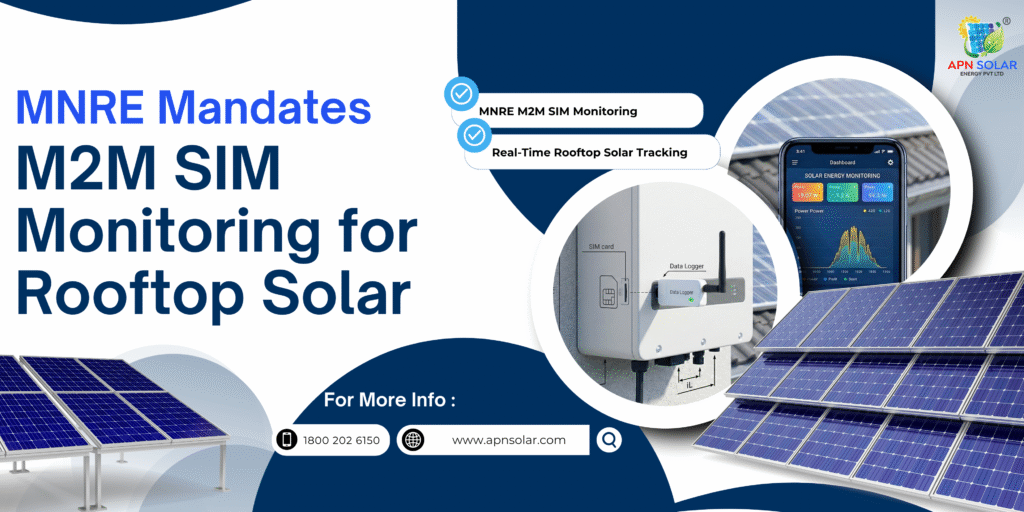
The MNRE M2M SIM mandate is a major MNRE solar policy update introduced under the PM Surya Ghar: Muft Bijli Yojana to strengthen transparency, performance monitoring, and subsidy governance across India’s rooftop solar ecosystem.
Under this mandate, the Ministry of New and Renewable Energy (MNRE) requires eligible rooftop solar systems to be equipped with M2M (Machine-to-Machine) SIM–based monitoring devices. These devices enable real-time tracking of solar generation data and system performance, which is automatically shared with MNRE and designated government platforms.
What MNRE Has Mandated
MNRE has made it compulsory to install M2M SIM-enabled monitoring hardware with rooftop solar systems sanctioned under the PM Surya Ghar scheme. The monitoring system must:
- Record real-time solar power generation
- Transmit data remotely via SIM connectivity
- Enable centralized government-level performance verification
This requirement applies at the system level, not as an optional add-on.
Who the Mandate Applies To
The MNRE M2M SIM mandate applies primarily to:
- Residential rooftop solar systems installed under PM Surya Ghar
- Systems seeking central government subsidies
- Approved vendors, EPC companies, and installers executing MNRE-compliant projects
Installations without compliant monitoring risk delays or rejection of subsidy claims.
Why This Mandate Matters Nationally
This MNRE solar policy update is designed to:
- Prevent false capacity claims and inactive systems
- Ensure subsidy funds are released only to operational plants
- Improve long-term data accuracy for India’s renewable energy planning
- Build trust in rooftop solar adoption at a national scale
By enforcing M2M-based monitoring, MNRE is shifting rooftop solar from a documentation-driven process to a data-verified, performance-based ecosystem, aligning with India’s 2030 renewable energy targets.
What Is M2M SIM-Based Monitoring in Rooftop Solar?
M2M SIM–based solar monitoring is an advanced solar rooftop monitoring system that uses a dedicated mobile SIM card to automatically transmit real-time solar performance data to a central server. Unlike manual or Wi-Fi–based tracking, M2M monitoring works independently of the homeowner’s internet connection, ensuring uninterrupted data reporting to government and utility platforms.
This system allows MNRE and DISCOMs to verify that a rooftop solar plant is actively generating electricity, which is essential for subsidy approval under schemes like PM Surya Ghar.
Meaning of M2M SIM Monitoring
M2M (Machine-to-Machine) SIM monitoring refers to the use of a cellular SIM embedded in solar inverters or external data loggers to send system data automatically.
In M2M SIM based solar monitoring, machines communicate directly with monitoring servers without human intervention.
Key data transmitted includes:
- Daily solar power generation
- System uptime and health
- Fault alerts and performance trends
This creates a transparent, tamper-proof monitoring mechanism for rooftop solar systems.
How It Differs from Traditional Solar Monitoring
Traditional solar monitoring typically relies on Wi-Fi or manual data logging, which can fail due to connectivity issues or user interference. In contrast, an M2M SIM–enabled solar rooftop monitoring system offers:
- Independent connectivity (no home internet required)
- 24/7 automatic data transmission
- Higher reliability for government verification
- Mandatory compliance with MNRE subsidy rules
Because of these advantages, MNRE now prefers M2M SIM-based monitoring over conventional monitoring methods for subsidized rooftop solar installations.
Why MNRE Introduced Real-Time Monitoring for Rooftop Solar
As rooftop solar installations scale rapidly across India, the Ministry of New and Renewable Energy (MNRE) has strengthened oversight through digital verification. MNRE mandates real-time monitoring for rooftop solar to ensure that every subsidized system is installed correctly, generating power consistently, and contributing reliably to the grid.
This policy move reflects India’s transition from capacity-driven targets to performance-based renewable governance, where generation data not paperwork determines compliance and subsidy eligibility.
Rooftop Solar Growth and Data Visibility Challenges
India’s rooftop solar capacity has grown exponentially in recent years, driven by central subsidies and state-level incentives. However, this rapid expansion created major data visibility gaps. Many systems were:
- Installed but not generating optimally
- Partially operational or disconnected
- Difficult to track once subsidies were disbursed
Without centralized monitoring, MNRE and DISCOMs lacked reliable insights into real-world generation. By mandating real-time monitoring for rooftop solar, MNRE ensures accurate, continuous visibility into how rooftop systems perform across India. This policy significantly improves rooftop solar monitoring in India at a national scale.
Grid Stability, Transparency & Security Goals
Beyond subsidy verification, MNRE’s real-time monitoring mandate also supports grid stability and energy security. Accurate generation data helps:
- Balance supply and demand at the distribution level
- Detect faults or abnormal generation patterns early
- Prevent data manipulation or false capacity claims
From a transparency perspective, real-time monitoring builds trust among consumers, utilities, and policymakers. For DISCOMs, it reduces operational risk. For MNRE, it creates a data-backed foundation for future solar policy decisions. This makes rooftop solar monitoring in India more reliable, secure, and scalable.
How M2M SIM Monitoring Works Under PM Surya Ghar Scheme
To ensure transparency and real-time verification, MNRE has integrated M2M SIM–based remote monitoring into rooftop solar systems installed under the PM Surya Ghar scheme. Understanding how M2M SIM monitoring works in PM Surya Ghar scheme helps homeowners know what data is tracked and why it is essential for subsidy approval.
In simple terms, the system automatically records solar generation data and securely transmits it to government platforms without requiring any action from the consumer.
Role of Inverters and Monitoring Devices
Under the PM Surya Ghar scheme, the solar inverter acts as the central data source. Modern inverters are either:
- Built-in with M2M SIM modules, or
- Connected to an external monitoring device (data logger) with an M2M SIM
These components continuously record:
- Electricity generated by the solar panels
- System uptime and performance trends
- Error alerts or shutdown events
This setup enables remote monitoring for solar rooftop systems without relying on Wi-Fi or manual reporting.
Data Flow from Rooftop System to National Server
The data transmission process follows a simple, automated flow:
- Solar panels generate electricity
- The inverter measures generation data
- The M2M SIM transmits this data via a secure mobile network
- Data reaches MNRE-linked national monitoring servers
- Authorities verify system performance for compliance and subsidy processing
Because the data flow is continuous and tamper-resistant, MNRE can confirm that rooftop solar systems remain operational long after installation. This ensures accountability while maintaining ease of use for homeowners.
Is M2M SIM Monitoring Mandatory Under PM Surya Ghar?
Yes, M2M SIM monitoring is mandatory for rooftop solar systems installed under the PM Surya Ghar: Muft Bijli Yojana, as per the latest MNRE rooftop solar guidelines. MNRE has clearly linked real-time monitoring compliance with subsidy eligibility and system approval, making it a non-optional requirement for beneficiaries.
Any rooftop solar installation seeking central financial assistance must comply with this monitoring mandate.
Applicability for New Rooftop Solar Installations
The M2M SIM mandate applies to:
- All new residential rooftop solar installations under PM Surya Ghar
- Systems installed through MNRE-empanelled vendors and EPCs
- Projects submitted for central government subsidy claims
Existing rooftop solar systems installed before the mandate may not require retrofitting unless they apply for scheme benefits or upgrades. Non-compliant new installations risk subsidy rejection or delayed approvals.
Alignment with State Net Metering Regulations
MNRE’s monitoring requirement works alongside state net metering regulations, not as a replacement. While net metering governs energy export, billing, and tariffs, M2M SIM monitoring ensures generation data transparency and verification.
DISCOMs in many states now cross-check net metering approvals with MNRE’s monitoring data. This alignment ensures:
- Accurate energy accounting
- Reduced billing disputes
- Policy consistency between central and state authorities
Together, M2M monitoring and net metering create a more reliable and accountable rooftop solar ecosystem in India.
Benefits of M2M SIM Monitoring for Rooftop Solar Stakeholders
The introduction of smart monitoring for rooftop solar through M2M SIM technology delivers measurable benefits across the entire solar value chain. From homeowners to installers and regulators, real-time data access improves transparency, system reliability, and long-term performance. These benefits explain why MNRE has made M2M SIM monitoring a central pillar of rooftop solar governance.
Benefits for Homeowners
For homeowners, M2M SIM–based monitoring offers peace of mind and visibility into solar system performance without manual effort. Key benefits include:
- Real-time tracking of daily and monthly solar generation
- Automatic performance verification for subsidy compliance
- Early detection of faults or downtime
- No dependency on home Wi-Fi or user intervention
This smart monitoring for rooftop solar ensures homeowners receive the expected savings while staying fully compliant with MNRE requirements.
Benefits for Installers & EPC Companies
Installers and EPC co mpanies gain operational efficiency and credibility through centralized monitoring. The benefits of M2M SIM monitoring for rooftop solar installers include:
- Remote performance tracking across multiple installations
- Faster troubleshooting and reduced site visits
- Proof of system performance for audits and subsidy processing
- Improved customer trust and post-installation service quality
This data-driven approach allows EPCs to maintain high installation standards and long-term system reliability.
Benefits for DISCOMs & Regulators
For DISCOMs and regulators, M2M SIM monitoring enables large-scale oversight with minimal manual intervention. Benefits include:
- Accurate, real-time visibility of rooftop solar generation
- Reduced billing disputes and false capacity claims
- Better grid planning and load management
- Policy enforcement based on actual performance data
By enabling smart monitoring for rooftop solar, MNRE and DISCOMs can manage distributed solar growth more securely, transparently, and efficiently.
Impact on Solar Installers, EPCs & OEMs
The M2M SIM monitoring mandate has significantly reshaped operational standards for solar installers, EPCs, and equipment manufacturers. Compliance is no longer limited to installation quality alone ongoing performance visibility and data accuracy are now essential parts of solar power compliance guidelines in India.
This shift pushes the industry toward more reliable hardware, smarter system design, and long-term accountability.
Compliance Responsibilities for Installers
Under MNRE guidelines, installers are now responsible for ensuring that rooftop solar systems support solar inverter remote monitoring through M2M SIM connectivity. Key compliance responsibilities include:
- Installing MNRE-approved inverters or data loggers
- Ensuring uninterrupted data transmission post-commissioning
- Registering systems on designated monitoring portals
- Maintaining accurate system metadata (capacity, location, installer details)
Experienced installers like APN Solar, which operate in alignment with MNRE solar power compliance guidelines, are already equipped to manage these responsibilities while ensuring smooth subsidy processing for customers.
Equipment & Technology Readiness
OEMs and EPCs must now prioritise monitoring-ready equipment to meet MNRE standards. This includes:
- Inverters with built-in M2M SIM support
- External monitoring devices compatible with multiple inverter brands
- Secure data transmission protocols
- Long-term SIM validity and uptime assurance
Solar inverter remote monitoring is no longer a value-added feature—it is a compliance requirement. Installers and manufacturers that adapt quickly gain regulatory trust and long-term market credibility.
M2M SIM Monitoring vs Traditional Generation Meters
The shift from traditional generation meters to M2M SIM–based monitoring reflects India’s move toward renewable energy digital monitoring. While both methods measure solar output, M2M monitoring provides deeper visibility, higher reliability, and policy-level integration that conventional meters cannot offer.
Accuracy & Data Access
Traditional generation meters record cumulative energy but often require manual reading or periodic downloads, limiting real-time insights. In contrast, M2M SIM monitoring enables real-time energy generation tracking with automatic data transmission.
differences include:
- Traditional meters: Limited access, delayed reporting, local data storage
- M2M SIM monitoring: Live data, cloud-based access, continuous reporting
This real-time visibility helps homeowners, installers, and authorities instantly verify system performance and detect issues early.
Security & Policy Alignment
From a compliance standpoint, M2M SIM monitoring offers significantly stronger security and alignment with government policies. Traditional meters can be prone to data gaps or manipulation, whereas renewable energy digital monitoring through M2M SIMs ensures:
- Tamper-resistant data transmission
- Secure, encrypted communication
- Direct integration with MNRE and DISCOM platforms
This makes M2M SIM monitoring the preferred and compliant choice under current MNRE rooftop solar guidelines.
What This Means for the Future of Rooftop Solar in India
The M2M SIM monitoring mandate marks a structural shift in how India manages distributed solar generation. By embedding real-time visibility into every rooftop system, MNRE is laying the foundation for a digitally governed, performance-driven solar ecosystem. This move goes beyond subsidy control it reshapes how rooftop solar integrates with national energy infrastructure.
Role in Smart Grids & Digital Energy Systems
Real-time rooftop solar data is a critical enabler of smart grid integration in India. With M2M SIM monitoring:
- Distributed solar generation can be forecasted more accurately
- Load balancing at the feeder and transformer level becomes easier
- Grid operators can respond faster to fluctuations
This level of visibility allows rooftop solar to function as an active grid asset, not just a passive energy source. Over time, such digital monitoring will support advanced use cases like demand response, dynamic tariffs, and battery-enabled hybrid systems.
Long-Term Impact on India’s Solar Energy Policy
From a policy perspective, M2M SIM–based monitoring significantly strengthens India’s solar energy policy by shifting the focus from installed capacity to actual, verified power generation. This data-driven approach enables:
- Data-driven policy decisions based on real-time generation performance
- Better targeting of subsidies and incentives, ensuring funds reach active systems
- More accurate national renewable energy planning using verified rooftop solar data
As India moves toward its 2030 clean energy goals, digitally monitored rooftop solar systems will play a crucial role in ensuring accountability, scalability, and long-term investor confidence across the renewable energy sector.
Frequently Asked Questions
1. What is M2M SIM-based monitoring in rooftop solar?
M2M SIM-based monitoring uses a cellular SIM installed in a solar inverter or data logger to transmit real-time rooftop solar generation data automatically to central servers, enabling continuous performance tracking without relying on home Wi-Fi.
2. Is M2M SIM monitoring mandatory under PM Surya Ghar scheme?
Yes. MNRE has made M2M SIM-based real-time monitoring mandatory for all rooftop solar systems installed under the PM Surya Ghar scheme to ensure subsidy eligibility, system verification, and ongoing performance tracking.
3. How does M2M SIM monitoring work?
Solar panels generate electricity, the inverter records this data, and the embedded M2M SIM transmits generation and system status automatically to MNRE-linked national servers through a secure mobile network.
4. Will M2M SIM monitoring increase rooftop solar cost?
M2M SIM monitoring slightly increases initial cost due to hardware and SIM connectivity, but the impact is minimal. It improves subsidy approval speed, system reliability, and long-term transparency, making it cost-effective overall.
5. Can M2M SIM monitoring replace generation meters?
No. M2M SIM monitoring does not replace generation or net meters. Physical meters are still required for billing and regulatory compliance, while M2M SIM monitoring provides real-time digital performance verification.
6. Who is responsible for M2M SIM compliance?
The installer or EPC is responsible for installing MNRE-compliant M2M SIM monitoring, registering the system, and ensuring data transmission. The homeowner must keep the system operational to remain subsidy-compliant.
7. Does this rule apply outside PM Surya Ghar?
Currently, M2M SIM monitoring is mandatory mainly for PM Surya Ghar installations. However, MNRE may extend similar monitoring requirements to other rooftop solar schemes in future policy updates.