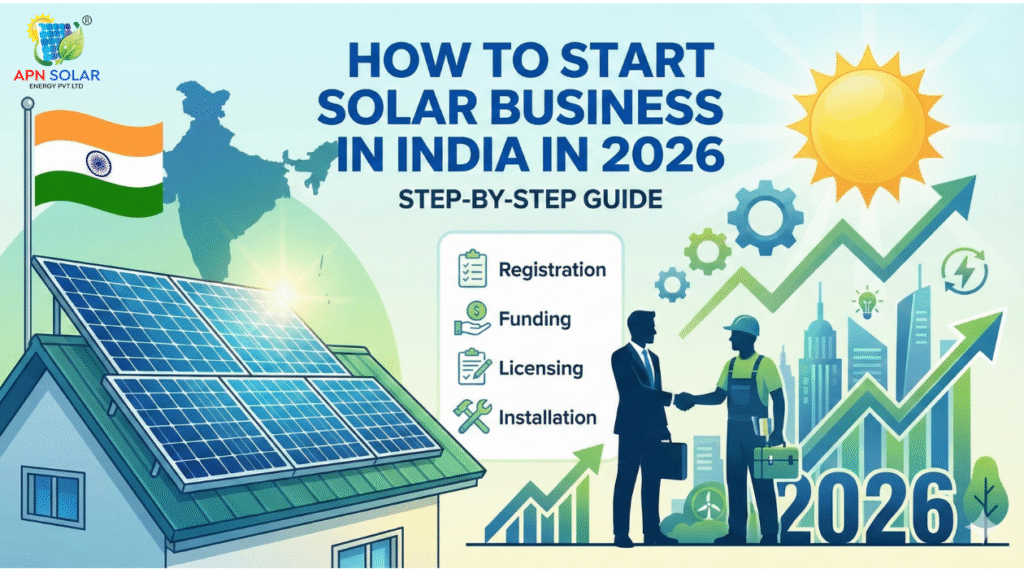
Why Starting a Solar Business in India Makes Sense in 2026
India’s renewable energy sector is poised for significant growth in 2026, making it an ideal time to explore a solar business in India. With ambitious national targets for clean energy adoption, the government aims to expand solar capacity across residential, commercial, and industrial sectors. This surge in demand creates substantial opportunities for entrepreneurs looking to establish a solar energy business in India.
Rising Demand for Rooftop and Commercial Solar
Both residential rooftop solar and commercial installations are experiencing rapid adoption. Rising electricity costs, combined with increased environmental awareness, have prompted households and businesses to seek cleaner alternatives.
This growing interest in solar solutions positions new ventures for high engagement and recurring revenue through solar electricity business models, including installation, maintenance, and after-sales services.
Government Support and Subsidies
The Indian government continues to encourage solar adoption through various subsidies, net metering policies, and financial incentives. Programs under MNRE and state-specific schemes reduce upfront costs for solar entrepreneurs and their clients, making investment in a solar business more financially attractive. Leveraging these incentives can accelerate profitability and shorten the payback period for new solar ventures.
Growing Profitability for New Solar Entrepreneurs
With multiple business models available such as installation, franchise, dealership, and distribution the solar sector offers scalable opportunities. Entrepreneurs can start with a focused model and expand into larger commercial or distribution operations as their expertise grows. This combination of strong market demand, government backing, and multiple revenue streams makes 2026 an ideal year to establish a solar energy business in India.
Types of Solar Business Models You Can Start in India
The solar industry in India offers multiple avenues for entrepreneurs to establish a profitable business. Selecting the right business model depends on your investment capacity, technical expertise, and long-term goals. Understanding the main types of solar business models allows you to make informed decisions and maximize growth in the solar business in India.
Solar Panel Installation Business (Residential & Commercial)
One of the most common and accessible entry points is the solar panel installation business, catering to both residential and commercial clients. This model involves installing rooftop solar systems, grid-tied or off-grid solutions, and providing maintenance services. It is particularly attractive because it allows entrepreneurs to start with moderate investment while generating recurring revenue through service contracts.
For new entrepreneurs, studying the complete solar panel installation process in India provides insights into technical requirements, customer expectations, and operational workflow. Offering high-quality installation and maintenance services ensures repeat clients and builds credibility in the solar panel business segment.
Solar System Dealer / Solar Panel Agency Model
The solar system dealer or agency model focuses on selling solar products panels, inverters, batteries, and accessories directly to end-users or installers. Entrepreneurs in this model act as intermediaries between manufacturers and customers, making it possible to generate profit without directly handling installations.
This business model is ideal for individuals who want to leverage their network and focus on sales and distribution. Understanding the differences between a solar agency and dealership is essential for making informed choices. Learn more about the solar agency vs solar dealership model to choose the best approach for your business.
Solar Franchise Business Model (Low-Risk Entry)
A solar franchise offers a structured, low-risk entry into the solar market. Franchises provide brand recognition, technical training, marketing support, and lead generation, reducing the learning curve for new entrepreneurs. This model is particularly appealing for those who want to start a business without developing a brand from scratch.
Entrepreneurs can explore multiple franchise models to determine which aligns best with their investment and operational capacity. For insights, check out the best solar franchise in India. Additionally, understanding the pros and cons compared to independent ventures helps in decision-making.
Read more about solar franchise vs independent solar business to evaluate which model suits your goals.
Step-by-Step Process to Start a Solar Business in India
Launching a successful solar business in India in 2026 requires careful planning, a clear understanding of the market, and knowledge of available business models. Following a structured step-by-step approach ensures you make informed decisions while maximizing profitability in the growing solar business in India sector.
Step 1 – Market Research & Business Idea Selection
Before investing a single rupee, thorough market research is crucial. Identify the target segment where you want to operate:
- Residential rooftop solar: Growing interest from homeowners looking to reduce electricity bills.
- Commercial & industrial solar: High-demand for energy-intensive businesses aiming to cut operational costs.
- Franchise model: For entrepreneurs who want a lower-risk entry with brand support.
- Dealership or distribution: Focused on supplying panels, inverters, and accessories to installers or other businesses.
Conduct surveys to understand local energy consumption patterns, competitive pricing, and customer preferences. This research will help you generate innovative solar business ideas and plan scalable solar panel business ideas that match your target market’s needs.
Step 2 – Choose the Right Solar Business Model
Choosing a suitable business model is critical for long-term success. Each model has its own advantages:
- Installation Business (EPC Model): Offers recurring revenue from installations and maintenance. Requires technical knowledge but has lower upfront costs compared to plant-level operations.
- Solar Franchise: Provides brand recognition, training, leads, and marketing support. A great option for first-time entrepreneurs seeking structured guidance.
- Dealership / Agency: Focuses on sales and distribution of panels and inverters. Profitable if you establish strong vendor relationships and network with installers.
- Solar Plant / Solar Farm: Capital-intensive, requires large land, regulatory approvals, and higher expertise, but offers significant long-term returns.
Choosing the right model ensures alignment with your investment capacity, skill set, and risk tolerance while positioning your solar business and solar energy business for sustainable growth.
Step 3 – Business Registration & Legal Compliance
Registering your solar business is a legal necessity and builds credibility with clients. Key steps include:
- Business entity selection: Choose between Private Limited Company, LLP, or Proprietorship depending on liability, funding, and tax considerations.
- GST registration: Mandatory for invoicing and claiming input tax credit.
- State and municipal approvals: Ensure compliance with local electrical regulations and safety standards.
- Mandatory certifications: Certain certifications are required to operate a solar business legally, ensuring quality, safety, and compliance.
Learn more about the solar certifications required in India to meet regulatory standards and reassure customers of your professionalism.
Step 4 – Investment & Cost Planning
Calculating accurate investment requirements is vital to avoid cash flow issues. Consider:
- Equipment costs: Solar panels, inverters, mounting structures, and balance of system (BOS) components.
- Inventory & storage: Space for storing panels and components safely.
- Manpower: Technicians, installers, and administrative staff.
- Marketing & operations: Digital marketing, client acquisition, and office expenses.
Government subsidies and schemes reduce initial investment, making solar ventures more attractive. You can refer to solar installation cost and subsidy structure to estimate costs accurately and plan your financing.
Step 5 – Product, Technology & Vendor Selection
Selecting the right technology and vendors ensures quality and customer satisfaction:
- Solar panels: Decide between monocrystalline, polycrystalline, or hybrid systems based on efficiency and cost.
- Inverters and batteries: Choose high-quality components for long-term reliability.
- Vendor evaluation: Compare suppliers on price, warranty, delivery timelines, and service support.
For more details, check the types of solar panels in India and understand the differences between monocrystalline vs polycrystalline panels. This knowledge helps you build a solid solar panel business plan and ensures high performance and customer satisfaction.
Step 6 – Installation, Execution & After-Sales Support
Providing high-quality installation and reliable after-sales support is essential for reputation and recurring revenue. Focus on:
- Installation standards: Follow manufacturer guidelines and safety protocols.
- Project monitoring: Track timelines, costs, and quality during each installation.
- After-sales support: Offer cleaning, maintenance, and performance checks to ensure system efficiency.
For guidance on maintenance, refer to solar panel maintenance and cleaning. Well-maintained systems increase customer satisfaction and strengthen your brand reputation in the solar panel installation business.
Step 7 – Marketing & Lead Generation
Effective marketing is crucial to attract clients and generate consistent leads. Strategies include:
- Digital marketing: Local SEO, Google My Business listings, and social media promotions.
- Referral programs: Incentivize existing customers to recommend your services.
- On-ground promotions: Tie-ups with real estate developers, commercial property owners, and industrial clients.
Sharing the benefits of reduced electricity bills, sustainability, and quality service builds trust. For detailed strategies, check solar marketing strategies in India. Proper marketing positions your solar business in India as a trusted solution for energy needs.
Step 8 – Scaling Your Solar Business
After establishing your initial operations, growth strategies can include:
- Expanding into commercial or industrial projects.
- Offering franchise opportunities or multi-city operations.
- Establishing distribution networks for panels and components.
- Benchmarking your business against leading solar companies in India to adopt best practices in operations, marketing, and technology.
Scaling systematically ensures long-term profitability and sustainability while reinforcing your position in the solar business in India market.
Conclusion
Starting a solar business in India in 2026 presents a unique opportunity to enter one of the fastest-growing renewable energy sectors. With rising electricity costs, increasing adoption of rooftop and commercial solar, and supportive government policies, entrepreneurs can establish a sustainable solar energy business in India with significant long-term profitability.
Success in this sector relies not just on investment but on trust-based execution, including quality installations, reliable after-sales service, and compliance with all regulatory standards. By carefully planning your business model, selecting the right technology, and leveraging marketing strategies, your solar venture can scale effectively, tapping into both residential and commercial markets.
For those seeking structured guidance and support, partnering with an experienced brand can accelerate growth and reduce operational risks. APN Solar, with its expertise in solar projects, franchise support, and end-to-end solutions, provides entrepreneurs with the tools and training necessary to succeed in the Indian solar industry.
Starting a solar business today is more than just a commercial venture it’s a chance to contribute to India’s sustainable energy future while building a profitable and scalable enterprise.
Frequently Asked Questions
1. How to start solar business in India in 2026?
Starting a solar business in India in 2026 involves selecting the right business model, registering legally, planning investment, choosing reliable vendors, and executing installations efficiently. Entrepreneurs can choose between franchise, dealership, installation services, or commercial solar projects to match skills and investment capacity.
2. What is the minimum investment to start a solar panel business?
The minimum investment depends on the business model. A small-scale solar panel installation business can start with moderate capital for equipment, marketing, and trained manpower. Franchise-based models require additional fees but offer structured support, training, and pre-existing brand credibility.
3. Is solar franchise better than independent solar business?
A solar franchise in India offers advantages like brand recognition, training, lead generation, and reduced marketing effort. Independent solar businesses provide more control and profit retention but require stronger expertise in operations, marketing, and technology. Choosing depends on risk appetite and investment capacity.
4. How profitable is solar panel installation business in India?
Profitability varies with scale, location, and service quality. Residential and commercial rooftop installations can generate consistent revenue through installations, maintenance contracts, and AMC services. High-quality execution and customer service significantly improve long-term margins in the solar business in India.
5. What licenses are required to start a solar business?
Licenses depend on the business type. Basic requirements include: business registration (Private Limited/LLP/Proprietorship), GST registration, electrical permits for installation, and MNRE-approved certifications for compliance and safety. Proper licensing builds credibility with clients and partners.
6. Can I start solar business without technical background?
Yes, technical knowledge is helpful but not mandatory. Entrepreneurs can partner with certified installers, hire trained staff, or opt for a solar franchise model that provides training, technical support, and operational guidance to run the business successfully.
7. How long does it take to break even in solar business?
Break-even depends on the business model, investment, and scale. A small installation business may break even within 1–2 years, while a franchise or larger commercial venture may take 2–3 years. Efficient operations, quality service, and strategic marketing accelerate the payback period.