
Choosing the right solar company in India for your home can make a big difference in your solar investment. With brands like Tata Power Solar, Waaree and Adani Solar available, finding the right option can feel confusing. In this guide, APN Solar explains how to compare solar companies, installation costs, panel quality and warranties so you can make an informed decision for your home.
But here is something worth understanding before you make a decision: the best solar panel company for your home is not necessarily the one with the most famous brand name or the lowest quotation. It is the one that offers suitable equipment, professional installation, transparent pricing and dependable after-sales support.
At APN Solar, we believe homeowners should understand what they are paying for before investing in a solar system. In this guide, we will compare some well-known solar companies in India, explain what to look for when choosing an installer, and help you make a more informed decision.
If you are considering rooftop solar for your home, you can also visit APN Solar to explore available solar solutions and enquire about your requirements.
Which Is the Best Solar Panel Company in India for Home?
There is no single solar company that is the best choice for every household. The right option depends on your location, electricity consumption, available roof space, budget and the service support available in your area.
Here are some established names worth considering when comparing residential solar solutions in India.
| Solar company | What to consider |
| Tata Power Solar / Tata Power Solaroof | Established rooftop solar presence, installation network and residential solar solutions |
| APN Solar | A solar solutions provider to contact for information about suitable systems, installation requirements and quotations |
| Adani Solar | Solar module manufacturing and renewable energy capabilities |
| Vikram Solar | Indian solar module manufacturer with residential and commercial applications |
| Waaree Energies | Indian solar manufacturer with a range of solar modules and products |
This is a shortlist of companies to research, not a verified ranking from first to fifth. Their offerings, service availability and suitability vary by project.
Before choosing any company, check the specific products being offered, warranty documentation, relevant vendor registration, installation coverage and customer support arrangements.
1. Tata Power Solar
Tata Power Solar, through its rooftop solar business, is one of the prominent names homeowners encounter when researching solar installation in India.
The company offers residential rooftop solar solutions and has an established presence across multiple Indian markets.
Why homeowners consider Tata Power Solar
- A recognized name in India’s power and renewable energy sector.
- Residential rooftop solar installation services.
- A broad network of channel partners and service support.
- Solar solutions designed for household electricity needs.
- Financing options and support offerings that may vary by product and location.
What should you check before choosing?
Ask for a detailed quotation that specifies the panel manufacturer and model, inverter, mounting structure, installation scope, warranties and any additional charges.
Also, confirm who will handle your installation, commissioning, documentation and service requests in your area.
Best suited for: Homeowners who value an established provider and want to evaluate an end-to-end rooftop solar solution.
2. APN Solar: Explore a Solar Solution for Your Home
Choosing solar should start with understanding your home, not simply picking a brand from a list.
At APN Solar, we encourage homeowners to consider their electricity usage, available rooftop area, budget and long-term requirements before deciding on a solar system.
Rather than assuming that one system suits every home, start by understanding what your property actually needs.
Before requesting a quotation, consider these questions
- How much electricity does your household use each month?
- Do you have sufficient unshaded roof space?
- Are you looking for a standard grid-connected system or backup during power cuts?
- Do you want to explore subsidy eligibility?
- What equipment, warranties and installation services are included in the quotation?
These details make it easier to compare solutions and avoid paying for features you may not need.
Looking for rooftop solar for your home? Visit APN Solar to explore our solar solutions and contact our team about your requirements.
We recommend requesting a clear quotation that explains the proposed system capacity, equipment, installation scope and applicable terms before making a purchase.
3. Waaree Energies
Waaree Energies is an established Indian solar manufacturer known for its solar modules and related solar products.
When comparing residential systems, homeowners should distinguish between buying solar panels from a manufacturer and buying a complete rooftop solar installation from an installer.
The panel brand is important, but the complete system also includes the inverter, mounting structure, electrical protection, wiring and installation workmanship.
Why consider Waaree?
- A range of solar modules for different applications.
- An established presence in the Indian solar manufacturing sector.
- Different product specifications and technologies to compare.
- Potential availability through solar dealers and installation partners.
What should you check?
Ask for the exact module model, rated power, efficiency, applicable warranty terms and current certification details.
If you plan to apply for a government residential subsidy, verify that the proposed equipment and installation meet the scheme’s current requirements.
Best suited for: Homeowners comparing solar module options and quotations from different installation providers.
4. Adani Solar
Adani Solar is another established Indian solar manufacturing brand that homeowners may encounter while comparing rooftop solar quotations.
When evaluating Adani Solar or any other manufacturer, focus on the specific panel model being proposed rather than relying only on the brand name.
What to consider
- Module specifications and efficiency.
- Product and performance warranty conditions.
- Availability through your chosen installation provider.
- Compatibility with your proposed system design.
- Local installation and after-sales arrangements.
Remember that the company manufacturing your solar panels may not be the same company responsible for installing and maintaining your rooftop system.
Best suited for: Homeowners who want to compare established Indian solar module brands and the installation packages available through local providers.
5. Vikram Solar
Vikram Solar is an Indian solar module manufacturer with products used in different solar applications.
For a residential installation, it is important to compare the specifications of the exact module offered rather than assuming that all panels from a particular manufacturer have identical performance.
What should homeowners compare?
- Module efficiency and rated output.
- Performance under the expected rooftop conditions.
- Product warranty and performance warranty.
- Installation provider experience.
- Availability of replacement and service support.
A good quotation should clearly identify the equipment being supplied so that you can compare it fairly with competing offers.
Best suited for: Homeowners looking to compare solar panel manufacturers and available module options.
Solar Panel Company vs Solar Panel Manufacturer: What Is the Difference?
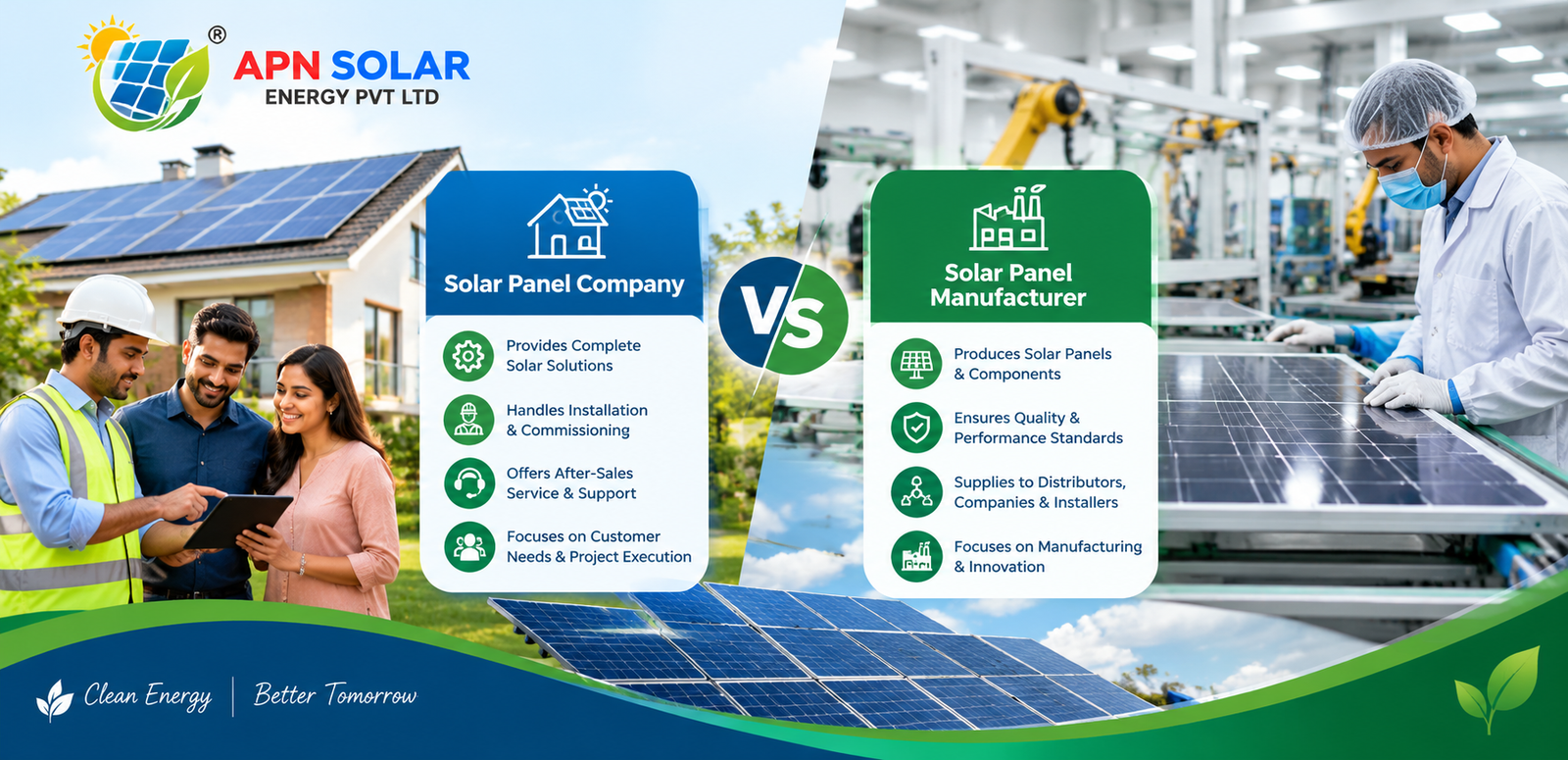
This is one of the most important things to understand before choosing a solar provider.
A solar panel manufacturer produces the modules that convert sunlight into electricity. A solar installation company, often called an EPC provider, designs and installs the complete solar system.
Some companies operate in both areas, while others specialize in only one.
For example, you may receive a quotation from an installer offering panels manufactured by a different company.
That is not necessarily a problem. What matters is whether the proposed equipment is suitable, the installation is performed properly and you know whom to contact for service or warranty claims.
Before signing a contract, ask:
- Who manufactures the solar panels?
- What is the exact model number?
- Who is responsible for installation?
- Who handles inverter or electrical-system problems?
- How are manufacturer warranty claims managed?
- Who will assist with the required commissioning and subsidy documentation?
Clear answers to these questions can be more valuable than choosing a company based on brand recognition alone.
How to Choose the Best Solar Installation Company for Your Home
A solar system is a long-term investment. Here are the factors worth comparing before you decide.
1. Check the quality and specifications of the solar panels
Look beyond the brand name.
Compare the rated output, module efficiency, applicable certifications and warranty terms for the specific model included in the quotation.
Ask the installer to provide the relevant product datasheet rather than relying only on verbal claims.
2. Check the inverter and other components
Solar panels are only one part of the system.
The inverter converts the electricity produced by the panels into usable electricity for your home. Mounting structures, cables, connectors, electrical protection and earthing also matter.
Make sure your quotation identifies the main components and clearly explains what is included.
3. Compare complete installation costs
The lowest quotation is not always the best value.
One provider may include installation, mounting structures, wiring and commissioning, while another may list some of these items separately.
Compare the complete project scope, taxes and any additional charges before making your decision.
4. Verify warranty coverage
Solar installations may involve separate warranties for panels, inverters, mounting structures and workmanship.
Ask for the written warranty documents and clarify whether the warranty is provided by the manufacturer, installer or both.
Also ask how service requests are handled and whether any travel or replacement charges may apply.
5. Confirm subsidy and regulatory requirements
If you plan to apply for the PM Surya Ghar Muft Bijli Yojana, check the current official requirements before installation.
The proposed system, vendor and installation process must meet the applicable conditions. Do not assume that every solar panel or installation package automatically qualifies.
6. Ask about after-sales service
Even a well-designed system may need inspection, troubleshooting or repairs during its operating life.
Before choosing an installer, find out whom you can contact if your inverter stops working, generation falls unexpectedly or you need help with a warranty claim.
A provider that explains the service process clearly gives you a better basis for making a decision.
How Much Does a Home Solar System Cost in India?
The price of a rooftop solar system depends on its capacity, equipment, roof conditions, installation complexity and location.
The following table gives a simple way to think about system sizing. It is not a price quotation.
| Household requirement | Capacity to investigate |
| Lower electricity consumption | 1–2 kW |
| Moderate electricity consumption | 2–3 kW |
| Higher electricity consumption | 3–5 kW |
| Large home or higher daytime demand | 5 kW and above, subject to suitability |
These are starting points, not fixed recommendations. Your actual system size should be based on your electricity bills, usable roof space, expected solar generation and applicable connection rules.
For an accurate quotation, ask the installer to specify:
- Total installed system price.
- Panel and inverter models.
- Included installation and electrical work.
- Applicable subsidy assumptions.
- Any additional charges.
- Expected generation and the assumptions behind the estimate.
Can government subsidies reduce the cost?
Eligible residential consumers may be able to receive assistance under the PM Surya Ghar Muft Bijli Yojana.
The standard central subsidy structure provides ₹30,000 for 1 kW, ₹60,000 for 2 kW and up to ₹78,000 for eligible systems of 3 kW or higher, subject to applicable rules. Different rates may apply in certain regions.
The subsidy is not a general benefit for every solar installation. Check your eligibility, the approved process and the latest official guidelines before making a financial decision.
For a detailed explanation, read our guide to PM Surya Ghar Subsidy 2026.
Which Solar System Is Best for Your Home?
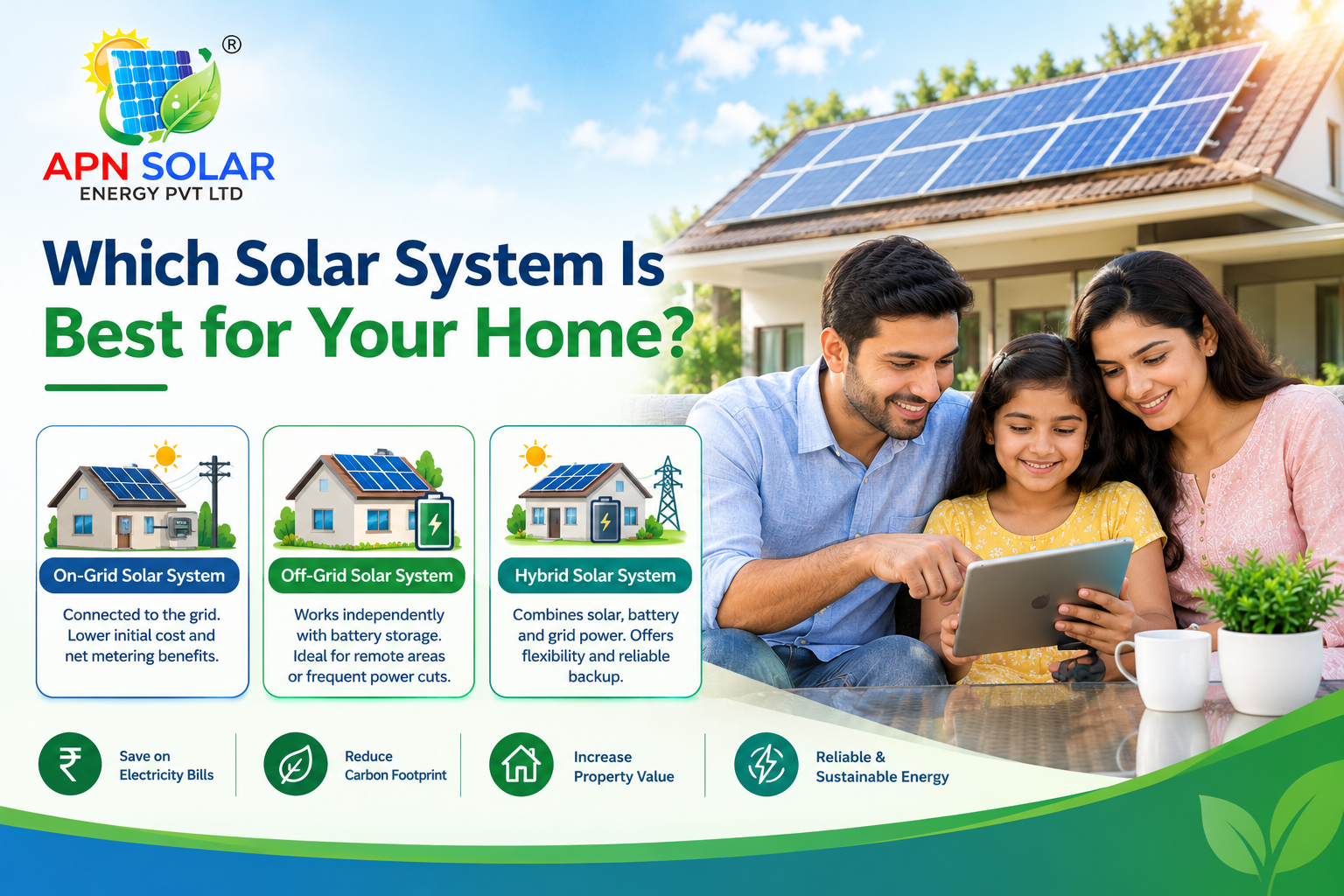
The right system depends on how you use electricity and whether you need backup power.
On-grid solar system
An on-grid solar system works in connection with the electricity grid. It can help reduce the amount of electricity you purchase from your utility, subject to system performance and the applicable billing arrangement.
It generally does not provide backup during a grid outage because grid-connected inverters normally shut down for safety.
Off-grid solar system
An off-grid solar system operates independently of the electricity grid and generally uses batteries to store energy for periods when solar generation is unavailable.
It may be suitable for locations without reliable grid access, but battery capacity and system design need careful planning.
Hybrid solar system
A hybrid system combines grid-connected solar with battery storage, depending on the configuration.
It may be suitable for households that want solar generation and backup power, but the additional equipment can increase the initial cost.
Before choosing, explain your backup requirements to the installer so that the proposed system matches your expectations.
Common Mistakes to Avoid When Buying Solar Panels
Even if you choose a recognized manufacturer, a poorly planned installation can create unnecessary problems.
Avoid these common mistakes:
- Choosing a system based only on the lowest price.
- Comparing quotations without checking the exact equipment.
- Ignoring roof shading and structural suitability.
- Assuming solar will eliminate every electricity charge.
- Expecting an on-grid system to power your home during a grid outage.
- Overlooking warranty exclusions and service responsibilities.
- Assuming a subsidy is guaranteed before the eligibility and approval process is complete.
A little research before installation can help you make a more confident decision.
Why Request a Solar Consultation From APN Solar?
Every home has different electricity requirements, roof conditions and budget considerations.
That is why a useful first step is to discuss your requirements before deciding which system to purchase.
At APN Solar, we invite homeowners to explore suitable solar solutions and enquire about their installation needs.
When contacting our team, keep your latest electricity bill and a few details about your property ready. This can help the discussion focus on the capacity, roof space and installation options relevant to your home.
Ready to explore solar for your home?
Visit APN Solar and contact our team to discuss your requirements.
Before committing to any installation, ask for a detailed quotation, written equipment specifications, warranty terms and a clear explanation of the installation process.
Final Thoughts
Choosing the best solar panel company in India for your home involves more than comparing brand names.
Look at the quality of the equipment, the experience of the installation team, the complete cost, warranty coverage and the support available after installation.
Tata Power Solar, Waaree, Adani Solar and Vikram Solar are useful starting points for your research. The best option for your home will depend on the actual products and installation package available to you.
At APN Solar, we encourage homeowners to understand their requirements, ask questions and compare quotations before making a long-term investment.
Thinking about switching to rooftop solar? Visit APN Solar to explore your options and enquire about a solution for your home.
Company offerings, prices, warranty terms and subsidy rules may change. Verify current product details and eligibility with the relevant provider and official sources before purchasing.
Frequently Asked Questions
Which is the best solar panel company in India for home use?
There is no single best company for every home. Tata Power Solar, Waaree, Adani Solar and Vikram Solar are among the established names worth researching. Compare equipment specifications, installation quality, warranty terms, local service and total project cost before deciding.
Is Tata Power Solar better than other solar companies?
Tata Power Solar has an established rooftop solar business and a substantial service and channel-partner network. However, the right choice depends on your location, quotation, equipment and service requirements. Compare specific offers rather than assuming one provider is best for every household.
Is it better to buy solar panels directly from a manufacturer?
Not necessarily. A manufacturer supplies the panels, while a complete rooftop installation also requires system design, an inverter, mounting structures, electrical work and commissioning. Many homeowners benefit from comparing complete installation quotations.
How many solar panels are required for a 3 kW home solar system?
The number depends on the wattage of each panel. For example, a 3 kW system using 500 W panels would require approximately six panels, subject to the final system design and equipment availability.
Can I receive a government subsidy if I install rooftop solar?
Eligible residential consumers may receive assistance under the PM Surya Ghar scheme, subject to the current guidelines and required application and commissioning process. Check the official portal before installation.
How long do solar panels last?
Solar panels are designed for long-term operation, and many come with performance warranties extending to 25 years or more. Actual performance depends on the product, installation, environment and maintenance. Review the warranty documents for the specific model you purchase.
What should I ask a solar company before buying?
Ask about the proposed capacity, panel and inverter models, total installed cost, warranties, installation timeline, subsidy requirements, net metering and after-sales support. Request these details in writing.
How can I get a rooftop solar quotation from APN Solar?
Visit APN Solar and contact the team about your home solar requirements. Sharing your monthly electricity consumption, installation location and available roof space can help you start the discussion.